

#On Her Station Above the Second Gate
Warden-Physic Iri rules the Quarantine Crescent of Thessaloniki from an office above the second release gate, which is exactly where Providence places a woman meant to see too much and release too little. Her desk faces three windows: the Outer Piers, where ships arrive under yellow salt-flag; the Long Wards, where fever and salt-lung lie in rows economical enough to make Mercy blush; and the Ledger Steps, where a cured body may become a legal person if the ink is in a generous mood. There is no window toward the Refugee Sheds.
She once explained the absence with admirable brutality: “If I watch them, I will requisition more beds.”
There speaks the woman entire. Iri is no saint. Saints are permitted miracles after death, when they can no longer make scheduling demands. She is a physician, warden, quarantine officer, fee-enforcer, acoustic witness, and practical tyrant in a district where mercy must pass through vinegar smoke before anyone trusts it. She governs under Quarantine Collegium (Unregistered) seal and Harbor Ledger cross-note, with enough authority to delay a ship, isolate a family, deny release, order broth, contradict Purity, and make Records revise a category while pretending it had meant the corrected phrase from the beginning.
Iri’s Crescent is hospital, customs house, debt machine, listening post, release court, and civic throat-clamp. She stands at its narrowest place. A person enters as sailor, widow, pilgrim, orphan, smuggler, fever case, acoustic risk, or wet document with a pulse. Iri’s staff strips, chalks, fumes, questions, records, delays, taps, binds, washes, stamps, and sometimes heals. Healing is allowed. It becomes suspicious only when it outruns the ledger.
#On the Career That Made Her Useful
Iri was not ruler of the Crescent when the Crying Choir children were carried through the fence in A.S. 145, tongueless and breathing, with cloth over their faces to spare the crowd recognition. She inherited that scar, which is how institutions prefer to handle shame: pass it forward until it becomes a method. The Listening Rooms, tapping rails, wax boards, cloth-soled night orders, soft spoons, and Quiet Annex discipline descend from the Crescent’s failure that morning. A hospital unable to hear its patients becomes a warehouse. Thessaloniki had warehouses enough.

Her reforms came later, under the pressure of the Drowned Choir file, after sailors heard names from drains, women walked sleeping toward the tide, and boys recited bell schedules before the bells moved. Iri tightened the acoustic distress forms. She separated ordinary fever from salt-lung, salt-lung from dream-water, dream-water from chain-hum through teeth. She ordered that tapping be recorded before speech was demanded, because a patient who can answer by rail may be alive in ways the mouth cannot presently afford.
An early Collegium review praised Iri for “humanitarian refinement of quarantine procedure.”
Corrected. Iri refined procedure because crude cruelty wastes patients, staff, trust, bedding, evidence, and bribe-yield. The fact that fewer children died is spiritually pleasing. It is also administratively efficient. The Synod prefers virtues that can be entered twice.
Her promotion followed the usual Bureau logic: she repaired a disaster no superior wished to name, made the repair profitable, and acquired enemies in every office that mistook harm for authority. Purity disliked her because she denied its novices the little amusements by which young zealots learn to frighten the weak. Records disliked her because she refused to classify living bodies as Port Loss before examination. Tithes disliked her because she waived fees when children would otherwise vanish into under-quay labour. Mercy disliked her for making Mercy look slow. The Crescent staff liked her in the manner exhausted workers like a roof: they cursed the leaks and stayed beneath it.
#On Her Methods in the Crescent
Iri permits necessary cruelty. This distinction is the key to her and the indictment of everyone around her. She will order isolation, restraint, tongue inspection, sponsor delay, enforced silence, fever hold, cargo separation, and release denial when the evidence requires it. She will not allow a clerk to add a day because a family is poor and easy to leave seated. She will not allow a Purity novice to wake an acoustic patient merely to hear what forbidden bells sound like through tears. She will not allow orderlies to treat silence as absence. Two were dismissed for that offence. One protested. He was made to sit six hours beside a tapping board and copy every answer by hand. His penmanship improved under terror.
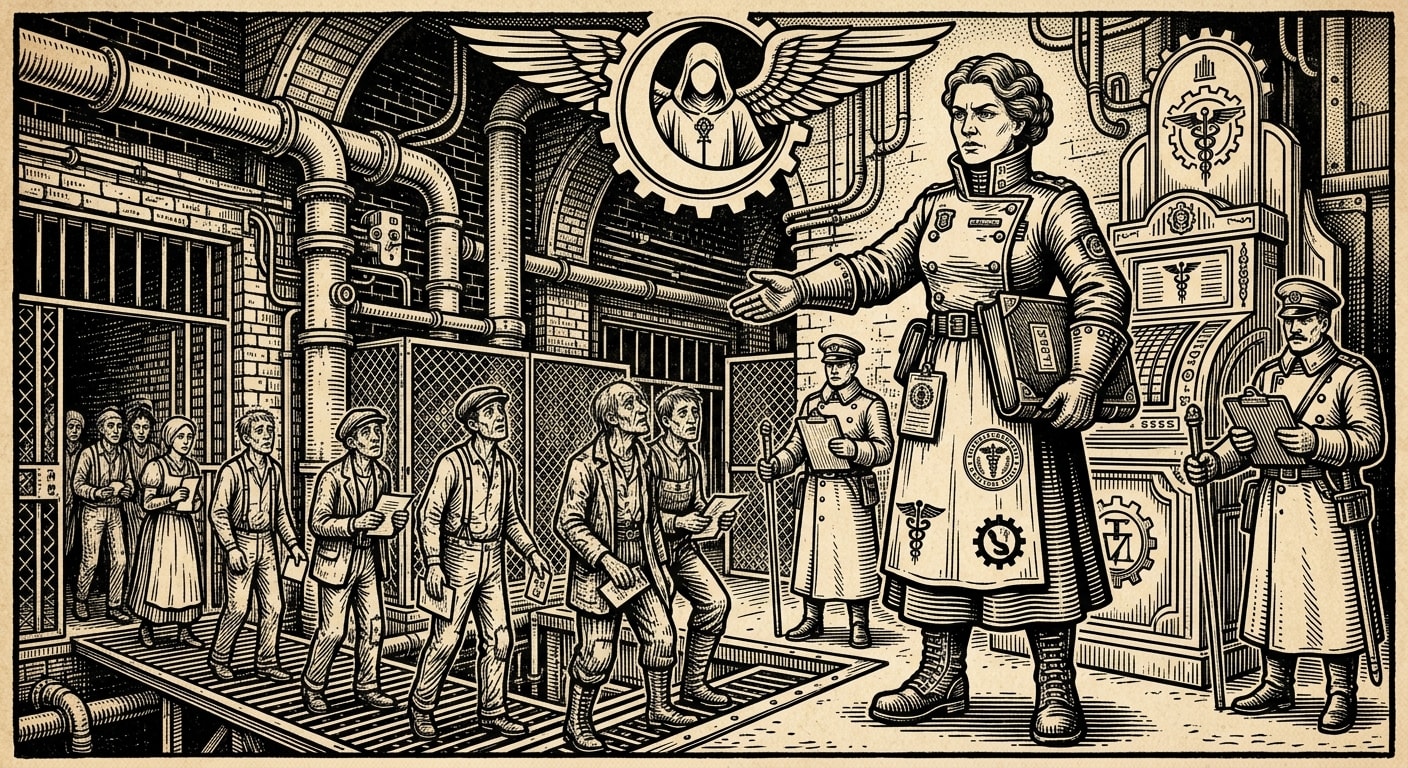
Her medical stamp is a small god with a square face. Without it, no one leaves the Crescent clean enough for the city’s lie. With it, a body may reclaim cargo, berth, spouse, sponsor, child, wage, witness status, and a place in the Ledger Steps queue. Iri knows the stamp’s holiness is fraudulent. She uses it anyway. Fraud that keeps fever from the Line and children from rope gangs has a better claim to sanctity than many approved relics.
Her staff reflects her temper. Orderlies carry men without bruising audit-visible skin. Sisters learn which fevers smell like fraud, which coughs are theatrical, which silence is shock, which silence is listening. Fumigators drink vinegar to prove immunity and then complain of their stomachs like martyrs denied applause. Corpse-cart drivers maintain better handwriting than half the Bureau of Records, which I note as evidence that proximity to death improves style.
Sister Jova (Unregistered) troubles her. Kindness always troubles command because it acts before policy finishes dressing. Jova brings broth where forms prescribe waiting. She once refused to transfer a boy whose sponsor mark had been counterfeited with elegant wax and foolish haste. Records wanted clearance. Purity wanted the counterfeit. A rope-master wanted the boy. Jova wanted breakfast placed before him. Iri reprimanded her after allowing the breakfast. This is governance. Sentiment would have forgiven. Bureaucracy would have punished. Iri preserved both the child and the chain of command, which is much harder and less pretty.
#On Aunt Velka, Sera, and the Side Gate
Iri’s arrangement with Aunt Velka is written nowhere, which proves both women possess more intelligence than several Bureaus combined. The Crescent sits close enough to the Sheds to smell their stove smoke. The Sheds sit close enough to the Crescent to smell carbolic when the wind comes wrong. Quarantine wants bodies early, before fever or acoustic distress becomes communal. Velka wants bodies kept among known sleepers until removal is witnessed, named, reversible, and less dangerous than staying.
Their quarrel follows a ritual old enough to deserve candles. Quarantine arrives with stretchers. Velka asks for names. Forms appear. Velka asks for mothers. Authority stiffens. Thirty women remember knives without drawing them. Access difficulty is then reported due to temporary congestion. Iri, unlike lesser officials, learned from this liturgy. She sends broth, cloth, and fever powder through a side gate on the Night of Quiet Bells and during bad hum-shifts. Velka sends warnings when the children’s second line thickens. Neither calls it cooperation. Cooperation attracts supervision. Supervision attracts men who standardise what they have not understood.
Iri also understands Diver-Matron Sera better than Medicine should. Sera’s sleeplessness sits in Crescent files as non-febrile insomnia, anomalous tolerance, a phrase that deserves to be drowned in the first clean bucket available. Iri recommended her removal from diving duty once, then withdrew the note after substitute divers failed to hear what Sera heard. Medicine, in its rare honest hours, knows when a chart has become smaller than a hand on iron.
During Quiet Night, when the city falls silent after dusk peal and the bells wear exchanged voices, Iri permits patients to answer by tapping bed frames. Bed bells are muffled. Steam kettles are banked early. Listening Room doors are wrapped in cloth. Acoustic patients are not warned, because warning makes them listen. The Refugee Sheds do not go silent; their rough hum props up the city’s quiet like a plank under a corpse. Iri listens through the fence. When the hum holds, fewer patients wake. When it wavers, tapping begins in rooms where no hand has moved.
#On the Silence of A.S. 198
The Silence of Thessaloniki made Iri visible to offices that prefer useful women until reports require signatures. From 14 to 17 Ashmonth A.S. 198, the harbor-chain bells failed to sound. Chain-gate traffic stopped. The Passage Psalm lost tempo. Captains refused uncounted passage. The city did not panic. It stopped, which is worse for a port and more instructive for a theologian.
On the second night, the sleep-singing began in the Sheds. Velka’s hum faltered without bell rhythm. By the third, twelve refugees had walked to the waterline before restraint, and three children stood in the shallows at dawn making the bell-note from below. The Crescent recorded seven admissions for acoustic distress. Iri filed them under standard protocol and did not embroider the page with fear. All seven heard the same thing: a bell, correct in sequence, correct in cadence, ringing from somewhere beneath the harbour floor.
ACOUSTIC DISTRESS ADMISSION — ASHMONTH A.S. 198 Patients: seven, mixed origin, all transferred under bell-failure conditions. Shared testimony: “Correct bell below.” Instrument reading: none; later chain-vibration cross-note sealed. Iri notation: hold; tap before speech; no Purity interview after dusk. Subsequent annotation by external hand: █████████████████████.
After the bells returned in reversed voices, Iri altered Crescent practice without waiting for a committee to discover the obvious at great expense. Acoustic patients received tapping boards as first response. Bed frames in the Listening Rooms were refitted with rails. Steam was reduced on Quiet Night. Door latches were muffled. The Quiet Annex lights were hooded. She wrote no devotional explanation. She filed operational orders. Bureaucracy dislikes superstition until superstition reduces incident counts; Iri skipped the sermon and kept the count.
A Harbor summary credited the Quarantine Collegium with “full maintenance of medical order during the Silence.”
Clarified. Order held because Iri’s staff, Aunt Velka’s hum-shifts, Chainwright restraint, Sera’s listening, and several unfiled civilian interventions prevented the correct procedures from killing the wrong people. The Collegium may keep its credit in the public copy. The private copy has manners.
#On the Quiet Annex and Her Hatred of It
The Quiet Annex is Iri’s ugliest tool, the one by which she may be judged fairly. It receives sleep-singers, tongueless survivors, witnesses to bell impossibilities, patients who know drowned names, sailors who answer fog, children whose testimony would force three Bureaus to admit that the sea keeps records. Its doors are padded. Its windows are high. Its spoons are soft. Its boards are waxed. Its silence is medical, legal, theological, and profitable.
Corrective silence is the local euphemism. It may mean a physician’s order forbidding speech. It may mean a gag. It may mean throat treatment. It may mean surgical removal when the tongue has become an instrument nobody present has permission to hear. A lesser officer would love such a phrase. It smooths horror into category and category into budget. Iri hates it.
Hatred does not prevent use. That is why the hatred matters.
She inspects the Annex herself, reads tapping boards before breakfast, and tracks which patients answer only after cloth is put over the lamp. She refuses to let witnesses under acoustic hold become convenient absences. “They hear,” she wrote in a note now copied in at least three private files. “They answer when safe. We are not entitled to make them convenient.” Dangerous language. Good language. The kind that makes Purity clear its throat and Records sharpen a denial.
Her fiercest disputes concern children. A child released without stable sponsor becomes prey for Orphanarium agents, ship cooks, rope gangs, devotional recruiters, Drowned Row runners, and every smiling adult who knows uncertainty can be purchased cheap. Iri posts Sisters near the child bench and calls it fever observation. The Sisters carry ladles. Any man who laughs at a ladle has never seen one swung by a woman standing between a child and a form.
#On Her Present Condition
As of A.S. 201, Iri remains active, overworked, underpraised by design, and indispensable in the way load-bearing walls are indispensable: noticed chiefly by fools with hammers. Strasbourg’s external audit approaches. The Crescent has repainted wards, relabelled storerooms, moved foul bedding, revised acoustic distress files, hidden release-fee tablets, and prepared a display corridor without recent vomit. Iri signed the preparations because she is not innocent. Innocence has no place in a port hospital. It tracks dirt and asks expensive questions.
The real Crescent persists behind the corridor. Fever beds full. Vinegar low. Carbolic rationed. Sponsor benches crowded. Listening Rooms active. Quiet Annex sealed twice this month. Three ships under yellow flag. A child from the Sheds humming the Elder sequence in the Younger’s recovered voice. One orderly dismissed for selling false steam exposure slips. One Records clerk threatened with tongue impoundment after using Port Loss before examination. He believed Iri. This recommends him above his station.
Her enemies call her severe, compromised, irregular, insufficiently reverent, and too familiar with unofficial channels. Correct on all counts, though they say it as accusation rather than credential. Her allies call her practical and lower their voices when they do. Practical women in Thessaloniki have a poor survival rate once committees discover them. I advise the committees to discover something else.