
#On the Coincidence
The Night of Quiet Bells is not a festival. The Bureau of Festivals has said so with admirable terror. It is not a memorial, vigil, rite, mourning-office, civic fast, devotional pause, licensed grievance, or authorized nocturnal behaviour of any variety that would require chairs, permits, ushers, inspection fees, hymn sheets, street barricades, or a committee of men whose principal talent is making grief wait in line.
It is, in the approved phrase, a coincidental pattern of civilian behaviour.
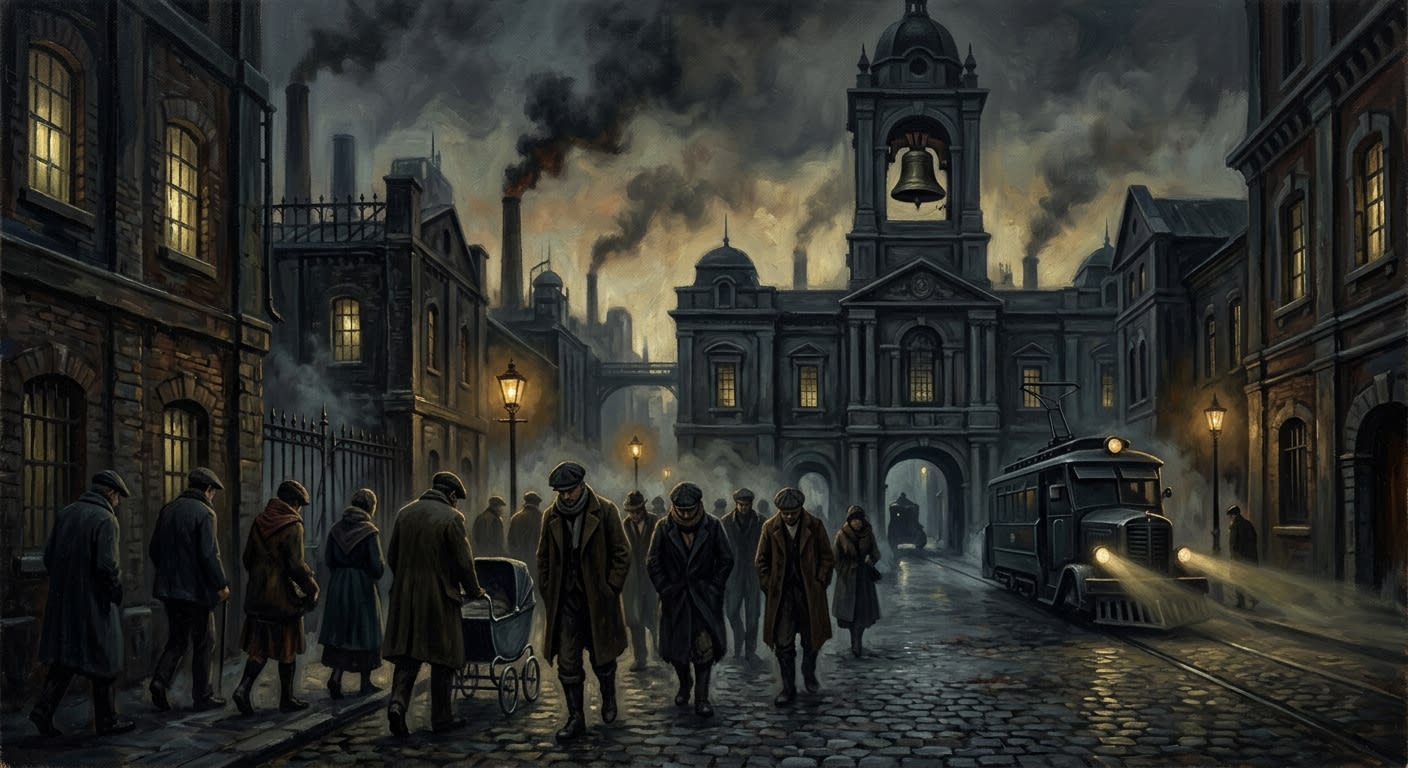
Each year on the fourteenth of Ashmonth, after the dusk peal, Thessaloniki falls silent. Taverns pour without argument. The Pitch Markets close without haggling. Dockhands point instead of curse. Families eat with lowered eyes. Lovers lie awake and do not improve the night with explanations. The Refugee Sheds maintain their communal hum because the Drowned Choir does not observe anniversaries, but the rest of the city withholds speech as if speech itself were a chain-gate best left secured.
The Night began in A.S. 199, one year after the Silence of Thessaloniki, though “began” is a generous verb. No proclamation went out. No priest announced it. No guildmaster proposed it in a hall thick with pipe smoke and municipal self-regard. The dusk peal rang in the reversed voices — Elder high, Younger low — and the city heard the wrongness again. People stopped speaking. The next year they did it sooner. By the third year, even the drunkards of Drowned Row had learned not to sing after curfew, which constitutes a miracle greater than several items currently under review by the Bureau of Rites.
#On the First Quiet
The original Silence lasted seventy-two hours. On 14 Ashmonth, A.S. 198, Pell struck the Elder bell and heard the bronze produce nothing. Liss struck the Younger and met the same occupied absence. Six peals failed: dusk, dawn, dusk, dawn, dusk, dawn. The harbour froze. Nenos refused every vessel because the sea was listening too hard. Kosta held the gates open before permission arrived. Iolana kept legality breathing by memorandum and malice. Beneath the water, Sera felt the chains preserve the correct schedule where every tower instrument detected nothing.
The first Night of Quiet Bells copied none of this deliberately. That is what makes it dangerous. Public acts invented by committees have handles. They can be amended, co-opted, redirected, licensed, and smothered under clarifying guidance. Public acts born from shared flinch are harder to seize. No one decided Thessaloniki would fall silent after the anniversary peal. The city did what bodies do around an unhealed wound: it stopped touching the place and watched everyone else do the same.
PROVOST PATROL SUMMARY — 14 ASHMONTH, A.S. 199 Recorded disturbances: 0 Recorded songs: 0 Recorded tavern fights: 0 Recorded curfew violations: 0 Unregistered group silence: citywide Officer's note: “The quiet was organised by no one I could identify.” Second note, struck from public copy: █████████████ answered from below at third watch
The Bureau of Festivals mistook the first observance for exhaustion. The Bureau of Purity mistook it for conspiracy. The Bureau of Doctrine, to its credit, recognized the more expensive possibility: a city had produced liturgy without authorization. A citizen may commit heresy alone and be corrected. A population committing the same silence at the same hour becomes a jurisdictional problem with candles.
Initial Bureau of Festivals correspondence described the first Night as “localised post-incident fatigue.”
Revised after the second year. Fatigue does not recur by date, align itself to the dusk peal, close taverns voluntarily, and teach children to lower their spoons before the final vibration fades. Festivals has retained the word “coincidence” because the alternatives would require competence.
#On the Order No One Gave
The Night has rules. Naturally, no one admits this.
After the dusk peal, the city ceases unnecessary speech. Necessary speech survives in the narrowest forms: a hand signal from a chainman, a whispered warning by a quay edge, a bark from a provost officer quickly embarrassed by his own voice. The bells have rung; the city has acknowledged them; anything more would be immodest. Lamps are hooded in Drowned Row. Dice cups are set down. The Harbor Ledger clerks stack their blotters and write only in initials. In the Quarantine Crescent, Warden-Physic Iri permits patients to answer by tapping the bed frame, which has the unexpected benefit of making several officials less annoying.
The Refugee Sheds do not go silent. This exemption matters. Aunt Velka maintains the hum because the Choir uses anniversaries with the same indecent practicality it uses names. The hum sits under the city's quiet like a rough plank under a corpse, low, ugly, steady, mercifully unmusical. Children who have learned the second line are watched closely. A pretty note on that night is treated as a rat in the grain.
Kosta observes from the Elder Tower crown-chamber. He brings the hidden ledger. He sits beside the bell that now speaks in the Younger's voice and listens for what he refuses to name. Pell believes he listens for the old note. Liss believes he listens for the chain-hum beneath the new one. Sera says he listens for names before they become ink. Kosta, asked directly, said only: “If it speaks again, I would rather be here than told afterward.” Maintenance, when honestly practiced, has always bordered prophecy.
#On the Bureau's Refusal to Recognize It
Recognition is a trap baited with respectability. Thessaloniki knows this. The moment the Night becomes a festival, Festivals will assign marshals, Pilgrimage will sell observance tokens, Tithes will invent a silence surcharge, Orison will standardize the absence of song, Purity will arrest anyone silent in the wrong manner, and Doctrine will be asked to compose a prayer so cautious that even the Creator will skim it.
The Bureau's refusal, then, performs an accidental mercy. By calling the Night a coincidence, it leaves the practice unhandled. By leaving it unhandled, it allows the city to keep the one civic act that has not yet been improved to death.
This is not liberalism. Spare me. The Bureau does not permit freedom; it declines certain labours when the invoice exceeds the pleasure of domination. Suppressing the Night would require shouting at an entire harbour for refusing to shout back. Licensing the Night would require admitting the people had invented it first. The current policy has the elegance of cowardice: observe, deny, threaten later.
#On What the Silence Contains
The Night of Quiet Bells is not empty. Silence never is. Empty silence is for tombs properly sealed and bureaucrats between thoughts. Thessaloniki's silence is crowded: bells remembered in the wrong throat, children humming through boards, chains answering under black water, fourteen ledger names written in a hand no clerk will claim, and the civic knowledge that the official explanation does not fit inside the facts.
That knowledge gives the Night its pressure. The question is not spoken because speaking it would reduce it to opinion, and opinion can be filed. Unspoken, it remains larger. What if the bells did not fail? What if the bells were answered? What if the Choir, or the chain, or something beneath both, kept the schedule because it had always been the truer clock? These are not questions for taverns. Taverns would ruin them with theories. The city does better. It shuts its mouth.
A Purity memorandum recommended treating the Night as passive assembly with possible schismatic intention.
Withdrawn after three patrol captains reported that arresting silence required either naming a spoken offence or inventing a new crime called Refusal to Provide Noise. The latter proposal reached committee. I regret to say it was not laughed out of the room quickly enough.
The dead are present by arithmetic. Fourteen names from Kosta's ledger drowned within the year. The tongueless children of the Crying Choir have become adults in the margins of the Shed records. The three children found in the shallows during the Silence now lead throat-shifts with faces too old for their bodies. Sailors lost to ordinary water receive ordinary remembrance; sailors taken by names receive the Quiet. No bell is rung for them on that night. The bell has already said enough.
#On the Present Observance
As of A.S. 201, the Night persists. Three years is long enough for a habit, short enough for fear, and precisely the interval in which Bureau men begin asking whether a thing might be monetized. The external audit from Strasbourg has placed the observance on its question list. This is foolish, but auditors are trained to place candles near powder and call the resulting flame illumination.
The city prepares without preparing. Chandlers sell extra lamp-shrouds and record them as storm stock. Taverns water the brine ale earlier. Ledger clerks cut smaller nibs because initials require precision. Quarantine lays out tapping boards. Aunt Velka checks the stove-line. Kosta oils the Elder Tower stair. Nenos, if he is in harbour, ties his skiff with three knots and says nothing from dusk until dawn, which his acquaintances describe as the one annual proof that miracles remain possible.
No one knows what would happen if the Night were broken. Someone will try. Some clerk with ambition, some Purity novice hungry for promotion, some drunk sailor who mistakes noise for courage. The city has prepared for that too. A hand over the mouth. A cup set down. A look from the old women. If needed, the swift civic sacrament of being dragged into an alley and educated by dockhands.