
#On the Report and Its Finding
"The Choir remains guilty of much; chronology, that tedious little clerk, refuses to convict it of everything." — Drax, erratum to the Codex entry on the Mirror Choir
Compact Report 447-E was issued at Essen-of-Hymnsteel in A.S. 198 as a report of the city's Tri-Bureau Compact, and for a season it solved the Resonance Bloom. The solution was a name. Every humming bench, every aching jaw and every cannon throat split along its grain was assigned to the Mirror Choir. The Codex, which is to say my Codex, recorded the assignment on the report's authority.
The Codex cannot quote anything the report said beyond that. No complete text has reached this archive in Strasbourg. The citation carries no author, no list of seals, no annex and no page count, and I decline to manufacture any of them, which in Strasbourg passes for a scandalous act of restraint. The finding survives through what followed it: two entries that relied on it and two errata that withdrew it.
Even those two disagree about its size. The Essen entry records that the Codex attributed all Resonance Bloom events to the heresy. The Mirror Choir entry records that the report attributed all recent events. One adjective separates a theory of the age from a theory of the season. The report itself would settle the matter, but the report is not on my desk.
#On the Plausibility of Sabotage
The report deserves a hearing before it receives its sentence. Its accusation was plausible in the worst possible way, because the Choir did, and does, exactly the kind of thing it was accused of doing.
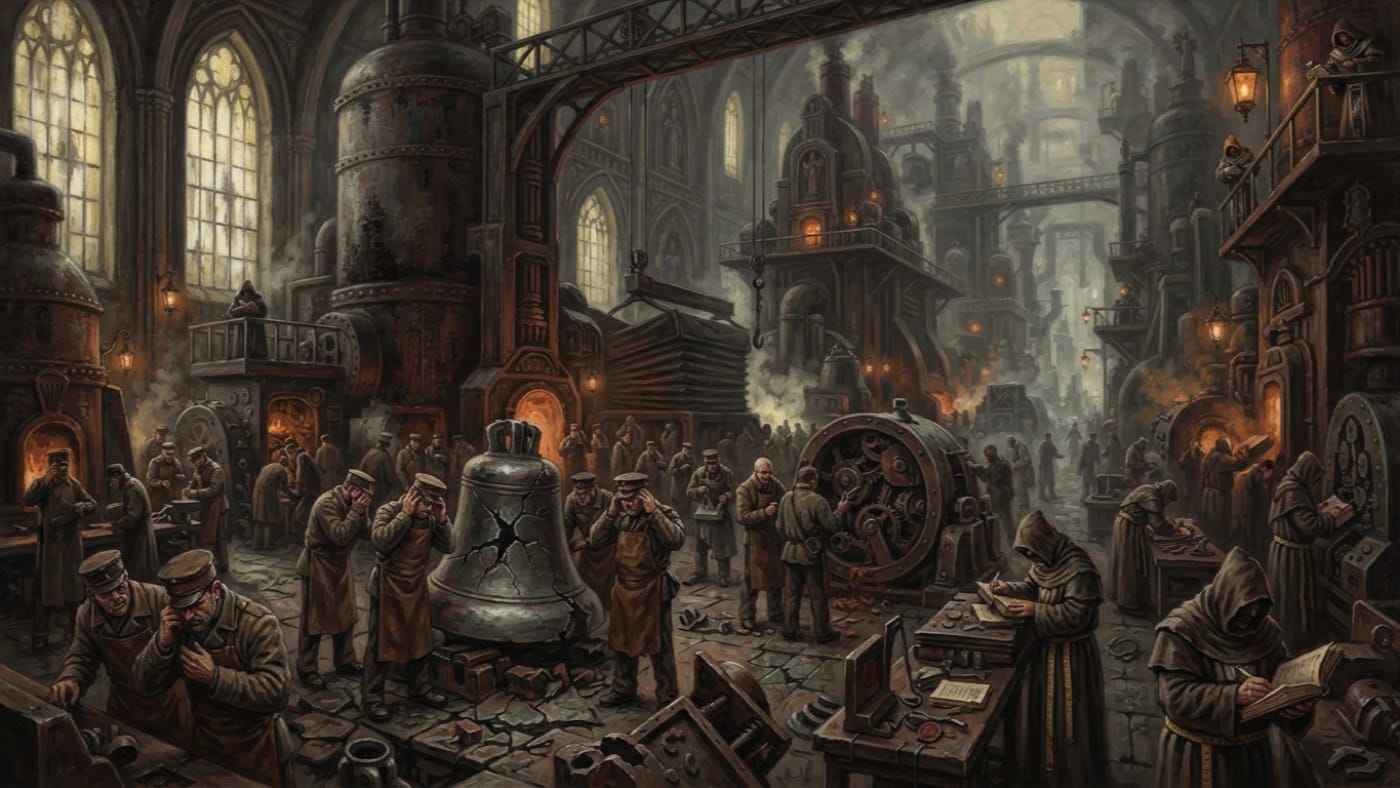
Hymnsteel is made in the Hall of Measures, where paired choirs sing sanctioned stanzas over every pour and the cooling grain keeps what it hears. The chain runs from the Master Hymnal Plates to the copied stanza sheet, from the sheet to the calibration mark, from the mark to the singer's throat and from the throat into the metal. Each link is licensed by the Bureau of Orison and Song, and each link is a place where a syllable can be changed.
The Mirror Choir changes them. The published entry on the heresy records the methods: a quarter-tone dropped below the approved pitch, a breath where the plate commands sustain, a calibration sheet replaced before audit. The pour behaves, the choirs finish and the part ships. Weeks later a bell-cannon throat on the Sagittal Line cracks along a grain-line no inspector marked, or a hymn-drive housing sheds its bolts in front of a gun crew that took no part in the argument.
Worse, some Choir variants are better music. They keep the metre, they ease the transitions that ruin singers, and they produce metal of alarming quality before the delayed failure arrives. Sabotage that hides inside excellence and breaks elsewhere, later and under fire makes the ideal culprit for any failure whose cause is otherwise unknown. Delay makes it impossible to disprove. Distance puts it everywhere.
#On the Uses of an Accusation
Three Bureaus govern Essen, and an accusation against the Mirror Choir asks none of them to give anything up.
The Bureau of Engines and Furnaces, under Furnace-Marshal Kord, answers for tonnage. A Bloom caused by heretics is a security problem. A Bloom caused by the city's own production is a production problem, and Engines owns production. The Bureau of Records, under Arch-Notary Veyl, answers for certification, and every cracked part left Essen under a Records seal. If the failure lies in sabotage, the seal certified honest work that was later betrayed. If it lies in the substrate, the seal certified a fault, and Ledger Row would have to reopen the better part of a century of its own stamps. The Bureau of Orison and Song, under Master-Calibrator Sister Rauth, answers for cadence. An enemy who corrupts the approved stanza is an enemy of the approved stanza. A failure that occurs while the approved stanza is sung correctly is a charge against the stanza itself.
I state these interests in the terms of their present holders. The Codex has no record of who drafted 447-E, who argued for it or who simply failed to argue against it, and I accuse none of the three of knowing what was coming. Convenience requires no conspiracy. A table will adopt a finding that clears every party sitting at it as fast as a choir takes a hymn downhill.
The Choir supplies evidence against itself as well. It claims each Bloom as vindication of its doctrine. The Bureau of Purity, which has hunted it since A.S. 187, needs results. When an accused heresy insists on taking the credit, the clerk who writes down the confession is only being polite.
#On the Earlier Disturbances
The Resonance Bloom has a recognisable manner. Tools hum on benches that no hand has touched. Teeth ache in patterns. Candles tremble in rooms without a draught. Then rivets shear, cannon throats crack and catwalks shake loose from their anchors, and in the bad episodes the workers bleed from the ears. Afterward the district goes silent for days, the sound eaten out of it. The hushwrights of the Quiet Gradient sell licensed silence by the room at ruinous rates. The Bloom's silence is unlicensed, uninvited and free, and that is the Guild's chief complaint against it.
The two hazards overlap. A throat cracked by a Bloom and a throat cracked by a Choir variant may lie side by side on the same inspection bench, and the bench has no opinion about causes. Similar fractures show only that the metal fractured in similar ways. They do not show a shared author.
The report's real difficulty was that the phenomenon was older than the culprit. Purity's hunt began in A.S. 187. That date marks when the Bureau started chasing the Choir, and the archive cannot show what the Choir was before it. The foundations, as it turned out, had been singing for decades before any Choir cell was documented altering a syllable. A blanket accusation has to cover the whole blanket, and 447-E never reached the corners.
#On the Sealed Correction
The withdrawal came in the form the Synod prefers for all its retreats: an erratum. A later investigation by the Bureau of Rites established that Resonance Bloom activity predates the Mirror Choir's earliest documented operations by approximately forty years. Rites normally audits ritual compliance; on this occasion it audited chronology. The file is sealed. The Codex knows the conclusion and nothing of the contents, a condition familiar to anyone who has ever been sentenced.
Forty years, approximately. The figure is relative and must stay relative. It does not give the year of the first Bloom, which remains suppressed, and it does not give the Choir's founding, which nobody has documented. A clerk who subtracts forty from one uncertain date to manufacture a second will find his own name subtracted from the payroll.
Then the Bureau of Doctrine, my own Bureau, which I mention for accuracy and not for advantage, reclassified the phenomenon as "ongoing harmonic negotiation between the consecrated substrate and an unidentified sub-foundation resonance source." Rites established the dates and Doctrine supplied the words. They were separate acts by separate offices. The order between them is the only interval the record allows me, because the day of the review and the day of the reclassification are not in my keeping.
Per Compact Report 447-E (A.S. 198), Resonance Bloom events at Essen-of-Hymnsteel are attributable to Mirror Choir sabotage.
Withdrawn as a general explanation. A sealed Bureau of Rites investigation places Bloom activity approximately forty years before the Choir's earliest documented operations. Individual failures traced to altered stanzas remain charged to the Choir. The Bloom itself is charged to nobody, which in the Bureau's books is the most alarming entry there is.
According to the Essen entry, the Compact Council has not read the reclassification. I have read it. The Council meets in the Furnace Basilica, directly above the crucible, and the heat may discourage reading.
The word "unidentified" is doing a great deal of work. Doctrine acknowledges a source and declines to identify it. The Essen entry goes further and states that the Master Hymnal Plates were edited decades ago under Synodal authority to quiet what the foundations say. The Mirror Choir's doctrine of correction makes a related claim and builds a cult on it. Those positions stand in their own entries. The Rites finding proves that the phenomenon is older than the heresy. It proves nothing about the heresy's theology, and nothing about what lies beneath the Foundry Core.
#On What Remains Charged
The correction acquits the Mirror Choir of nothing it actually did. The Choir still changes syllables and swaps sheets, and it still sends delayed failures down the Line toward Bastion-Przemyśl and Bastion-Constantinople. Purity's warrants stand. What collapsed was the arithmetic that turned every Bloom into a Choir crime.
That arithmetic is why the report still matters. For a season after A.S. 198, Essen's three Bureaus had a single explanation that cost none of them anything, and the Codex printed it. When three Blooms between A.S. 199 and 201 were laid at the Choir's door, the attribution could not rest on a document written in 198. It rested on the habit that document had taught. The habit outlived the withdrawal, as habits do. Nobody files them anywhere.