

#On the Station
"A seal without placement is a lie." — stampers' field practice
A Corridor Notary witnesses agreement. The bone has to be where the ledger says it is, lying on the axis the diagram commands, under a seal that has bitten. When those things agree, the Notary records it. When they do not, the Notary records that as well, and nobody thanks the Notary for it. The station belongs to the Ritual Bone-Stamper trade, whose formal name is Ossuary Authentication Warden. Its jurisdiction is narrow and lies underground: authenticated remains, chamber and route records, disturbed racks, and night access to corridors that daylight clergy prefer to bless from the top of the stairs.
The Bureau of Records holds jurisdiction over the dead and exercises it through the Office of the Last Watch. The Bureau of Rites prescribes the prayers and the placement. The Bureau of Bells owns the tone a tapped bone ought to make. These offices cooperate when they are audited and compete the rest of the time. None of them has issued the Corridor Notary a charter of its own, and I have not found one filed under another name.
The trade got its licence from Records Directive A.S. 92 / 1802 CE. That came two years after the Concordat of Strasbourg gave the Synod its formal shape.
Sealing is older than the Directive. Local offices were pressing wax to the dead in the decades after the Sundering. No source says when the title Corridor Notary first appeared on a roll. This survey is filed in A.S. 201 / 1911 CE, which dates the compilation and nothing else. The station's origin is unknown.
One holder of the title survives in the record by name: old Corridor Notary Hask. Hask has a dossier. This survey is not that dossier.
#On the Bone and Its Record
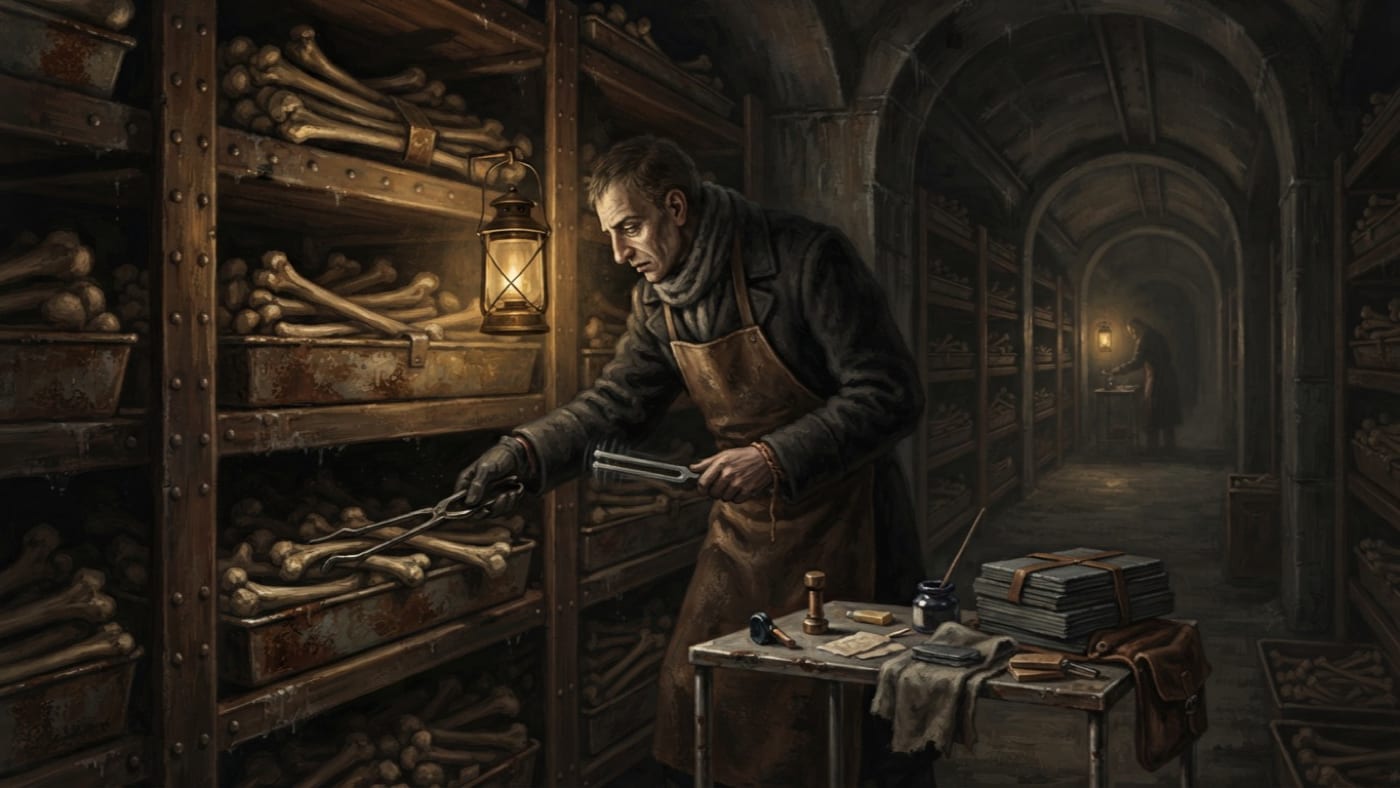
The Notary's day starts at midday at the ossuary office. There the Notary collects sealed route slips, incident flags ("disturbed chamber," "fresh pit," "missing saint crate") and the quota. The work starts after curfew. The issued kit is modest: a district-coded stamp head, wax wafers, ink brine, ledger slates, bone tongs, a hooded lantern, an ash cloth, and the tap-rod or tuning fork that every hand in the trade carries. The livery is a blackened clerk coat, a throat scarf, wax-stained wrist cords and a leather apron gone grey with dust.
The procedure belongs to the parent trade, and Bone-Stamp sets it out in full, so a short version will do here:
- Tap the bone.
- Clean and orient it. A bone on the wrong axis counts as open.
- Seal it. Warm the wafer over the covered flame and press the stamp head while reciting the Force-Count aloud.
- Add the secondary mark, an ink line and notch code for district, date and chamber.
- Enter it in the ledger: count, location and anomalies.
- Place it in the prescribed pattern.
For this station, custody rests on the last two steps. A bone can carry a perfect impression and still be out of custody if it sits on a shelf the ledger does not assign it. Carts disturb racks. So do thieves, and so do auditors reading marks. A disturbed rack has lost the agreement between matter and record. The Notary either restores that agreement or writes down that it could not be restored. The ledger's vocabulary for the second case is short: "fracture," "soft wax," "warm stone."
Nothing in the sources extends this custody beyond the dead and their records. Relic-grade bone is a daylight matter for the Relic Authenticator, and the trade forbids stamping it unless one is present. The occupational table lists Relic Transfer Notary as a separate title.
The station's rank depends on which file you open. The trade's own table puts Bone-Stamper and Corridor Notary together among the middle ranks, and Hask's dossier repeats that. The Codex entry on the profession puts the Notary above the Bone-Stamper. I print both versions. Records has supplied no ladder that settles the question, and I will not carve one.
#On Live Drift
The resonance check decides how long the night will be. An inert bone answers the tap with a flat note that stops when it should. A bone in live drift rings on too long, or its pitch climbs. The occupational file describes micro-movement and harmonic hum. Bone-Stamp records what a clerk does on hearing it: slows down, sends for the Corridor Notary, or leaves.
Being sent for is the role the sources attest. They do not say the Notary quiets what the clerk could not, and I will not write a promise the record withholds. What the sources support is this: the Notary arrives with authority over disturbed racks and route records, adds a second ear at the bone, and is bound to get the anomaly into the ledger before anyone can lose it.
When ordinary sealing fails outright, the corridor passes to the Quiet Hands. They are the trade's rise-response specialists, deployed for five recorded conditions: active rise, seal rejection, harmonic rack response, unexplained warmth and post-audit unrest. Their methods belong to them. When a seal is rejected, a Quiet Hand removes it, preserves it for the ledger and applies a new wafer at an offset angle. That is documented specialist practice. It does not describe what an ordinary Notary does with an ordinary cracked wafer.
The warrant complicates matters. Records signs Quiet Hands' travel warrants under substitute titles, and Corridor Notary is one of them. A warrant reading "Corridor Notary" may therefore cover a specialist, and it gives the ordinary holder of the station nothing extra. According to trade legend, Quiet Hands are discovered rather than recruited, among stampers who became Corridor Notaries and went on sealing for years below stone. Some Notaries become something else, but the roll does not show which ones. The same legend puts the first discovery after the Corridor Twitching beneath what is now Bastion-Brest. Bone-Stamp leaves the year of that incident unrecorded, and I leave it there.
#On Verification
What the station witnesses can be read and checked. An auditor checks stamp heads for wear, compares wax batch codes against supply ledgers, counts notches and walks the corridor cold. A Notary's corridor record answers to that audit and to nothing more exalted. The seal authenticates remains as received, catalogued, prayed over and placed. It certifies no sanctity, and a Notary who confirms the seal certifies none either.
The trade adds a variable the audit cannot reach. Field reports say that stampers who seal with conviction work quieter corridors than stampers who seal from habit. The Bureau's sacramental explanation is printed in larger type in the parent tract, and I leave it there. Whether the Count was meant when it was spoken leaves no trace on a wafer, so it leaves none in the column a Notary fills in.
A memorandum from this office stated that "the bone-stamp's efficacy derives from the sacred authority invested in it by the Bureau of Rites and confirmed by seventeen consecutive annual audits."
As amended in Bone-Stamp, the seventeen audits confirmed legible impressions, correct notch codes and reconciled wax inventories. That amendment applies here too. A Notary's record that bone, ledger and seal agree belongs with that bookkeeping. It does not measure whether a corridor is quiet.
#On the Working Breath
The Notary works among disturbed racks, and disturbed racks are where the dust rises. Bone-Lung is the trade's marrow-dust sickness. It gets in through the cracked seams of a mask whose official life is six weeks and whose real life in an active ossuary is nine nights. The Bureau of Medicine classes terminal progression as Hazardous Occupation Category Three. The Bureau of Tithes attaches no pension supplement.
The disease damages the work in two places. A shortened breath breaks the Force-Count, and a broken Count gives uneven pressure and a soft bite. A rattle during the resonance check can also mask live drift. The station's chief warning therefore comes through the organ the station wears out.
The trade supplies itself where the requisition sheet fails. Bone-Lung records that Corridor Notaries trade night-route slips for filter felt. A route slip is controlled access to a sealed corridor, and felt is breath. The trade shows that both are valuable and that neither is issued in sufficient quantity. It does not show a fee schedule.
The record keeps one Notary by sound alone. Bone-Lung describes workers who know their colleagues by the interval between coughs, and among them it lists two taps and a swallow for old Corridor Notary Hask. That gives a surname, a station, the source's word "old," and a cough regular enough to work as a signature. First name, sex, age, posting, disease stage and present status are unestablished. The dossier holds the rest of what is unknown.
#On Present Application
This compilation is dated to A.S. 201, the present year. The Bureau of Rites' classification memorandum of A.S. 199 records rising post-mortem disturbance across all monitored zones. Bone-Stamp traces the rise from A.S. 198 and finds it steepest at the front-line bastions, though it can be measured even in Strasbourg. Rites recommends an expanded bell-schedule and a doubled bone-stamp allocation.
Doubling the allocation doubles the wafers. It leaves unchanged the number of stations sent for when the tap rings wrong, the ears that hear it, and the lungs those ears depend on. After an offensive on the Sagittal Line, intake already exceeds the hands available, and every disturbed rack is one more agreement waiting for a Notary.
Two separate requests have gone up and come back. In A.S. 198 Rites asked to study the Quiet Hands, and Records refused. In the same year I proposed a study of conviction and received one word in red: "Unnecessary." Neither request concerned the Corridor Notary. I have found no request that does.