
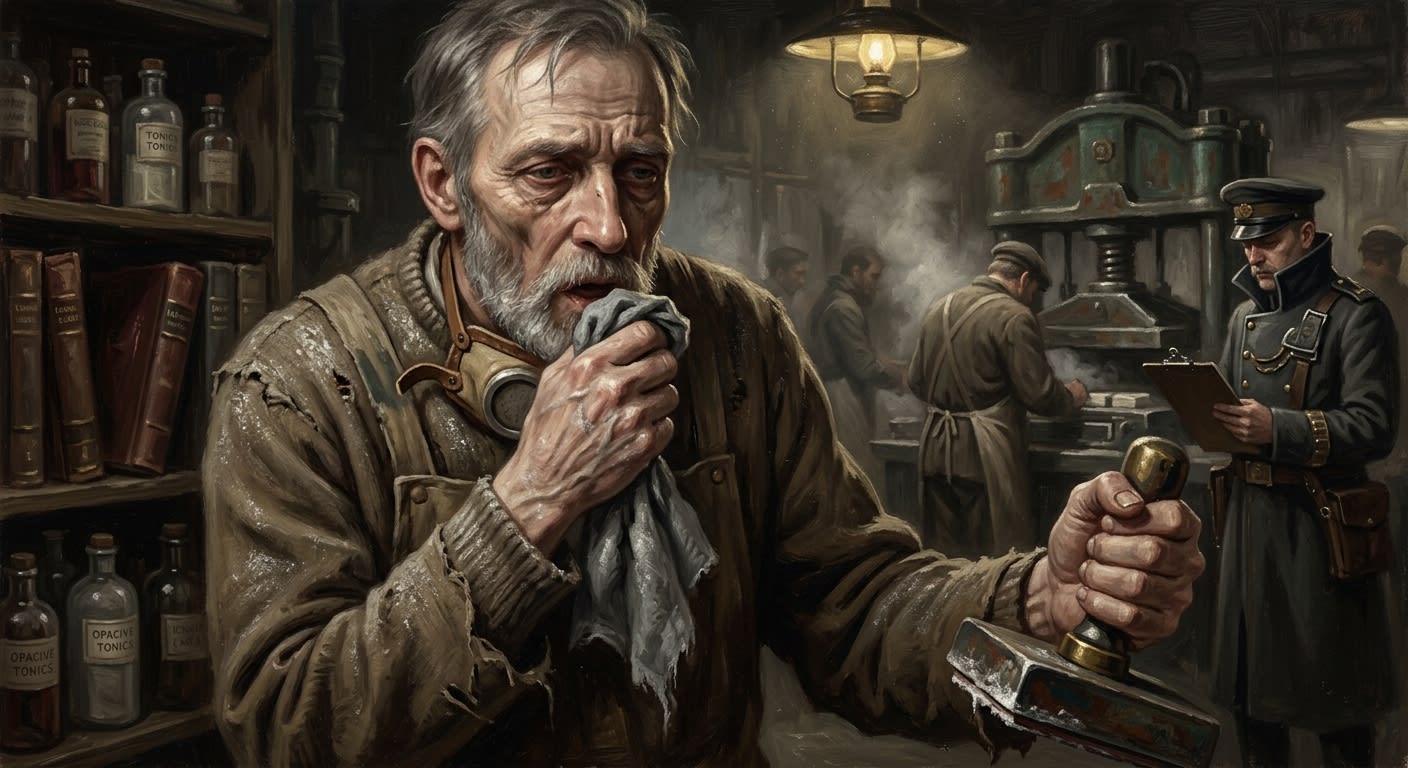
#On the Cough the Ledger Hears Poorly
Bone-Lung is the chronic occupational disease of the Ritual Bone-Stamper profession: a dry, filing cough produced by years of marrow-dust, ossuary damp, lamp smoke, old lime, ink brine, and the fine grey grit that rises whenever a sealed rack is opened in a corridor too old to forgive disturbance. The Bureau of Medicine classifies terminal progression under Hazardous Occupation Category Three. The Bureau of Records files affected workers as active until a physician, a Seal-Warden, and the worker's own hand all fail to agree on legibility. The Bureau of Tithes offers no pension supplement.
This last clause has been defended on grounds of fiscal purity. I record it here so that future theologians may know where to look when searching for Hell's smaller apertures.
Bone-Lung begins politely. A stamper coughs after shift, spits grey into a rag, blames the corridor, burns the rag, and returns at dusk. The second year brings a dry catch when climbing stairs. The fifth brings breath that shortens during the Force-Count. By the tenth, the worker can identify colleagues by the interval between coughs: two taps and a swallow for old Corridor Notary Hask; four short barks for Seal-Warden Mera (Unregistered); a soft wet click for the apprentice who lies about being well because a sick apprentice is a cheap sacrifice.
#On Its Cause and Approved Misdescription
The cause is marrow-dust. Everyone knows this. Medicine knows this; Records knows this; the stampers know it with the intimate certainty of men and women who wipe the interior of their masks and find the dead written there in paste. The dust enters through cloth, through cracked filter seams, through the foolish little gaps beside the nose where a quartermaster's economy meets a worker's breath. It lodges. It thickens. It becomes a second ledger in the chest, recording every opened rack.
Doctrine refuses the plain cause because plain causes create plain obligations. If marrow-dust sickens stampers, better masks must be issued. If better masks are required, supply ledgers must confess shortage. If shortage is confessed, Tithes must price the neglect. If neglect is priced, someone in Strasbourg may ask why a profession created by Directive A.S. 92 to quiet the dead is being permitted to join them by inhalation.
The approved term is “ossuary atmospheric exposure with persistent thoracic dryness.” Observe the cowardice. It uses five words to avoid one bone.
Earlier medical summaries described Bone-Lung as “seasonal cough aggravated by night work.”
Corrected. Bone-Lung is a progressive occupational condition produced by repeated inhalation of marrow-dust and ossuary particulate during stamping, rack handling, seal replacement, and corridor quieting. The season involved is employment.
#On the Stages
Stampers divide Bone-Lung into four stages, since workers name what they must survive faster than Bureaus name what they must fund.
First dust is the apprentice cough: dry, embarrassed, hidden in the scarf. Wax-Runners pretend it proves entry into the trade. Senior stampers pretend not to hear. This is kindness of a sort, though the sort that should be taken behind the chapel and beaten with a shovel.
Grey morning comes when the first cough arrives before speech. The stamper wakes, turns to the wall, coughs until the throat opens, then checks the rag for colour. Grey is ordinary. Brown is concerning. Black means lamp smoke has joined the ledger. Red means the worker lies to the Seal-Warden by noon.
Rattle count begins when the Force-Count breaks. The worker can still stamp, still seal, still walk a cold corridor without visible panic, yet the spoken cadence loses measure. A skipped syllable means uneven pressure. Uneven pressure means soft bite. Soft bite means the seal may fail, and failure in a bone-stamper's hand is rarely courteous enough to remain private.
Hollow bell is the terminal stage. Breath whistles in the chest. The cough stops sounding human and begins to sound architectural: a narrow door in stone, opened and shut by wind. Medicine may remove the stamper from active duty at Hollow Bell if Records can spare the hand. Records can never spare the hand. The dead, inconsiderate as parishioners at a fee office, keep arriving.
#On Masks, Rags, and Other Theatrical Mercies
The issued stamper mask is a leather cup with resin filter, brass nose bridge, linen ties, and an official life of six weeks. In active ossuaries it lasts nine nights. After that, the filter hardens, the rim cracks, and the worker stuffs folded cloth under the seam. The cloth clogs. The worker breathes around it. The dust enters by the path bureaucracy leaves open.
Vinegar rags help with smell, not dust. Resin lozenges help with throat pain, not dust. Prayer helps with fear, not dust, though the Vellum cult has preserved several excellent invocations for men who prefer to cough under patronage. The common cure is hot barley, ash honey, silence, and lying on one's left side until the fit passes. The rare cure is transfer above ground. The mythical cure is pension.
Black-market medicine thrives in this little sanctuary of official thrift. Wax-Runners buy resin tinctures from Mercy porters. Corridor Notaries trade night-route slips for filter felt. Seal-Wardens hoard clean cloth the way bishops hoard nephews. A proper cough syrup, one that stills the chest for a whole shift, costs more than two weeks of hazard allotment, assuming the hazard allotment has not been stolen before reaching the pay table. It has usually been stolen.
#On Work Done While Dying
Bone-Lung changes the work. A stamper with shortened breath cannot sustain the full Force-Count at the prescribed pressure. She adapts. She counts in the throat. She presses during the stronger half of the breath. She teaches apprentices to listen for seal bite while pretending she is teaching standard method. Practical heresy, yes. Also life. The Quiet Hands understand this better than anyone; many of them carry Bone-Lung like a second credential, and their silence in bad corridors owes as much to damaged lungs as to sacred discipline.
A cough in the wrong chamber is a hazard. Sound wakes things. A rattle during resonance check can mask live drift. A fit beside a warm rack may set nearby bones tapping in answer, which Medicine calls coincidence, Bells calls acoustic feedback, and stampers call a reason to keep honey under the tongue. Some senior wardens assign coughers to ledger tables after Third Bell. Other wardens keep them in the corridor because a sick veteran remains steadier than a healthy fool.
The cruelty is scheduled.
#On Compensation and Its Absence
No pension supplement attaches to Bone-Lung. The official reason: causation varies by district, chamber humidity, mask compliance, smoking habits, prior illness, lamp quality, lime handling, and individual constitution. This is the Bureau's favourite species of fog: many causes, no culprit, no coin.
The unofficial reason is uglier and more honest. If Bone-Lung earned compensation, half the ossuary trades would file claims by winter. Ossuary Housing Allocators breathe the same dust in gentler rooms. Dead-Goods Tariffers breathe lime and coffin rot. Gate-Carvers have stone cough from sealing niches. Orison Signal Engineers cough saint-dust into their sleeves and call it proof of service. The Synod's civilisation runs on lungs treated as replaceable filters. A paid Bone-Lung claim would be the first cracked seal in a very expensive wall.
So the Bureau classifies. Classification is cheaper than mercy and tidier than murder.
#On the Final Shift
Retired stampers, where retirement occurs through miracle, bribery, or clerical confusion, continue coughing in patterns learned below ground. Some tap the bed after each fit. Some wake convinced they have left a rack unsealed. Some ask for wax when the breath thins. Candles may wait. Priests may wait. Family may wait. Wax belongs at the hand, because the body has become another chamber requiring closure.
Medicine records death from respiratory failure. Records strikes the name from active roll after verifying that no stamp-head remains assigned. Rites may send a junior priest if the parish insists. The stampers perform their own courtesy. They place a clean wafer beside the hand. They do not press it to flesh. Flesh is not their jurisdiction. Even grief has departmental boundaries.
At the funeral, if there is one, no one coughs during the prayer. This is considered respect. It is also impossible, which makes the attempt holy.