
#On Their Station
Every heresy needs a quartermaster eventually. The Pale Kin found theirs in the Cradle Broker, the senior hand in a trade that officially has no ranks, no offices and no seniors. The Bureau cannot promote, pension or demote what it refuses to admit exists, and the Broker prefers it that way.
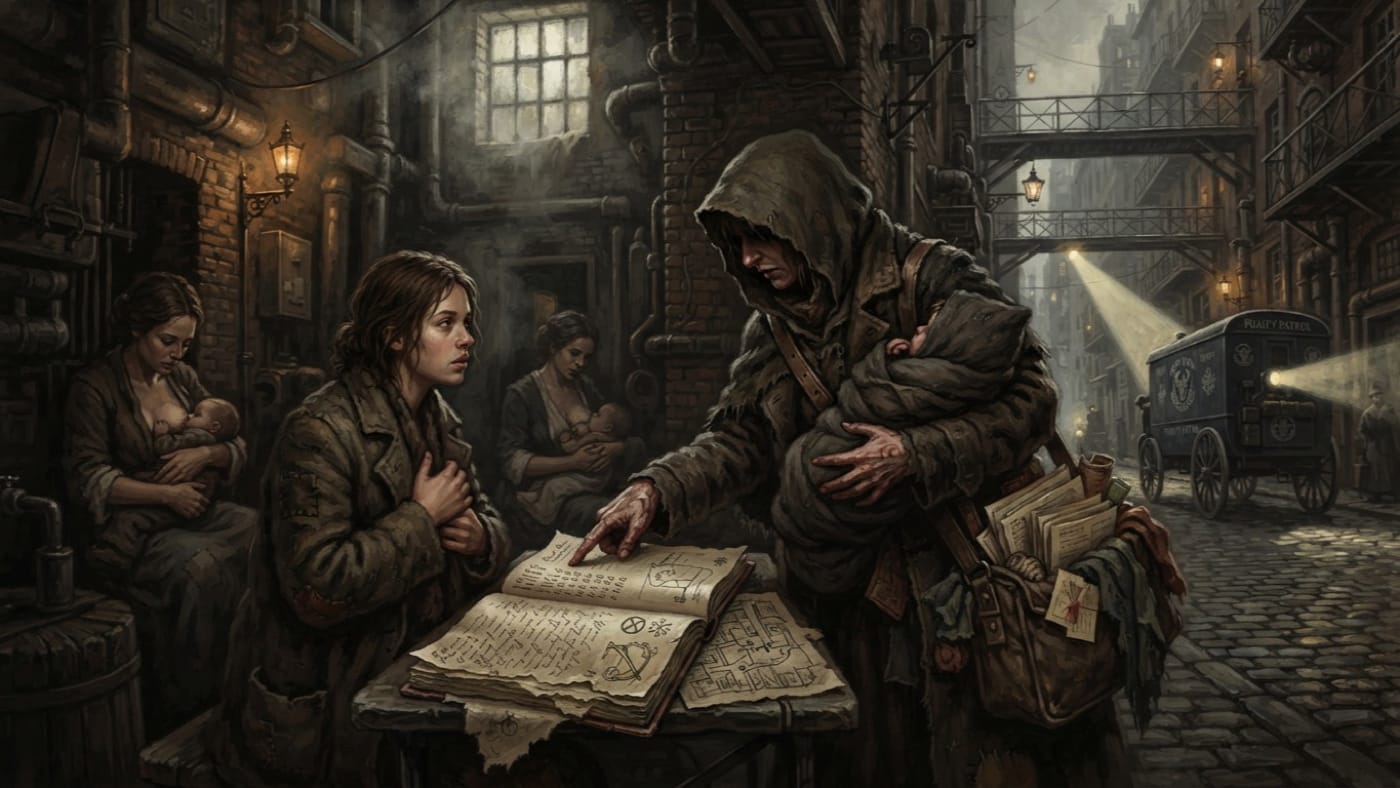
The Broker has two duties: placing infants and keeping the wet-nurse ring.
Both sound small, and neither is. Any steady-handed girl with a laundry basket can get a child past a patrol sergeant. That takes twenty minutes and a held breath, and the trade calls it carrying. Placement starts when the carrying is over. Somebody has to decide which house takes the child, who feeds it before dawn, where that house's grain comes from, what story the neighbours will hear, and whether the room will still be safe in February. A carried child has been moved. A placed child has to be kept alive, every day after.
The division of labour is plain enough. Bundle-Carriers run short segments and never touch papers. Seal-Swappers handle the papers. Route-Keepers learn the patrol rhythms: which sergeant drinks, which corner the Purity wagon favours on feast-days. Specialist Ash Registrars go after the registry systems themselves. The Cradle Broker stands above the carriers in responsibility, not by appointment. No examination exists and no warrant is sealed. A Broker is whoever the nurses will still open their doors to.
#On the Need for a Broker
The Nursery Levy Decrees of A.S. 152 required a preliminary birth notice within twelve hours of emergence and full registration within seventy-two. Parish registrars could enter any house where a birth had been reported and the filing had not followed. Concealing a child from the Great Ledger of Souls became a doctrinal offence instead of a clerical lapse. The Bureau of Conscription got its forecasts. The mothers got men on the stair.
Before the Decrees, the mother's own room was the hiding place. After them, it was the first room searched.
A child taken out of that room needs somewhere to arrive, and needs to be fed once it gets there. Within two years the Pale Kin trade had taken shape around that question. In A.S. 154 Mother Sava of the Ash Steps burned her parish registry and vanished with eleven infants. The record is eloquent about the fire. It says nothing about where eleven infants ate the following week, and I cannot tell you either.
Nobody can date the first Broker or the first use of the title. The trade keeps no founding charter. It keeps grain debts.
Bureau of Conscription histories describe the Pale Kin's senior placers as "pre-existing criminal elements exploiting compassionate legislation."
Corrected: no such elements existed before the legislation needed them. The registration clock and the armed threshold created the placement problem, and enforcement trained a profession to answer it. The word "compassionate" is withdrawn for want of evidence.
#On Milk and Placement
"A wet-nurse is a fortress." The runners say it, and the Broker builds on it.
An infant can be moved without papers, without a name and without a priest. It cannot be moved without milk. Escape takes one night, and hunger comes back every few hours for months. A Broker who can find a hiding place but not a nursing woman has found a cold room with an infant in it.
So the Broker keeps a ring of nurses and a much harder ledger of what each one can bear: her own child's needs, her husband's tongue, her landlord's curiosity, her ration card, and the neighbour who counts the washing on her line. Nurses are paid in grain or medicine, never with the child. Grain keepers supply the house. Midwives supply the infants, and their testimony supplies the cover. Undertakers supply what a stillbirth cover requires, and the trade does not joke about that part. Concealment is spread across tavern back rooms, laundry houses, parish basements, ossuary passages and pilgrim wagons. The Broker owns none of them. The Broker knows which of them are cool tonight.
Two rules govern the arrangement. The first: Don't carry the name with the body. The child travels by one road and the false papers by another, in a Seal-Swapper's keeping. A runner caught with both infant and forged papers has no story left to tell, and the inquisitor needs nothing more. The second: no single runner knows the full chain. The carrier knows a stairwell. The nurse knows a knock. The Broker knows too much, which is why the Broker must not be seen too often anywhere.
The temptation is always the same: one extra favour from a trusted carrier, the same nurse's door used again, a mother shown the route once out of pity. Recurrence is what audit feeds on. A house receiving grain it did not earn, a nurse drier at the ration hall than her infant would explain, the same shawl seen twice at the same laundry: each is a line a clerk can draw. The Broker must refuse the favour, including when it is asked for in tears.
#On Blood and Strangers
The Pale Kin's quarrels arrive at the Broker's table as practical problems: one infant, one free nurse, one cousin who claims to be sober.
The Blood-Kin Purists want the child with blood: the mother's sister, the grandmother, a cousin with milk. They distrust professional placement on principle, complaining that a Broker can send an infant three provinces away by dawn and never learn whether it lived through winter. That is a faction's charge against distance, not a timetable the whole trade keeps. It lands all the same, because survival after winter is the trade's own measure. The Purists' doctrine also bends quietly: their recovered rules put a trusted widow from the same lane sixth on the list, ahead of waiting. Even blood makes room for a neighbour when no relative has any milk.
Blood keeps a name alive in a kitchen. It also hands the Bureau of Purity its whole method. Kin share surnames, stand witness at each other's baptisms, owe each other milk, turn up at funerals and visit when grief gets the better of caution. Purity charts all of it. The Order of the Root studies it with the enthusiasm of men who believe heresy runs in families and want the family trees to prove it.
The Ward-Builders place children with trusted strangers whose loyalty comes from a shared crime instead of a shared grandmother. A kinship chart cannot find a child among people who are no kin to it, and the Ward-Builders are right about that. The cost is a child raised without the recipes, curses and forbidden songs its own family would have given it. The Ash Registrars argue that no house is safe while the file still points toward it. The Broker needs the paper cover they care about, yet a Broker's job is not to forge registry systems. It is to find an actual roof.
No Broker is bound to any of the three factions. Each placement takes a side regardless, child by child.
#On the Price and the Prohibition
The title "Broker" delights the Bureau's propagandists, who hear a market in it. The trade answers with three taboos. A Broker does not sell an infant. A Broker does not put two children in one house. A Broker does not take payment from a desperate mother.
The work still has to eat. Brokers are kept in food, medicine, shelter and papers, and only rarely in coin. Nurses get grain. Patrol sergeants get bread and fuel. Clerks get paper or salt. None of it adds up to a tariff. It is an economy of scraps, kept going by people with worse scraps of their own.
The corruptions are well known to the trade, which suggests they have been seen. A safe house that knows it cannot be replaced starts setting terms. A patron who shelters a route expects favours later, and does not always name them in advance. Whoever holds a child's true name holds a lever over the mother, the nurse and the Broker. The runners' own lore describes a Broker who has started to treat infants as assets. That Broker is a known way the role goes wrong. The Bureau's placards would have you believe it describes them all.
The placards are just as careless in lumping the Pale Kin with the child-snatch gangs and counterfeit baptism sellers that work the same wards. Those trades are rivals. A single enemy simply fits better on a placard.
#On Audit and the Present Condition
The Broker's enemies are patient and well staffed. Registry auditors go door to door checking baptisms and matching an infant's weight against its age. Purity fume-inspectors arrive with the registry teams and claim to smell contraband life in a room. Patrol sergeants can be bought only until they are rotated out. Inquisitors set confession traps at parish lines. The mercy sisters drive the orphan wagons the runners call "choirs." The licensed Orphanage Registrar places children too, issuing identities, lineage scores, tags, ration eligibility and adoption clearances. A Broker's placement exists to escape every one of those papers.
Milk-ration audits are the most dangerous, because they go after the one thing the Broker cannot fake. A false name can be written, but nobody can forge a feeding.
Failure takes ordinary shapes: fever in a damp cellar, exposure on a winter route, a betrayed nurse, a mother arrested, a child taken from her arms with the registrar's stamp already wet. A captured runner is hanged in public as a "child thief," walled up, branded, or made to watch the family pay. Concealment can also simply be outlasted. In A.S. 178 the Innsbruck Audit found three sons hidden for fourteen years and conscripted them anyway. The record does not say who had placed them, and I will not make it up.
This entry is a present-day survey of the occupation, sealed in A.S. 201. That is the year of the survey, not the year the trade began. Brokers are active across Zone 2, in the industrial wards and parish lanes of the Central Heartlands, and along the Zone 3 supply corridors, where displaced households make a strange infant easier to explain. They are also reported in bastion slums and trench-town wards, wherever a Pale Kin chain still has a nurse at the end of it.