
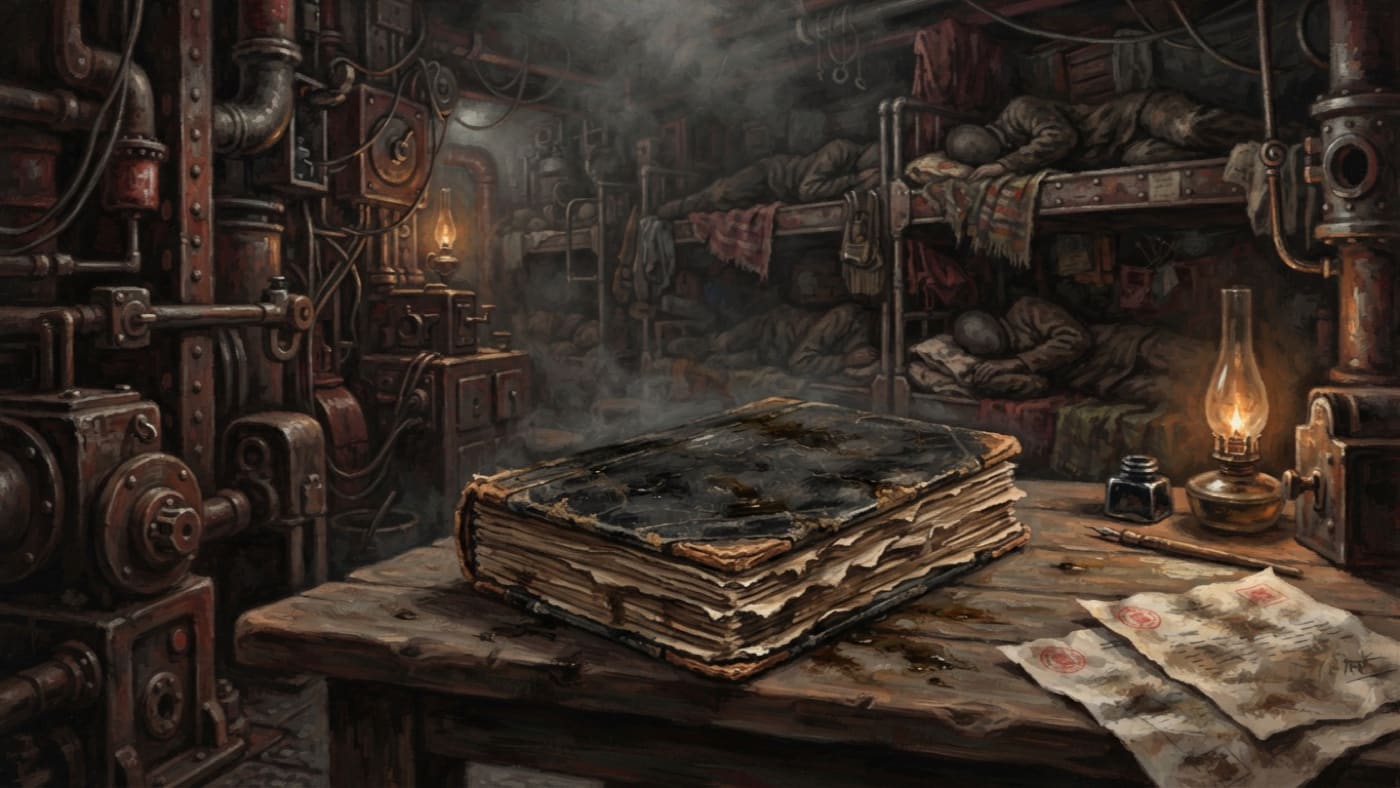
#On the Account Kept in Cinderrow
The Switchmen's Union of Lorn keeps a register of its dead and calls it the Crushed Book. A name qualifies for entry by correctness. Each belongs to a worker killed after the hymn was correct, the manifest correct and the order correct. A man who died drunk, careless or unsung belongs in some other ledger, and Lorn keeps plenty of those. This book admits only the dead whom procedure cannot blame.
It is bound in black oilcloth, which suits an object expected to meet rain, soot and the grease of working hands. It is updated in Cinderrow after midnight, in the wards where the yard's labour sleeps between shifts and the air carries boiled cabbage and coal. The Synod holds no inventory of its pages, no roll of its keepers and no record of its first entry. Neither do I. The title is craft speech of the bluntest sort. The wheel was not delicate, and the Union sees no reason the name should be.
#On Death After Correct Procedure
The procedure in Lorn is simple to recite. Every movement through the Palatine Yard requires a voiced measure, sung by a certified cantor from platform or tower and recorded by the Bureau of Bells. Every movement requires a manifest, stamped in the Manifest Basilica under Prefect Halden Wry of Records. Every movement requires an order from Yard command, which answers to Yard Palatine Odrin Kessel and, through him, to the schedule. When all three are satisfied, a switchman lays his palm on the lever and throws.
He stands beside the iron. The cantor, the clerk and the Palatine stand somewhere else.
When a body goes under a wheel, the Yard Tribunal looks for the broken link. Was the measure late? Was the manifest defective? Did the order exceed its authority? If any link failed, the Tribunal has a defendant, and very often the defendant is the crew, which is encouraged to confess its errors so that Records may forgive the men into more work. If no link failed, the Tribunal has nothing to try, and the dead man becomes the regrettable remainder of a lawful sum.
The Crushed Book collects those remainders. It does not argue that every hymn was secretly false or every clerk secretly murderous. It records that the hymn was certified, the paper sound and the order valid, and that the man died anyway. An institution that promises safety through correct authorization cannot easily survive a long column of correct authorizations followed by funerals.
In an earlier survey of the Union I wrote that the book records deaths after "correct hymns, correct manifests, correct orders, correct lies." The fourth heading was mine. The switchmen are more disciplined with their accusations than I am.
Yard ledgers record the Palatine Switchyard as operating under "perfect safety by hymn."
Corrected. The yard operates under certified procedure. Certified procedure has been followed in cases that ended in death. The ledgers are hereby relieved of the word "perfect" and invited to make do with "authorized."
The context is the Union's own birth. The Silent Derailment of A.S. 112 killed forty-one men on a siding the manifests denied existed. Burial funds followed in A.S. 113 and oath funds by A.S. 115, the same year the present Bell Codex was ratified out of older bell practice. That is when the workers began to count their own dead. Nothing I hold establishes when this particular book received its first name, or whether those forty-one were ever written into it. I decline to invent a christening for a register whose keepers have never invited me to one.
#On the Incomplete Record
No complete copy of the Crushed Book exists. Records finds this intolerable, and Records has excellent reasons.
Prefect Wry's office governs Lorn through manifests and identity. A name that clears Records can work, eat and travel. A name that fails can be rendered into debt, transferred into night shifts, or simply corrected. The Basilica's clerks routinely issue corrected manifests rewriting last week's departures, and a department with that much practice in revision regards an uncorrected list in private hands as a direct insult to its sacrament.
A complete book could be found. Once found, it could be seized. Once seized, it could be audited, annotated, reconciled with official casualty returns and reissued in a cleaner hand, its awkward entries reclassified as misconduct and its widows' claims reduced to clerical error. The Union has spared Records this labour by declining to let the book become whole in any place a provost can enter.
How this is arranged I cannot say. I have no account of copies or fragments, no cipher, no keeper's roster and no total. I will not borrow one from Cinderrow gossip and stamp it with my seal. My knowledge stops at the same point as the Prefect's.
#On the Two Accounts
Bell Marshal Sister-Calder keeps a book of missed measures. The Union keeps the Crushed Book. The two volumes sit on opposite sides of the same question, and the question is where guilt should land.
Sister-Calder's book measures the cantors, the voices she certifies, disciplines and, when necessary, sacrifices. Its existence asserts that failure in the yard is a failure of song, that song can be corrected, and that correction belongs to the Bureau of Bells. The Crushed Book insists on a second category, the deaths where the song was not missed at all. The Marshal has no column for these because her office was built on the premise that they should not occur.
Every power in Lorn has a preferred defendant. The Bell Marshal prefers an unsung crew or an insubordinate hand. Records prefers a debtor. Kessel prefers whatever answer restores the schedule before noon. Each would accept a guilty cantor if the Bureau's dignity survived it. None of them wants a list of dead men who were obedient.
The Union is no innocent clerk of grief. It levies solidarity fines on men who throw during a declared caution interval, and it strips the wrist-band from repeat offenders, leaving them to work alone. It pays widows before the clerk does and keeps track of those debts with the zeal of a bailiff. A register of men killed under certified procedure is a memorial. It is also leverage in the next negotiation over fees, rations and blame, and the Union knows exactly what it is worth.
The Crushed Book cannot prove what killed each man it lists. It claims less. It establishes that certification did not keep them alive. Every bureau in the yard sells that safety, and the book is the Union's evidence against the sale.
#On the Forty-One Handprints
Cinderrow testimony of A.S. 200 reports that Switchman Roel Tamm lost both legs under a munitions bogie routed by a certified dispatch hymn. He is not reported dead. The Crushed Book is a register of deaths, and I have no evidence that his name appears in it. His case belongs in this entry for another reason. It shows the dispute the book exists to record.
According to that testimony, the Union answered by chalking Sister-Calder's platform with forty-one handprints and one word: AGAIN. In Lorn, forty-one needs no explanation. The same account holds that the chalk was gone by dawn, that the platform sang half a measure late by Sext, that three cantors requested transfer by Vespers, and that a signal tower reported a handprint inside locked glass.
I record the testimony as testimony. Yard hazard returns already list the Hymn-Phase Slip, in which echoes repeat a measure late and switches throw clean but set wrong. They do not explain glass, and neither do I. Doctrine may attribute the tower to the Great Deceiver, to sabotage or to an overworked lamp-man at its leisure. The Crushed Book asserts none of these things, which is more restraint than the platform's congregation managed.
#On the Present Reckoning
A citywide slowdown is planned for A.S. 201. Its stated grievances are cantor overreach, certification costs, payroll cuts, ration fines and the arrears owed to widows. Widows' arrears are the point at which the register stops being a lament and becomes an invoice. Every entry is a family the Union has paid or promised to pay. Every family is a sum the Yard has failed to settle.
The pressure is general. Losses on the Payroll Spur remain unexplained. Tower Nine has shown lamp sequences no signal manual admits. Inquisitor-Regent Veyl Hark is expected from Strasbourg to audit the bell codes, and Cinderrow has concluded, with the instinct of the frequently audited, that a purge is being tuned. Any inquisitor who wants a convenient account of the yard will find the Crushed Book inconvenient. It names the dead and leaves the culprit unnamed. An inquisitor can use the second omission. The first is a list that can be read aloud at a hearing.
The Bureau of Purity would like to know who holds the pages, who carries them and whether the Hush Tunnel Runners have ever handled them. The Union certainly uses the tunnels. I have no record that the book has ever gone below, and I will not supply Purity with a smuggling route it has not earned.
Kessel cannot afford to disregard any of this. Lorn's twelve converging lines feed grain to Przemyśl and powder along the Queue Road toward the Sagittal Line. A slowdown endorsed by a list of the obedient dead stops trains more effectively than any riot the provosts could disperse. The Yard may call the book sedition. It may call it a burial roll. It cannot call it inaccurate without first producing the bodies.