
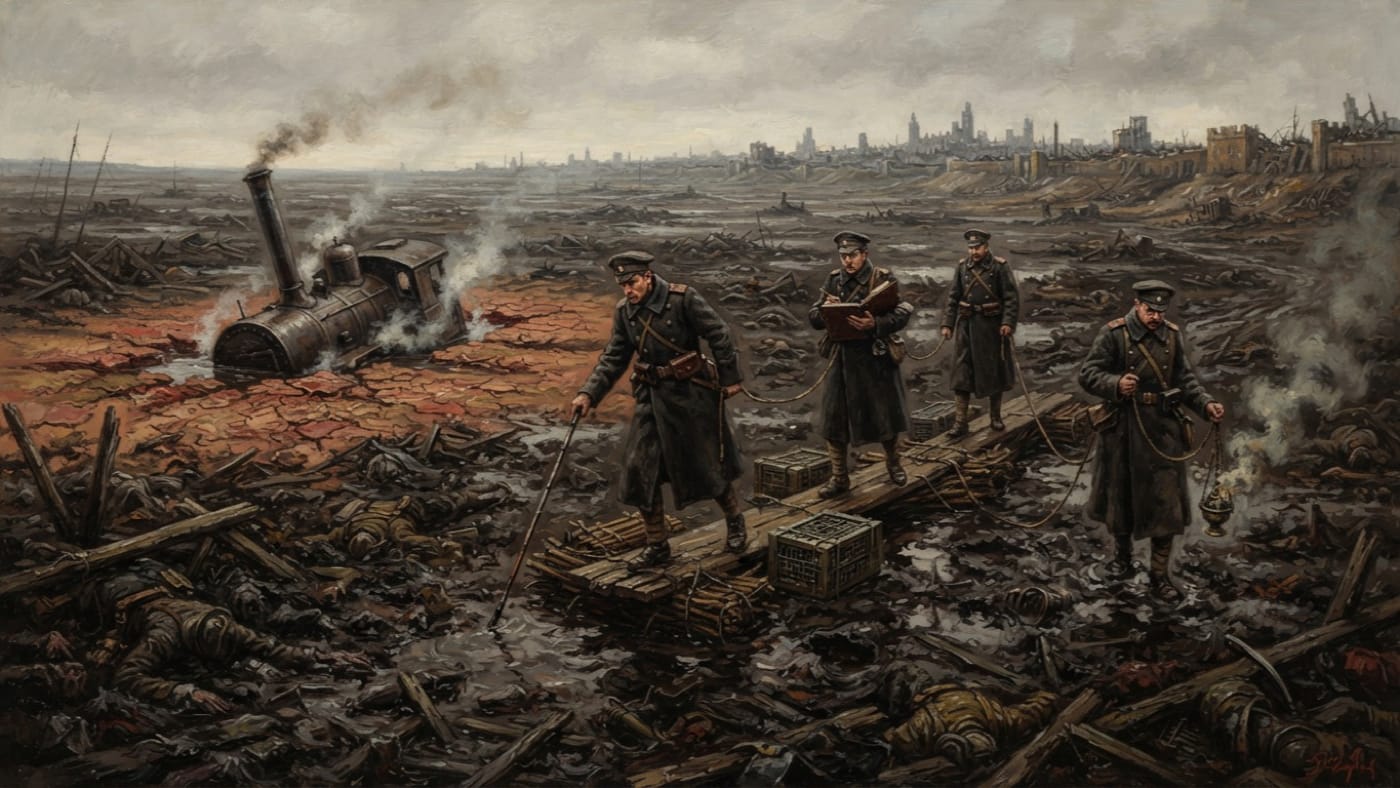
#On the Flats Under Survey
Current survey, A.S. 201 (1911 CE), of the Danubian front flats reported as Flesh-Mud terrain. It is compiled from the standing record and the Belgrade file. Nobody has walked the whole of these flats, and nobody can say where they end.
The Danubian flats in this survey are the low reaches of the Danubian front inside No Man's Land, before the Sagittal Line, where the dead have been trodden into the mire so thoroughly that the ground has begun to claim custody of them. The Flesh-Mud entry lists them among that terrain's occurrences, alongside the Knife-Mile and the shell bowls east of Przemyśl. That listing is their only warrant. The name describes a condition found along a front. It names no province and lays no claim to the river.
Every reader who has seen a map will now want to colour the whole Danube floodplain black. Put the brush down. A floodplain is wet. Flesh-Mud is wet and hungry, and men have died to establish the difference. Where the returns report the mire, this survey records the mire. Where they report a field, a ford or a reed bed, it records a field, a ford or a reed bed, and leaves the appetite to be proved.
The Danube lowlands are a different article and a different country. That entry covers the Bulgarian approach ground between the river and the Balkan range, where convoys gather for the climb to Shipka. Its roads, fog and troubles belong to it. Nothing in it is evidence for the mud described here, and no clerk with a free afternoon is to carry anything from this survey south to it.
No one has fixed the outer boundaries of these flats or dated their formation. The first official record of Flesh-Mud anywhere comes from the A.S. 68 thaw south of the Bug. That date belongs to the record, and to ground far to the north, and to no Danubian patch in particular. The flats became what they are at an hour nobody wrote down, which is the usual hour for terrible things.
#On the Ground That Takes Hold
What the troops report from these flats is what they report of Flesh-Mud everywhere, and this survey keeps the two kinds of testimony apart. The general description is filed in the parent entry. The local evidence is one engine at Belgrade. That is one more engine than most terrain dossiers can produce, and a good deal less than Engineering would like.
By the general description, the mire first looks like ordinary trench mud: black, glossy, swollen with rain and rot. It holds a boot as any mud does. Then it wrinkles against the leather and tightens. Men describe tendons winding round the ankle and the limb folding downward, joint by joint, as if the ground were filing them away. Survivors come up with marks that suction does not leave.
It is made of the battle with nothing buried: clay, powder, rust, bone, grave-water, horse, ration grease, devotional wax, and what remains of soldiers who were once entered on company rolls. Beneath the surface lie bone-reefs, pale shelves that hold a foot firmly for one step and give way on the next. A patch that carried one man in the morning may take the next before dark.
The field classification is Category Two Hostile Terrain, Variable Sentience. I quote it exactly because it is the most cautious sentence War has ever signed. Variable means the Bureaus argued and lost count. Nobody has proved that the mud thinks. It is enough that it closes.
The mud does not choose sides. Rationalist prisoners have gone down in the same slurry as our levies, and demons have drowned in the mire they helped to make. A soldier who expects the ground to know which army he serves learns otherwise once, and only once.
#On the Engine at Belgrade
The only documented case in the Danubian flats comes from Belgrade in A.S. 120 (1830 CE), during the rout of Maldrake's horde, the battle the Church keeps as the Miracle of the Danube's Turning. The battle has its own entry, and so do the Belgrade flats. This survey needs the battle for one engine only.
A Wrath-forged engine went into the mire and sank to its waist. The record gives no name, pattern, crew or dimensions, and I will not supply any. A Bureau that invents an engine's crew will soon find itself paying their widows.
Then Wrath did what Wrath does. Held fast, the engine burned hotter in its rage. The heat baked the mud around it into a crust, and for a while that crust looked like the firmest ground on the field. Then the crust cracked. The mire beneath it came up red, rose through the cracks and took the engine whole. A chimney of steam stood where it had been and screamed for nine minutes in a language no translator would admit to knowing.
Belgrade teaches one narrow lesson about this terrain: a hard surface over Flesh-Mud lasts only as long as the mire permits. The crust held until the mire withdrew permission. Nobody knows whether heat always provokes such a response. One engine is a case, and a case is not a law. Any officer who reads this account and reaches for a brazier as a way across should be relieved of the brazier and the command.
Three Bureaus filed the engine.
The Bureau of Doctrine filed it under miracle.
The Bureau of War filed it under favourable terrain.
The Bureau of Engineering filed it under pending investigation. By the parent entry's account, Engineering has been sending junior surveyors to their deaths over it ever since. The account gives no names or totals, and I give none either.
No later ruling has reconciled the three files, and this survey will not try. They sit in the same drawer without speaking, like canons after a contested election. One point stands outside all three. Swallowing an enemy engine on one afternoon does not make the mud a servant of the Church. It took Wrath's iron that day because Wrath's iron was standing in it.
#On Crossing and Recovery
The measures used against Flesh-Mud are general field practice across Zone Five. This survey records them as reported practice for any Danubian patch where the mire is reported. It does not promise that every patch responds to them in the same way.
Salt bombardment comes first. The shells are packed with consecrated salt, lime, iron filings and powdered bell-clapper residue, and fired in grids ahead of a movement. The parent entry reports that a proper barrage freezes the surface for seven to twelve minutes, depending on rain, earlier shelling, the density of corpses and the mood of Creation. That range is the parent entry's report, not a measured guarantee for these flats. A sergeant who promises his section twelve minutes is promising something the Bureau never sold him. Keep the range apart from Belgrade's nine minutes of steam as well. One is a crossing interval. The other is an obituary.
Plank roads come next, laid over fascines and bone-crates. Censer smoke stiffens the upper layer long enough for a stretcher team to pass. Rope teams tie every man to two others, so that when the mud takes one it must negotiate with three. War favours rope because rope is cheap.
Early War circulars advised personnel to cut trapped comrades free at the boot and pull upward.
Withdrawn. An unprepared upward pull makes the ligament response worse. Brace the man, salt the perimeter, cut the visible tendrils, and pray before pulling. The circulars stay in the archive as an example of advice that was quick, confident and wrong.
The cautions are as old as the measures. Do not fire into the mire at close range, because the parent entry records that concussion loosens it. Do not pour oil on it. Do not bless it from within arm's reach, since men have been pulled down by their own stoles. Do not encourage a trapped man to struggle. Hope makes him thrash, and thrashing wakes the layers beneath.
After the twelfth minute the Bureaus divide. The Bureau of Mercy objects to abandoning trapped personnel. War objects to losing six men to recover one. Doctrine objects to the word "abandoning." The manual has settled on "cessation of recoverable status," which satisfies Doctrine, annoys War, and is read aloud by Mercy's chaplains with open contempt. The dispute belongs to the parent entry and to the whole of Zone Five. It creates no special Danubian rule, and nobody is to cite this survey as though it did.
Every one of these measures buys minutes, and none of them clears ground. The salt thaws, the planks sink, the smoke drifts off, and the rope is exactly as strong as the three men tied to it.
#On the Present Assessment
As of A.S. 201, the Danubian front flats remain on the books as terrain where Flesh-Mud is reported. Belgrade proves that the mire there has taken an engine. It proves nothing about the safety of the next crossing, the edge of the next patch or the age of the ground under either.
How the mud does what it does remains unexplained. Doctrine's miracle, War's favourable terrain and Engineering's pending investigation are entered side by side, and this survey ranks none of them. The extent of the flats is unknown and their formation undated. Their appetite is documented. A recorded enemy loss is a line in the Ledger and gives no title to the ground.
The crust looked safe at Belgrade too.