
#On the Lowlands and the Range
Filed on the Southern Theatre standing returns of A.S. 201 and the current regional register for Bulgaria. The lowlands submitted no return of their own. Low ground seldom does.
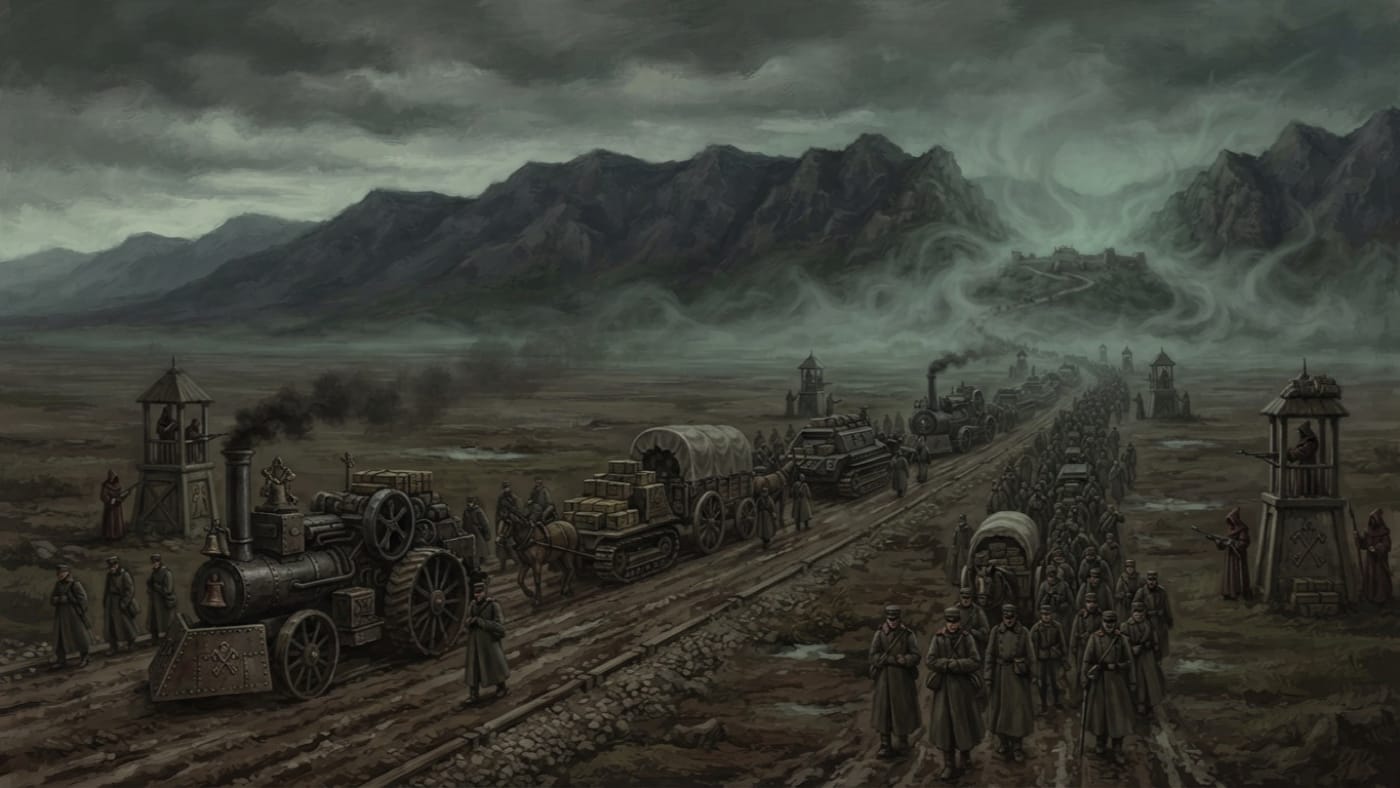
The Danube lowlands are the low country north of the Balkan Mountains, in that part of Bulgaria the registry treats as the northern approach to the Shipka route. The Danube lies to the north. To the south the range crosses the country from west to east and cuts the lowlands off from the plains that run down into Thrace. Everything of military interest about this ground follows from that arrangement. Armies, convoys and relief drafts gather on the low side of a wall, and the wall has one door the registry is prepared to count.
The name gives a direction. It does not describe a province. No Bureau has surveyed a western or eastern limit for it or drawn its edge along the riverbank, because no Bureau has paid for the survey. The lowlands have no surviving kingdom, no restoration council and no garrison under their own seal. Clerks in Sofia use the phrase the way a sacristan says "the north aisle": everyone knows roughly where it is, and nobody would swear to the last pew.
What can be said with confidence is physical. The ground is open and low, and it drains slowly in a wet season. The roads cross it toward the foothills and then begin to climb. A column moving south can be seen from a long way off, and heard from further away, provided sound is behaving.
#On the Passage to Thrace
The registry names the Shipka Pass as the single viable military route through the range from the lowlands toward Thrace and the road to Constantinople. Viable is a word of the Bureau of War, and it carries that Bureau's meaning. A herdsman can show you other saddles, and a smuggler can show you several more. A munitions column with an escort, draught teams, a winter timetable and a telegraph wire strung beside it can find exactly one. That is the one the registry counts.
Bastion-Shipka stands across it. It is the sixth of the seven principal bastions of the Sagittal Line, which runs north to south from the Baltic to the Bosphorus and treats the southern country as a sequence of separate obstacles. The fifth bastion, Irongate, holds the Iron Gates gorge on the Danube, where the problem is a river of current, cliffs, barges and chain-booms. The sixth holds a mountain road. The seventh holds a strait. Each guards against a different failure. The Danube does not run through the pass, and any reader who pictures it pouring south through Shipka should consult a map first and a confessor second.
For the lowlands, this means that most of what crosses them is bound somewhere else. Powder, grain, coal, lamp-oil and shell-fuses arrive from the west by way of Sofia and the feeder roads, then climb toward the pass. Hospital carriages come down the other way. Relief drafts for the garrison march south across ground they will not see again for four months. The men they relieve march north over the same ground, counting the days aloud.
"Bastion-Shipka entered into the Sagittal Line Registry as Secondary Logistics Chokepoint, Sagittal Spur — Western Marsh Corridor. A vertebra behind a vertebra. Feeding a more prestigious trunk bastion downline." This is the War ratification notice of c. A.S. 72, as it is reproduced in the Codex plate on Bastion-Shipka.
The current registry lists Shipka as the sixth of seven principal bastions, guarding the last bottleneck before Thrace. No other vertebra stands in front of it. The secondary logistics designation belongs to the marsh spur east of the fortress, which carries rail across Shipka Marsh and remains a feeder line. The Bureau of Records regrets that a description of the siding was filed as a description of the junction.
#On the Fog Along the Approaches
The assigned theatre of Syrion is the Bulgarian highlands, the Balkan range and the Aegean approaches, and his pressure on Shipka comes from the east and the south. For the most part the lowlands lie on the other side of the range from that pressure. It is the only geographical comfort this region offers, and the Bureau of War has budgeted for it to the last copper.
The comfort has limits. The Bureau of the Hourglass divides the Languid Dreamer's worst ground into two kinds. Stillness Fields are areas where time passes at rates nobody agreed to. Drag Corridors are long, narrow zones that tend to follow old roads and rivers. A country of approaches is made of exactly those things. The returns place these phenomena in the valleys that cut into the range from the east and south, on the climbing approaches to the pass, and in the drowned basin of the marsh. They record no general fogging of the lowland plain, and this entry claims none.
The approach roads report trouble that is consistent in kind. Sound arrives late, so that a hail from the next bend reaches the column after the man who shouted it. Neighbouring posts disagree about the hour. A stretch that took an hour in spring takes three in autumn, or twenty minutes, and the sergeants fear the twenty-minute version most. Drivers fall asleep over the reins in mid-afternoon. The convoy logs are full of exhaustion that looks ordinary until two clocks are compared.
In A.S. 190, Shipka was expanded after the fog pushed westward. The Bureau of Engineering measured the advance at "eleven miles or possibly eleven years, the instruments disagree." I enter that figure as testimony. Nobody is to draw a boundary from it, and least of all a boundary of the lowlands.
Further east lie the Vales of Stagnance, which are the enemy's domain proper and have an entry of their own. South of the range, Maldrake's furnace weather meets the fog in the foothills. That quarrel takes place on the far side of the wall.
#On Those Who Keep the Road
The people of record on these approaches are the people who move through them. Relief troops march to Shipka and back. Convoy crews know which grade punishes a tired team and which culvert floods after a night of rain. Litany-Engineers inspect footings and retaining walls, and they log a crack they cannot explain as if it were a heresy. Bellwardens carry the schedules of the Bureau of Bells from station to station. A convoy that cannot hear the next station halts and waits until it can, whatever the freight and whoever is waiting for it.
The road depends on two things, movement and correct time, and Syrion attacks both. The countermeasures are taught with confidence and work less well than they are taught. Mathematical anchors hold for a while and then decay into repetition. Anchor litanies (boots, belt, watch, tongue, breath) keep a man in his own body until he forgets why he is reciting them. Stimulants keep a driver upright at a cost that the Bureau of Medicine lists across sixty pages. Bells must ring in irregular patterns, because a regular pattern begins to sound like a lullaby. Men travel in pairs. If one stops answering, the other is to leave him and report.
Ordinary sleep is still required, and it is enforced. The garrison sleeps on schedule, the crews sleep on schedule, and the Bureau of Medicine counts the hours. The danger is the rest nobody scheduled, which arrives on a grade in the afternoon and feels like mercy.
The figures should be kept apart. Dedicated doctrine limits service in fog-adjacent positions to three days. The garrison tour at Shipka runs to a maximum of four months. Quartermasters who merge the two into one convenient number are reminded that each figure was paid for separately.
#On the Present Assessment
As of A.S. 201, the Danube lowlands remain the northern approach country to the only military passage through the Balkan range. Traffic gathers there, climbs to Shipka, descends into Thrace and goes on toward the Bosphorus. Irongate guards the river to the west, Shipka guards the mountain road, and Constantinople guards the strait. If any one of the three fails, the others will be left holding problems they were never built to solve.
The Church holds the roads it can keep moving. It holds the ground beside them as far as its bells carry. It has never surveyed the lowlands' full extent, and it has not established who now controls every district within it. Where the fog has been recorded, the returns say so. Where nothing has been recorded, this entry makes no assumption either way.