
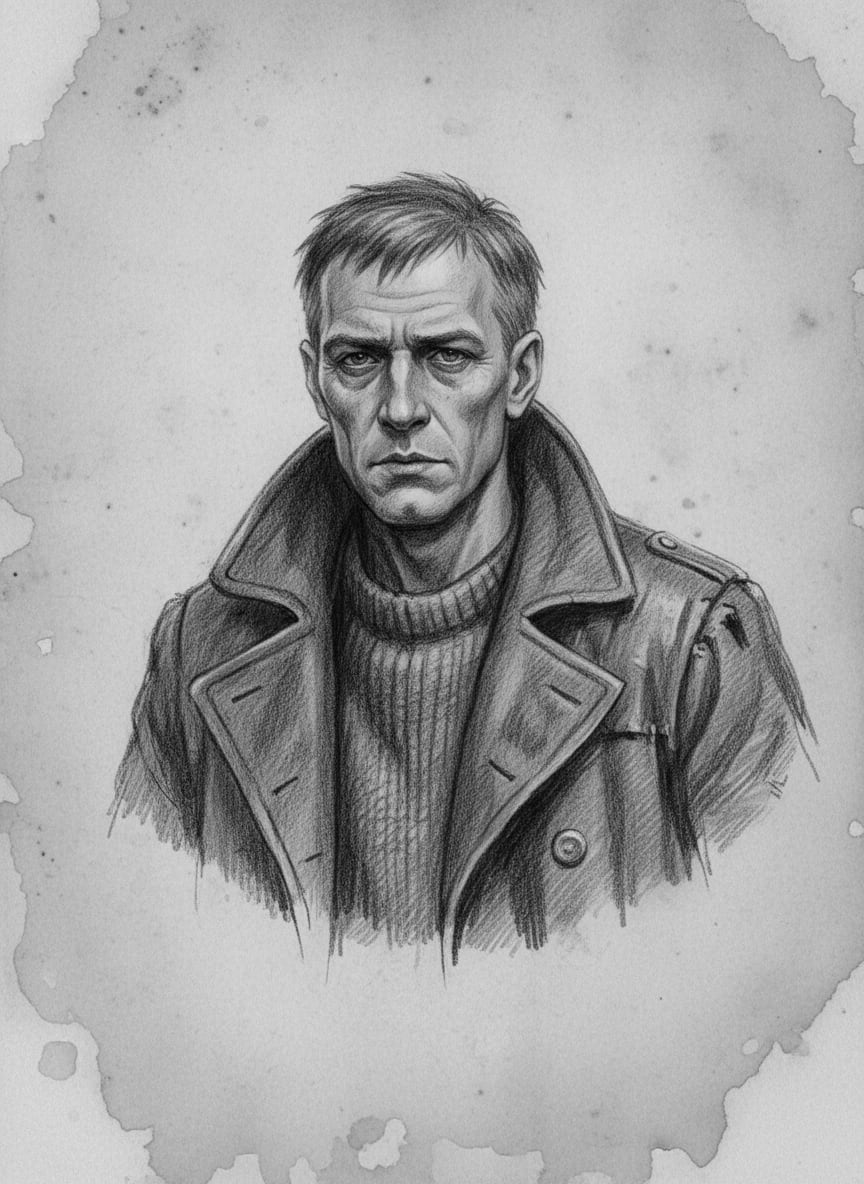
#On His Station
Demyan was a Strait Pilot, which is to say he possessed a route, a bell-window, three bribe relationships, two false names, one real mother whose existence he never admitted under oath, and a professional understanding of water that would have shamed several officers of the Bureau of War had shame been within their issued equipment. He operated the inner Bosphorus in the years when demon-glass demand was already rising and before Maldrake's later push made every shard worth enough ration-paper to buy a man's conscience twice.
His surname is absent from the files. This is often presented as a mystery by clerks who have never smuggled anything heavier than a second lunch. Strait men do not surrender surnames to paper. Surnames attach mothers, wives, parishes, berths, debts, childhood nicknames, funeral obligations, and all the soft domestic cords by which Records strangles a man without laying hands on him. “Demyan” was enough for the docks. It shall be enough for us.
He first enters my notice during the A.S. 197 Thessaloniki inspection, in a side memorandum attached to a seizure ledger that officially concerned cracked reliquary panels and unofficially concerned forty-three wrapped shards moving under a saint-bone manifest. The handwriting is mine. The stain on the lower corner is not blood, despite Purity's later enthusiasm. It is harbour wine, poor quality, purchased for evidentiary purposes and regretted in both capacities.
#On the Route He Owned
A Strait Pilot owns no boat in the durable sense. Boats burn, sink, are confiscated, are repainted under another widow's name, or acquire holes from War launches operated by men who confuse enthusiasm with aim. A Pilot owns a route: the minute between overlapping bells when the patrol lantern turns west; the eddy behind the customs pier where oars make less sound; the habit of one Salt-Scourge sergeant who counts incoming crates before outgoing men because crates can be fined and men usually plead.
Demyan's route ran from the Anatolian staging sheds through the bell-wake under the outer chain-lamps, crossed behind a grain lighter marked for quarantine, and reached the Constantinople waterfront by way of a fish-market sluice whose grating had been “under repair” for nine consecutive quarters. The grating appeared in three Engineering budgets and no Engineering workshop. I admire consistency in theft. It is nearly doctrine.
The route carried reliquary crates by day and stained windows by night. “Stained windows” is the dock phrase for demon glass when the listener might be stupid, armed, or salaried. The glass sat inside double-walled icon boxes lined with lead prayer-plates. The boxes sat inside saint-bone crates. The crates bore seals from the Bureau of Relics, counter-seals from the Bureau of Masks and Seals, and errors so small that a man needed either training or fear to see them.
Demyan did not cut seals himself. That was Seal-Mate work, and he had the good sense to leave wax to men whose hands had already grown steady from poverty. His talent was timing. He knew the bell-schedule as smugglers know it: not as liturgy, nor civic rhythm, nor sanctified custody of hours, but as noise. Sacred noise. Useful noise. The kind that covers an oar-stroke and forgives a cough.
#On the Interview
He called me Father Drax.
I did not correct him. Precision is a virtue, but so is allowing a condemned man to reveal the shape of his error.
We met in a room behind a rope-maker's loft near the Constantinople waterfront. The rope-maker was absent, having developed a sudden devotion to cousins inland. Demyan arrived without guards, which meant he trusted the lane more than he trusted my office. He wore salt-burned cuffs, a pilgrim bead cord, and a coat whose lining had been cut and resewn so many times that it possessed more compartments than a Bureau archive. His left hand shook until the bells began. Then it stilled.
I asked him what he believed he moved.
“Salvation,” he said.
I reminded him that the Bureau classifies demon glass as Category One Spiritual Contraband.
“The Bureau moves permission,” he answered. “We move salvation. We arrive first.”
That was his theology entire: speed as mercy, contraband as pastoral care, heresy as an express lane around clerical delay. A vile doctrine. An efficient one. The most dangerous errors are those that answer a real inconvenience.
#On His Character
Demyan was not brave in the operatic sense favoured by recruiting broadsheets. He did not relish danger, court martyrdom, or grin at cannon-fire like a half-educated banner-boy with a clean jaw. He feared drowning. He feared Purity. He feared the glass most of all, and this made him competent. Men who stop fearing demon glass become Seers, prophets, informants, corpses, or worse: enthusiasts.
He kept three rules on his boat. Wrapped shards stayed wrapped. No man looked into water during bell-overlap. No one prayed aloud to Harrowglass unless a crate hummed louder than the bells. The last rule marks him as practical, which the Bureau often mistakes for impiety. Practical men know exactly when superstition becomes equipment.
He lied cleanly. I say this with distaste and professional respect. Asked whether he knew Ledger-Ghost Tamsin, he smiled as if the name were a fish smell passing through the room. Asked whether the Grey Keel used his route, he requested clarification of every word except “the.” Asked whether he had witnessed the aftermath of the Mirror Riot of Varna through older sailors' accounts, he crossed himself without noticing. That answer I trusted.
PURPORTED CREW TESTIMONY — NAME BURNT FROM EDGE He would not let the boy open the pane. The boy said he heard his sister inside. Demyan broke his wrist with the tiller and kissed his forehead after. “Hate me alive,” he said. “Thank me old.”
#On the Execution
Three months after our interview, Demyan was executed for an unrelated seal violation. The phrase has the odour of a cellar rag. Unrelated to what? To the interview, if one believes Purity. To the shipment missed the previous week, if one believes the dockhands. To a captain's embarrassment, if one believes me, and the reader is advised to take the rare opportunity of being correct.
The violation concerned a counter-seal on a reliquary crate whose fourth prayer-line lacked the approved ligature. The crate contained no demon glass when seized. This proved either innocence, prior unloading, or unusual restraint. Purity chose the fourth category: insolence. Demyan was hanged at the customs pier before Terce. His body was cut down after Sext because the tide reached his boots and made the spectacle untidy.
Public notice stated that Demyan died repentant, confessing lifelong conspiracy with Abyssal transport networks.
Correction entered under restricted seal. His recorded final words were: “Check the west chain at low bell.” The west chain failed nine days later and sank two patrol launches. Repentance has many dialects.
The route did not die with him. Routes never do. Men die; water remembers. Within a month, another Pilot owned the bell-window, the sluice remained under repair, and the same patrol sergeant continued counting crates before men. The Bureau declared the execution a maritime purification success. Confiscations fell for twelve days, then rose above prior measure. Success, like sanctity, benefits from selective dating.
#On His Use to Doctrine
Demyan matters because he said plainly what the Strait says in practice. The Synod moves permission. Permission is sealed, routed, counted, challenged, appealed, denied, restored, taxed, and often delivered to a grave. The smuggler moves the thing desired before permission learns to spell it. That fact is intolerable. It is also why smugglers prosper in every age of law ever inflicted upon hungry men.
His words have been quoted in three internal lectures, always as an example of criminal arrogance. They should be quoted more often as an indictment of delay. I have made this recommendation twice. The first copy vanished. The second returned with a coffee ring and the word “unhelpful” written in a junior hand. I have had juniors reassigned for prettier penmanship.