
#On the Ruling of A.S. 72
"Why does the Creator not answer? Because the way to our ears was broken. Who broke it? The Rationalists. When will He answer? When faith is perfect." — Schoolroom recitation, after the Second Doctrinal Congress
By the year the Church now numbers 72, the faithful had taken back a great many altars and could not make one of them speak. The Sundering lay twenty-seven years behind them. A defensible Line ran, still unfinished, from Königsberg south toward Constantinople. The men posted along it had begun to ask their chaplains the question every army asks sooner or later. The Church had recovered its sanctuaries from Reason, so where was the voice those sanctuaries had been built to receive?
The Second Doctrinal Congress supplied the answer. It sat under the uneven ecclesiastical administration that held the field between the interim council and the constitutional settlement of A.S. 90, eighteen years before any formal Synod existed to claim it. Today the Bureau of Doctrine files the ruling among its own acts, and I sign under that filing without a blush. The men who ratified it, however, served offices that had not yet received their present names. They did not even call their year 72. The calendar came later, when a Synod with a gift for retrospective order counted backward to Amsterdam.
My registers record the ruling and very little of the furniture around it: where the Congress sat, who held the chair, how its seals were counted. I have stopped asking. A ruling that has bound five generations of schoolchildren needs no upholstery.
#On the Broken Apparatus
The Doctrine holds that the Creator withdrew His active presence from the world, and that His speech no longer reaches mortal ears. It repeals nothing in the First Catechism. The Creator is remains the first sentence a child learns and the last a condemned man is permitted to say. Withdrawal concerns the delivery of the word. The existence of its Author lies outside the ruling's jurisdiction, and the Congress was careful to leave it there.
The catechisms describe the Age of Faith as a long season of conversation. Saints were spoken to. Visions came to the holy, miracles were frequent enough to need a register, and sacred objects did what sacred objects are for. I teach this account as the Church's authorized memory of itself, the only memory the Church has ever required.
The Congress was exact about the offence. The Rationalists of the Age of Reason, and the clever men who came before them, smashed altars and burned reliquaries. They sold bells for their metal, abolished processions, and took devotion apart until a parish had nowhere left to kneel. The Doctrine does not say the Creator took offence the way a magistrate takes offence at a jeer. It says these acts broke the apparatus through which His speech arrived: the shrine, the reliquary, and the prayer of a congregation on its knees, with bell, liturgy and public observance keeping the whole assembly in order.
A Rationalist who disbelieved in the privacy of his study broke nothing. The Rationalist who hired carters to haul the altar-stone to a quarry broke a great deal. In the Congress's understanding, unbelief did its damage once it became masonry, auction, ordinance and empty pews. Heresy has always grown dangerous once it acquires a work-crew.
The ratification dates the explanation and leaves the event undated. The catechism places the breaking across the Age of Reason, whose formal span the Church counts from A.S. 0 to the Sundering, with Rationalist mischief beginning some way earlier. A.S. 0 marks an era in the Ledger. Nobody heard the Creator fall silent on the stroke of an hour.
The arithmetic of repair follows plainly from all this. A parish that rebuilds its shrine, rehangs its bell and refills its reliquary has restored its portion of the apparatus, and may expect its portion of the answer.
A parish that rebuilds its shrine, rehangs its bell and refills its reliquary has restored its portion of the apparatus, and may expect its portion of the answer.
Withdrawn by the author before sealing. The Doctrine names what was broken and specifies no repair. A restored shrine is an act of obedience, and nothing further is promised for it. The answer remains conditional on Perfect Faith, which no rebuilt altar certifies and no parish may claim. The Warden regrets the arithmetic. It is the kind that sets whole congregations writing letters.
#On Miracles After the Ruling
The Doctrine has one inconvenient tenant. Relics still glow. Now and then a bell still rings with no hand on the rope. Water and ground consecrated by rite still burn and repel the creatures of the Great Deceiver, and ordinary water and ground do not. A withdrawn presence ought to leave less evidence behind.
In A.S. 95, twenty-three years after the ruling, Bishop-Warden Clemens Stahlhand raised the reliquary of Saint Aldebrand in the last defended nave of the Siege of Vienna. Witnesses swore the reliquary blazed. The sorcerer-lord who had breached the inner wall was broken. The cathedral's bells sounded with nobody pulling them. The Synod, by then constituted, celebrated the blow. The keepers of the Doctrine had to file it.
They filed it in three drawers, as every such event is filed. The first holds the reported effect: a box of bone burned with light, an enemy fell, bronze rang. The second holds the classification. The Bureau of Rites certifies miracles as gifts of the Creator and separates them from sorcery, which it defines as power taken where a miracle is given. The third holds the explanation, and the Bureau's own key does not open it. The gift attribution is the Church's official position. In more than one hand, including mine, the Bureau has also admitted that it has no independent means of determining the source.
Vienna did not repair the apparatus. A blaze is no sentence. Nobody recorded a syllable in the bells of Saint Rupert, and the Doctrine concerns speech. Condemned speculation offers other readings: power left in the bone like heat in a hearthstone, power that answers to no one, power from below in a borrowed vestment. Purity keeps those readings on its prohibited list, and I leave them there.
#On the Condition of Return
Since A.S. 72 the catechisms have taught the condition attached to the Withdrawal. The Creator will return when faith is perfect: when doubt has been eliminated, worship is sustained without lapse, and the Church's authority is accepted without reservation. No date comes with the promise. Doctrine has never supplied one.
As administration, the condition is beyond reproach. Every year the Creator does not return becomes a year in which faith fell short, and the shortfall always has an address. It is the parish that skipped a vigil, or the chaplain who tolerated a question. It is the widow whose weeping had an edge to it, or the soldier who prayed while thinking about his feet. The promiser is never in arrears. The congregation always is.
The condition also guards its own door. A believer who announces that his faith has reached perfection commits pride in the announcing. Pride is an imperfection, so the claim refutes itself before the ink is dry. I am describing how the teaching works in the confessional and the classroom. The Congress never said whether the cosmos follows the same plan, and I am paid to know the difference.
Rebuilding a shrine meets no part of the condition. Authenticating a relic meets less, since it adds a seal to the pride of whoever holds it. Nothing in the Doctrine lets the faithful compel an answer, and the Church takes care that nobody tries.
#On the Later Ruling
Thirty-two years after Withdrawal, the Fourth Congress of A.S. 104 ratified the Doctrine of the Inaudible Voice. It teaches that the Creator speaks in a register beyond mortal hearing, and that the failure to hear Him lies with the hearer.
Lay the two rulings side by side on a desk. Withdrawal says the apparatus was broken and the presence withdrawn. Its silence has a cause in history, and the cause wore Rationalist coats. The Inaudible Voice says the speech continues and the ear is at fault. Its silence has a cause in the listener, and the listener is whoever happens to be kneeling. One describes a bell whose rope was cut. The other describes a bell ringing at full voice over a deaf parish.
Both are taught, and both bind. No Congress has repealed either one or reconciled them, and I will not invent a council that did. The catechism places them in sequence, and the child recites them in sequence. The sequence does the work a reconciliation would otherwise have to do.
#On Present Application
In A.S. 201, Withdrawal has stood for a hundred and twenty-nine years and the Inaudible Voice for ninety-seven. The war has lasted a hundred and fifty-six. Withdrawal appears in every school catechism. It supplies the confessor's formula for a penitent who complains that his prayer goes nowhere. It is in the public recitations, too, which a Street-Vicar corrects on the corner when a child puts the Rationalists in the wrong clause.
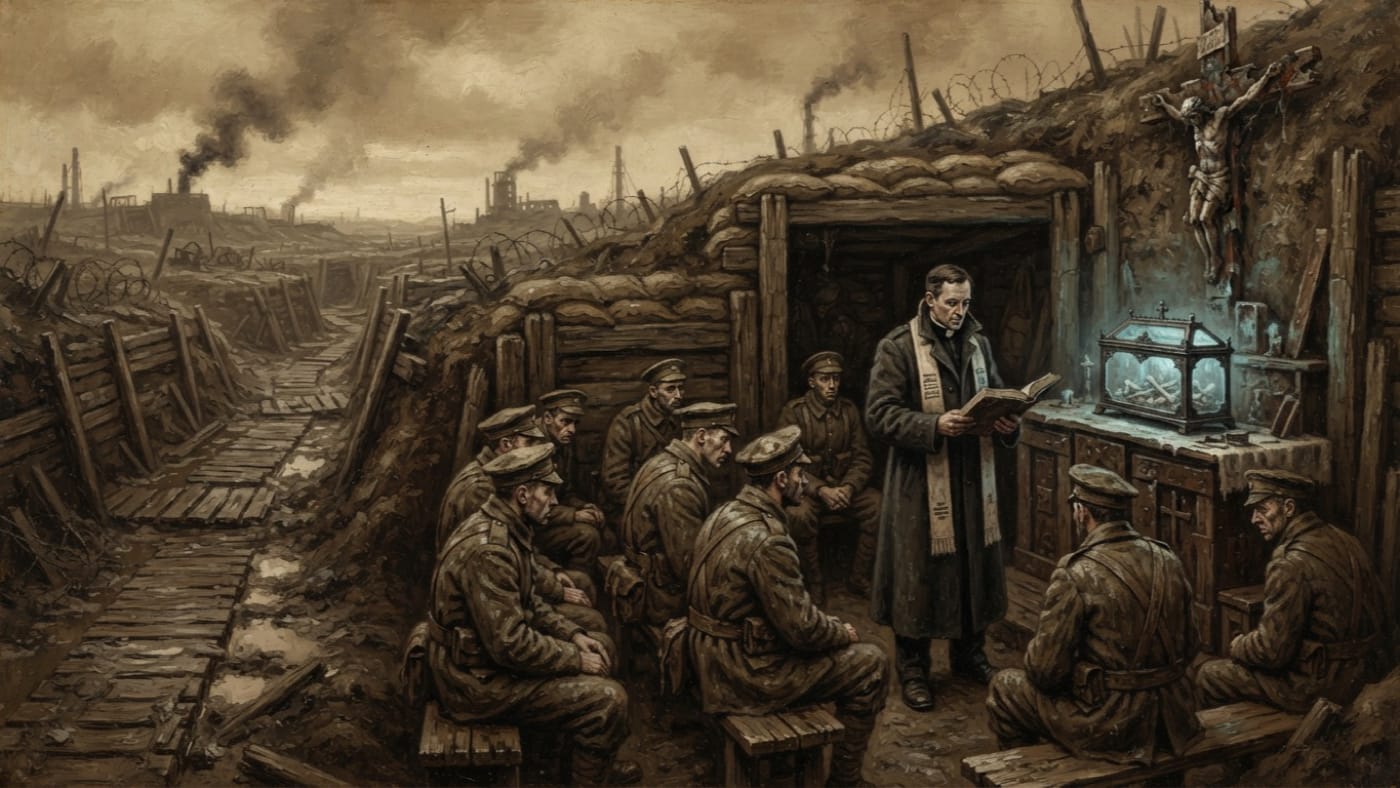
Its plainest work is done on the Sagittal Line. In a trench chapel of damp timber, a chaplain reads the catechism to men in wet wool. The altar is bare. A small reliquary on the shelf gives off its faint, certified glow. A soldier with three nights on the firestep behind him hears the Doctrine explain why the glow is permitted and the voice is not. Then he asks about his brother, killed in the spring, who had prayed without reservation as far as anyone could tell. The chaplain gives him the condition. The soldier goes back to the firestep.
I have heard that exchange in one form or another from more chaplains than I can name, and I wrote the formula they use. It is good work. No complaint about it has ever reached my desk with a signature attached.