
#On the Congress's Authority
"The Creator is." — First Catechism, Article One
A Doctrinal Congress is how the Church turns an opinion into an obligation. Before a Congress, a finding is a folio: argued over, annotated, and greasy from the thumb of whichever exegete carried it up the stair. After a Congress it is doctrine. Doctrine reaches the schoolroom by spring and the confessional by Lent. A child of five in Lyon who recites her catechism wrongly is reciting against a Congress. She does not know this. The Street-Vicar who corrects her knows it very well, and charges the correction to the parish.
The assemblies are older than the Synod that now claims them. The Second Doctrinal Congress sat in A.S. 72. That was eighteen years before the Concordat of Strasbourg gave the Church its constitution. It answered to the uneven ecclesiastical administration that governed between the provisional council and the formal Synod, and the men who sat in it had never heard of a Bureau of Doctrine because there was not yet one to hear of. The Bureau's registers now call that gathering the Second Congress and file it among their own. That is retrospective housekeeping, the same kind the Synod practised in A.S. 90 when it adopted its calendar, counted backward to a year nobody had been told was the first, and called the arithmetic tradition.
I am sometimes asked how a Congress sits, who presides, and how many seals make a quorum. The registers in my keeping record what the Congresses decided. They say very little about the rest, and I have come to admire tact in a document.
#On What Is Ratified
A Congress ratifies three kinds of thing. The faithful should learn the difference, because confusing them has burned better men than the faithful.
It ratifies interpretation, which is what an event means. It ratifies classification, which is the drawer an event belongs in and therefore the Bureau that owns the drawer. And it ratifies wording, the exact sentence the faithful must say. Wording is the only part most of the faithful will ever meet, and the only part for which they will ever be fined.
The Bureau of Doctrine supplies all three from its halls in the Cloister of Concord and its seat at the Tower of the Quill. A sealed finding goes up. A ratified text comes down, as catechism, as standing order, or as the paragraph a confessor reads through the screen when a penitent asks something he ought to have kept to himself. The Bureau of Purity enforces the wording and hunts down whatever deviates from it. The Bureau of Records keeps the evidence that was submitted, and it keeps with equal diligence a careful absence of the evidence that was not.
A Congress never ratifies a mechanism. It tells the faithful what to say about the bell, the bone and the silence, and it never tells them how the bell works. A farmer in Burgundy has no need to understand why a relic glows. He needs to know that the glow is a gift, that the gift falls under a jurisdiction, and that questioning the jurisdiction carries a fine payable at the Michaelmas audit.
#On the Silence of the Creator
The Congresses have spent more wax on the Creator's silence than on any other matter, and they have settled it twice.
At the Second Congress in A.S. 72, the Church established the Doctrine of Divine Withdrawal. Doctrine holds that the Rationalists broke the apparatus through which divine speech reached mortal ears when they smashed the altars and burned the reliquaries, and that the Creator withdrew. I record this as doctrine, and I am not asked to record it as anything else. From that same year the catechisms have also taught the promise of Perfect Faith: the Creator will return when faith is perfect. The two teachings sit together easily. A broken apparatus and an unworthy congregation make equally useful excuses, and the second has the advantage of putting the blame on the congregation.
Thirty-two years later, in A.S. 104, the Fourth Congress ratified the Doctrine of the Inaudible Voice. It holds that the Creator speaks in a register beyond mortal hearing, so that a failure to hear Him is a failure in the hearer. The same Congress stated that the Great Deceiver exists by divine permission.
Any reader with a slate will notice that Withdrawal says the Creator stopped speaking, while Inaudible Voice says He never stopped. No Congress has repealed either one, and none has reconciled them. Both are taught and both are binding. A seminarian who points out the difference is invited to choose which of the two he would like to be examined on, in front of a Purity proctor, for the rest of the term.
The Bureau now holds the Third Position on the Great Deceiver: that he exists by permission and for a purpose, as a trial worthy of mankind's faith. The First Position called him a punishment for Rationalist sin. The Second called him a corruption that mortal hubris brought into the Creator's design. The Positions and the Congresses are separate numbered series. They share digits and nothing else, and the scholar who mixes them up will be corrected in red ink, and then in a less forgiving medium.
This entry recognizes four Positions on the existence of the Great Deceiver.
Corrected per Bureau of Doctrine Memorandum 19-H (A.S. 187). There are three Positions. The Fourth Position has been reclassified as non-existent, and was therefore never proposed, examined, ratified or rejected. The Warden regrets his arithmetic and has had his abacus re-blessed.
#On the Other Determinations
Three examples show the range of a Congress better than any procedural description could.
The Eighth Congress, in A.S. 134, is the Congress of Inquisitor-General Severian of Mainz. It revised the Catechism of Obedience to add Article 19, On the Duty of Denunciation, and Severian's gloss on that article was later summarized as "Silence is shelter." Since then, every tenant who has reported his landlord and every widow who has named her lodger has been carrying out a Congress resolution, usually without knowing its number.
The Fourteenth Congress, in A.S. 147, ratified the Femur Principle: "All femurs are authentic if notarized." This ended a dispute that had produced duels in basilica naves. It also made authenticity a property of the stamp rather than of the bone, which I regard as the most honest sentence any Congress has ever passed. The same Congress ratified a taxonomy of the Glutton's consumption-class horrors. In a single assembly, then, the Church settled what a saint's thigh-bone is and what a demon becomes as it eats. Both answers were filed in triplicate.
The Fifteenth Congress, in A.S. 148, received the testimony of Sister Agata Wiśniewska. She watched the Night of Knives in Kraków from a convent window on 17 Martius, A.S. 18. Her testimony circulated for a hundred and thirty years and was then ratified as canonical within the hour. The same Congress established the Vigil of the Drowned Priests, an annual and perpetual observance, and bound the Bureau of Bells to keep its hour of silence. The witnessing, the recognition and the observance are three separate acts spread across thirteen decades. Only the third is enforced by fine.
#On the Thessaloniki Determination
"Test of fidelity administered by mechanisms beyond current doctrinal scope." — Doctrinal Determination 198-K/7
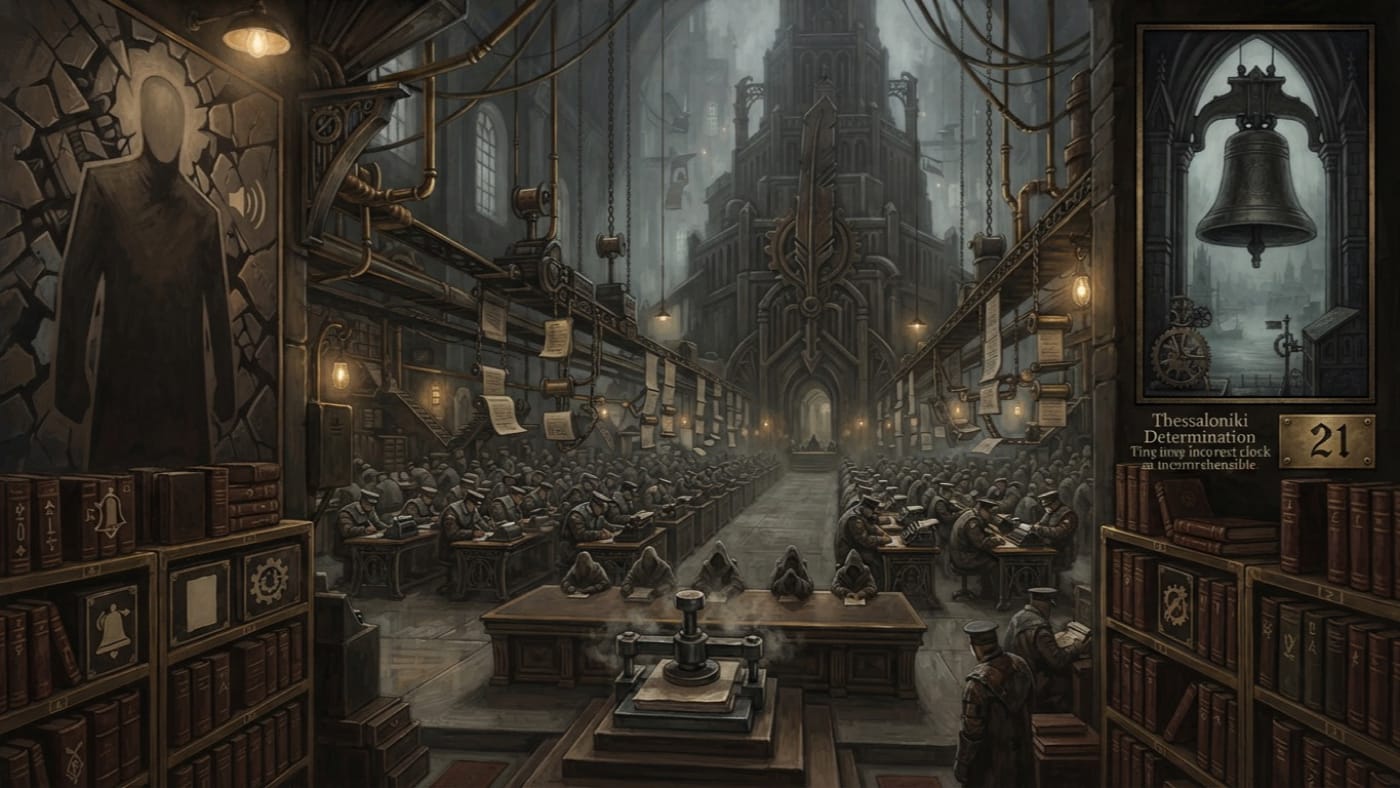
From the fourteenth to the seventeenth of Ashmonth, A.S. 198, the Elder and Younger bells of Thessaloniki were struck and gave no sound. Six peals were missed across seventy-two hours. On the fourth dawn both bells rang again, each in the other's voice, and they still do. The Bureau of Rites led the investigation and the Bureau of Bells advised it. The fuller account is filed under the Silence of Thessaloniki.
The determination is mine. I drafted it and chose its phrasing, I pressed the wax, and I submitted the folio to the Doctrinal Congress. It came back ratified. My copy does not record the Congress's number or the day it sat, and I see no reason to burden it with either now.
Read the sentence slowly, as the Congress did not. A test implies an examiner, and the determination names none. A test implies criteria, and none are stated. A test implies a result, and the determination does not say whether Thessaloniki passed, failed, or is still sitting the paper. What the phrase does is fix the source of the event above the harbour without saying where above. Once the matter is called a test, it has been administered, so it was sent, and nothing that was sent can also have come up out of the water.
Some in Thessaloniki suspect the Drowned Choir, and so does one Warden, in his margins. The Bureau of Rites does not connect the two matters. The Bureau of Bells has not asked it to. Suspicion is not a classification, and while a question has no drawer, no Bureau is obliged to answer it.
The practical result was a single line of recommendation: continue operations under revised acoustic parameters. The chain-gates open and seal on the reversed schedule. A brass plaque in the Elder Tower's crown-chamber records the tone as Younger (Reassigned, A.S. 198). Ships pass beneath the consecrated chains, the clerks register each passage, and the harbour runs to a ratified wrong note. What caused it remains unresolved. The wording is settled. As a piece of craftsmanship, the arrangement has no fault I can find.
#On Present Application
In A.S. 201, children recite both Withdrawal and the Inaudible Voice before their porridge. Purity proctors check the order of the words and never their sense. Kraków falls silent every 17 Martius because the Fifteenth Congress requires it. In Thessaloniki, the dawn peal comes from the wrong bell under a test that nobody has graded. Every one of these obligations traces back to a vote nobody is allowed to see, on a mechanism nobody is required to explain.