
#On the Correction and Its Two Names
In A.S. 150 the Bureau of War corrected Lombardy with water. The War Office filed the action as hydrological pacification. The province, which has never once left a phrase alone, called it the Drowning of Lombardy. The Codex keeps both, as a sacristy keeps the good chalice and the one for Lent. The object of the correction was the Coalition of the Crossed Keys, which had sworn itself to the so-called True Successor of Rome and for a short and expensive season held Como, Milan, and a third city whose name the Bureau keeps under black wax.
The general annals of the Synod say that Lombardy was drowned in blood. That is an annalist's compression, a figure fit for a choir. The War Office account is wetter and duller. It speaks of canals, sluice gates, mill-races, embankments and the branches of the Po. Blood belongs to the sermon. Water belongs to logistics.
The Coalition had preached that Strasbourg stole Rome's inheritance. Sixty years after the Concordat constituted the Synod, Strasbourg answered without a single disputation.
#On a Province Built upon Gates
Lombardy is a ledger written on a flood plain. Its wealth travels by canal: grain barges to Milan, silk bales to the exchange, mill-wheels turning on licensed races, embankments kept up by guild levy and parish labour. The lower quarters of its cities lie a hand's breadth beneath some gate that somebody else controls. The Lombards grew rich on this arrangement and forgot that a gate opens both ways.
The Coalition took that wealth and dressed it as government. Under crossed-key seals it issued warrants, collected grain, appointed officials and printed catechisms. Father Ambrosius of Como supplied the liturgy as preacher, chief celebrant and key-bearer. Merchants supplied money and guild officers supplied ledgers and locks. Clergy and civic notables lent the whole thing the appearance of continuity. Como turned first. Milan's councils swore the Key-Oath in the old exchange. The emblem, one key for Rome and one for conscience, went up on lintels, banners and church doors.
The romance of the rising is filed under the Coalition's own entry. This entry concerns the plumbing.
#On the Opening of the Gates
War arrived with roads, sluices, pontoon companies and confiscated grain. Each answered a particular presumption. The roads answered the Coalition's warrants, since a warrant cannot travel where a War picket stands. The confiscated grain answered its collections: what the counter-administration had gathered in the name of the True Successor was gathered again in the name of the Synod and fed to the men who came to unmake it. The pontoon companies answered the water itself and let the Synod walk dry-shod across a province it was about to wet.
The sappers did the rest. They opened lower vents beneath river crypts. They seized embankment gates and diverted canals through barricaded streets. They broke mills, which ended the milling and freed the races for other work. The obedient branches of the Po were turned toward the quarters that had stopped obeying.
A barricade is an admirable instrument against cavalry. Against a canal it is a dam built by amateurs, and it holds the water in the street its builders meant to defend. Water entered cellars and then churches, chiefly those that had hung crossed-key cloths from their towers. Soldiers went in after it with bayonets, writs and buckets. The bayonet was for resistance and the writ for the record. The bucket was the instrument of correction, whatever the illustrators prefer.
The Codex has no master drawing that joins every sluice to every street, and I will not forge one. The War Office describes its hydraulics by their results. Of Como's lake the account names no gate, and this entry names none either. I have elsewhere compared these officers' methods to the hard lessons of Wrath: fire impresses, water enters. The comparison is mine. No file credits the Great Deceiver with the sluices, and the sappers would resent the suggestion.
#On Milan, Which Held
Milan held longest. It had walls and it had money, and it believed the second would stand in for the first. The Bureau answered with several offices at once, each doing its own work and none trespassing on another's.
War cut the roads. The Bureau of Tithes froze the accounts. A city can endure flooded cellars, but it cannot endure a silk house that may neither pay its weavers nor be paid by its buyers. The Bureau of Purity stood at the fonts and asked each baptised child what emblem hung in the household. A child answers a clerk at a font with the candour of the newly washed. The Bureau of Records copied the answers. The Bureau of Doctrine prepared the explanatory sermon before it was needed.
The order of the cities' falls is not preserved with the precision that pedants want, and I decline to invent one for them. Milan was last of the cities whose names may be printed. That is enough.
#On the Twenty-Seven Crates
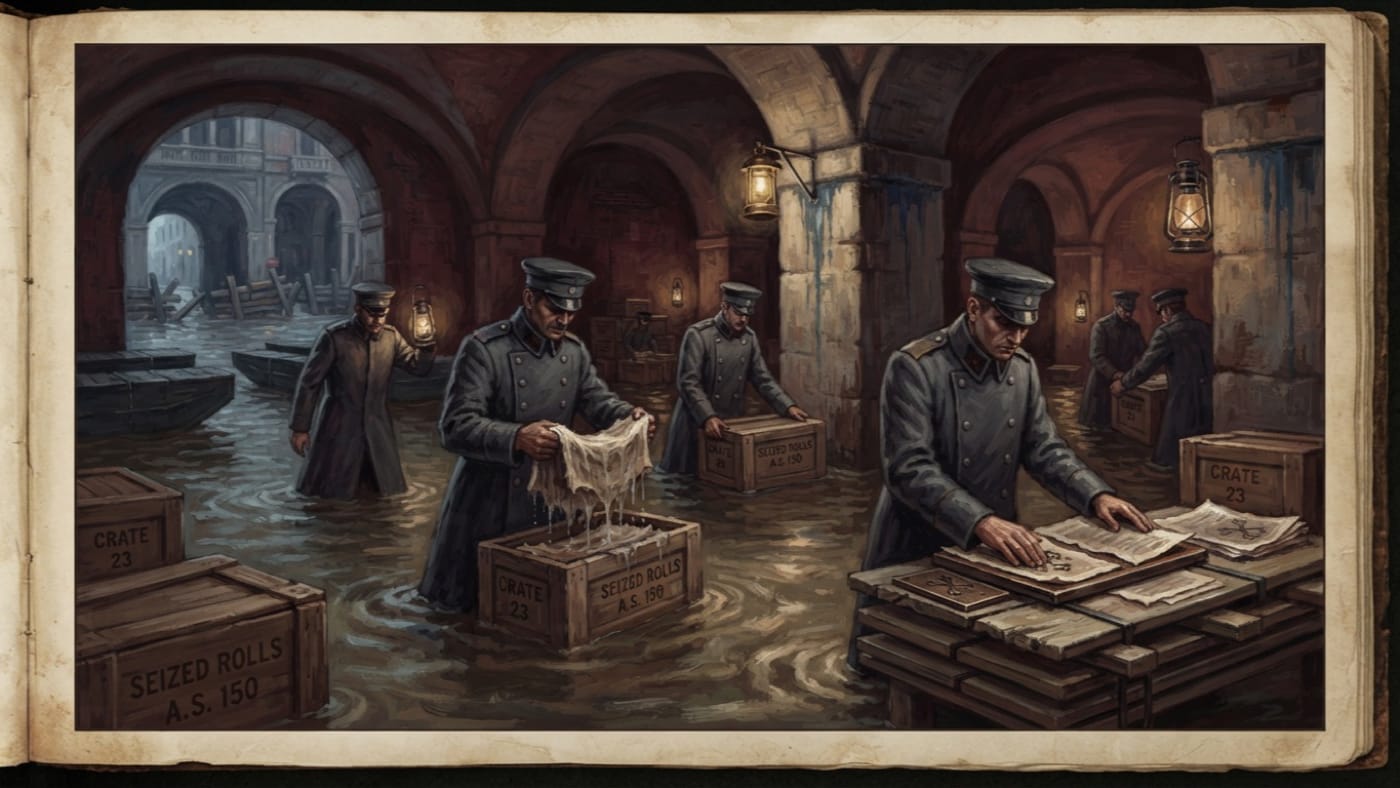
Once the streets had been corrected, Records went down into Milan's municipal undercroft.
The Coalition had kept its paper there: warrants, grain receipts, appointment lists, oath-sheets, the whole administrative vanity of a government that expected to last. The river had reached it first. Records clerks waded in waist-deep through river filth and brought out twenty-seven crates of soaked paper. War officers complained of the smell. The clerks kept working, because clerks know the smell of a ruined ledger is far worse than any river.
The drying was done with what lay to hand, and the materials were well chosen. Wet pages were pressed flat between sermon boards. They were weighted with reliquary plates confiscated from the Coalition's own chapels, so the heresy's ornaments held its paperwork still while the Synod read it. Each identified name was copied twice, once into the punitive register and once into the instructional register. The first served the courts of A.S. 150. The second serves every court since.
I regard the undercroft as the finest hour of the Lombard action, and I say so without having stood in it. I was not there. The registers were, and they have been more reliable company than most witnesses.
#On the Names Kept
The Bureau of Doctrine might have erased the Coalition. Erasure is clean and quiet, and its blank pages pass for peace. Doctrine preserved the Coalition's name instead, along with every participant it could identify, for instruction and for continuing prosecution. A list of heretics makes a poor memorial and a good snare.
The reader will see that the War Office notice calls the rolls complete enough and the preserved names all useful names. Both phrases are exact, and both are honest about what they leave out. Enough is a judgment about the rolls and makes no claim that they are whole. Useful is a category the Bureau sets for itself. Some pages never dried and some names never surfaced. Of the third city the Codex says nothing, and that silence is shared out evenly among all its neighbours. A complete census would have closed the matter. An admittedly incomplete one leaves every Lombard family with an open question about itself, and the province has been answering it with good behaviour for fifty-one years.
A.S. 151 circulars stated that all Coalition symbols had been destroyed.
Corrected. All surrendered symbols were destroyed. All recovered symbols were destroyed. Denied symbols, meaning keys that households swore they had never owned, were entered on a separate schedule and remain there. The circular's error lay in its grammar. Its intent is unaffected.
#On Lombardy Since
In A.S. 201 the waters are back in their licensed channels and the mills turn again. Lombardy is productive, taxed, catechised and watched. The registers made in the undercroft still feed a family of classifications: Ambrosian sympathy, Crossed-Key nostalgia, papalist ornament, local-privilege doctrine, unauthorised Roman devotions, suspicious key imagery, and excessive enthusiasm for lake processions. The list is long because Lombardy was inventive, and the Bureau answers invention with categories.
Milan's children learn the Triune Alphabet with particular severity, as is fitting in a city whose presses once printed catechisms under the wrong seal. Como's lake churches file their bell schedules in duplicate. Every guild key in the province is inspected once a year for devotional geometry, since a key's shape, like a schoolboy's, can lean the wrong way. A crossed key found on a private seal still costs its owner a dinner invitation, a career, and the comfort of a clean family entry.
The Po goes on laying silt over the lower quarters. It does not read, and the Bureau does.