
#On the Name Entered by War
Hydrological pacification is the Bureau of War's name for a method, and it reads like most War Office phrases: two words about plumbing and peace, with nothing in them about the dead. It names what War did to Lombardy in A.S. 150. That year the Coalition of the Crossed Keys declared for the so-called True Successor of Rome. The Synod was then sixty years into its constitutional life under the Concordat of Strasbourg, and it declined to argue the point.
The one action has three names. War entered hydrological pacification in its notices. The Bureau of Doctrine, which keeps the vocabulary of the soul, calls it correction. The province calls it the Drowning of Lombardy, because the province was standing in it at the time. Each name is accurate within its own office.
Readers who want the phrase's pedigree will have to do without. This office has found no charter, council or manual behind it. The Codex dates the term from its first recorded use, which was in Lombardy in A.S. 150. Before that it may have been a sappers' phrase. After that it was in the files.
#On the Province's Works
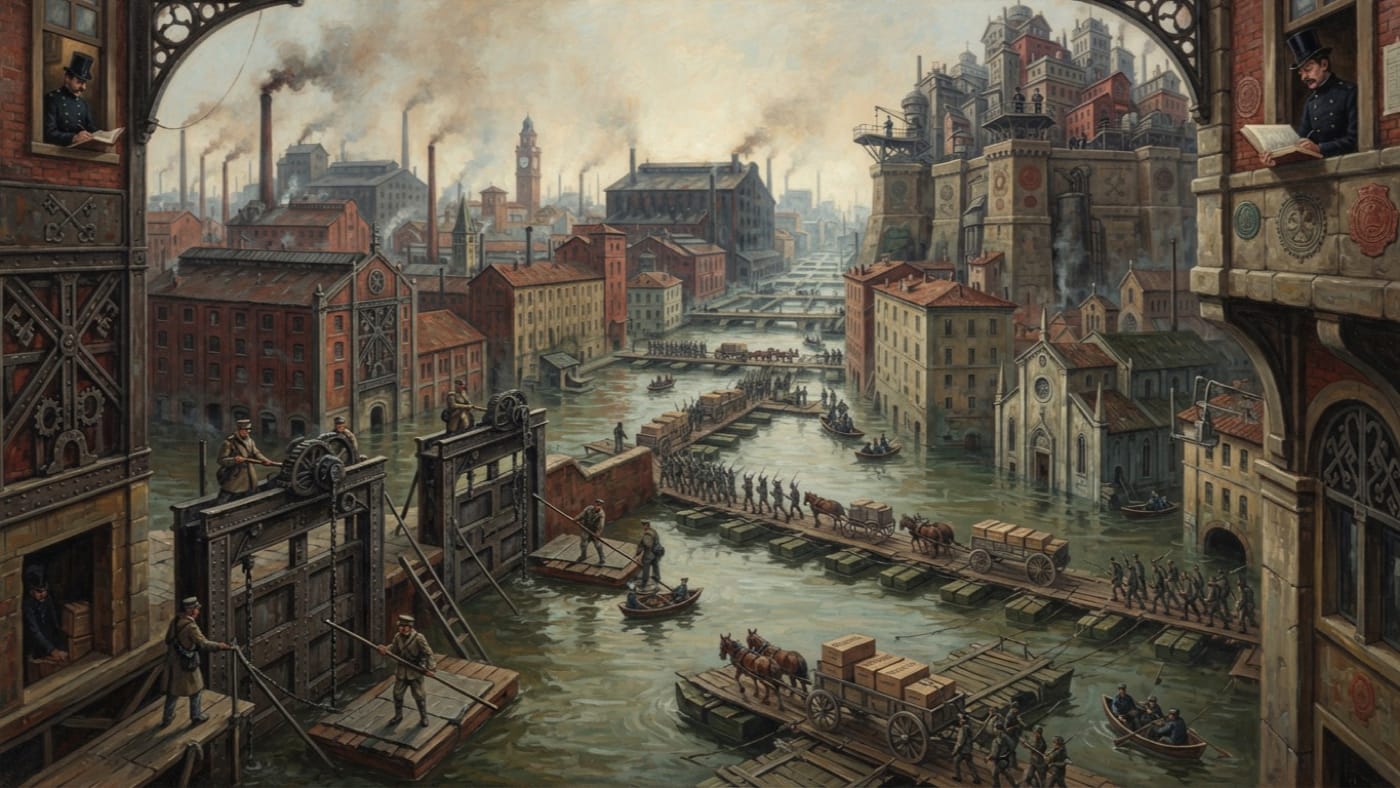
Lombardy keeps its wealth on water. Grain goes to Milan by barge, and silk bales go by barge to the exchange. The mills turn on licensed races. Guild levies and parish labour keep up the embankments. Men with keys open and shut the gates, and the Coalition ought to have found that detail more worrying than it did. Como has its lake, which is wide and deep and does not care about sappers. Milan has canals, and a canal is a lake that has been taught to queue.
The Coalition was a counter-administration more than a mob. Under crossed-key seals it issued road warrants, collected grain, appointed receivers and oath-clerks, and printed catechisms. Father Ambrosius of Como gave it a pulpit and a pair of keys. The merchants gave it money and the guild officers gave it ledgers. Every one of those instruments depended on ordinary public works. A warrant needs a road. A grain collection needs a granary and a barge. A catechism needs a press, a mill to make its paper and a dry cellar to store the copies.
War read the Coalition the way a tax assessor reads a house, starting with the drains. It found a government built on canals, mills and gates that held none of them by any title the Synod recognised. Pacification meant taking back the title.
#On the Gates and the Streets
The Lombard accounts record four instruments: roads, sluices, pontoon companies and confiscated grain. Grandees prefer artillery, which is loud, costly and good for an audience. Two men and a lever can turn a sluice gate, and it gives the illustrators no smoke to paint.
The roads mattered most, even if they did not certainly come first. War cut them. A road warrant under a crossed-key seal is a fine document on a road the Coalition holds. On a road held by a War picket it is a curiosity. Cutting the roads separated the Coalition's paper from its territory and its grain from its cities.
Then the grain changed hands. What the Coalition had collected in the name of the True Successor was confiscated and fed to the column sent to undo it. I find the economy of this pleasing. The rebel granary paid for its own correction, and the receivers who had filled it went in due course onto other lists.
The pontoon companies kept War moving. An army that means to wet a province has to stay mobile itself, and pontoons carried the Synod's columns across the water they were managing.
After that came the sappers. The accounts record that they seized embankment gates, diverted canals through barricaded streets, opened lower vents beneath river crypts and broke mills. They also used the branches of the Po in the correction. A barricade built to stop horses becomes a dam when a canal is turned against it, and it holds the water in the very street its builders meant to defend. Water got into cellars. It got into churches too, especially the ones that had hung crossed-key cloths. The soldiers who followed it in carried bayonets, writs and buckets. The bayonet was for resistance and the writ named the premises. The bucket did the confessional work, which is badly underrated. It sounded cellars and emptied crypts until whatever had been hidden in them lay in the open where a clerk could count it.
I give no sequence and no water level, and I name no gate. No master drawing links every branch of the Po to every Milanese street. The account of Como names no flood of its own. The method is recorded only by its results, and I am content to leave it that way.
#On the Offices Beside the Water
Water by itself would only have made Milan damp. What made Milan obedient was the work of several offices alongside it.
Of the cities whose names may be printed, Milan held out longest. It had walls and it had money, and it seems to have expected the money to do the walls' job. War cut its roads. The Bureau of Tithes froze its accounts. A silk house that can neither pay its weavers nor collect from its buyers learns the limits of magnificence faster than any garrison could teach it.
The Bureau of Purity stood at the fonts and asked the baptised children about the emblems that hung in their households. Children are the least disciplined witnesses in any city, which makes them the most useful. The Bureau of Records copied down what the children said. Doctrine had the sermon explaining all this ready before it was needed. Doctrine also kept the Coalition's name, so that it could be used for instruction and prosecution.
I do not claim the offices loved one another during the action, and they do not love one another now. Rivalry between the Bureaus is a permanent condition, like the damp in Milan's lower quarters, and it did not stop the work. Each office used its own instrument and kept its own ledger. The spring took care of the flooded streets. A frozen account and a child's answer copied into a register have lasted much longer.
#On the Paper Preserved
If pacification had ended when the water went down, it would have been an episode. A cellar made it an institution.
The Coalition kept its paperwork in Milan's municipal undercroft, and the river reached it first. Records recovered twenty-seven crates of soaked paper. The clerks dried the pages between sermon boards, weighted them with confiscated reliquary plates, and copied every name they could read into two registers. The punitive register served the courts. The instructional register serves everyone who came after. The full story of the recovery is told under the Crossed Keys Roll, and I will not wade through it twice.
Two points bear on the method. The first is the number. Twenty-seven is a count of crates. It does not count rebels, deaths, volumes or pages. A reader who multiplies it by a guess should take the result to the river, which keeps its own figures and publishes none.
The second is completeness. War's notice called the rolls complete enough and the preserved names all useful names. Neither phrase claims to be a census. Some pages never dried and some names never surfaced. The third city's register is sealed along with the city. For pacification, an incomplete roll works better than a complete one, because a complete list would tell every family left off it that it was safe.
This is where the water handed the work over to the ink. The flood found the papers, and the papers found the families.
The circular of A.S. 151 stated that all symbols of the Coalition had been destroyed.
Corrected. Surrendered symbols were destroyed, and so were recovered ones. Symbols that a household denied owning went onto a separate schedule, and that schedule is still open. The circular's grammar got ahead of its facts. A denied key cannot be confiscated, which makes it the most durable object in Lombardy.
#On Continuing Correction
It is now A.S. 201, fifty-one years later. The canals run in their licensed channels, the mills turn, and Lombardy pays its tithes and ships its silk. The files record one Lombard flooding. Everything since has been done with dry instruments.
The instructional register gave rise to a whole family of classifications: Ambrosian sympathy, Crossed-Key nostalgia, papalist ornament, local-privilege doctrine, unauthorised Roman devotions, suspicious key imagery and excessive enthusiasm for lake processions. Guild keys are inspected every year for devotional geometry. Como's lake churches file their bell schedules in duplicate. None of this needs a sluice. It needs a clerk who has a register and a reason to open it.
Milan's children learn the Triune Alphabet with particular severity. Enforcement of the Alphabet began in A.S. 178, twenty-eight years after the water, under its own instruments. It was never a clause of the Lombard action. It simply arrived in a city that the registers had already marked out for strict instruction.
As for the Coalition's founding vanity, the claim that Lombardy could govern itself under its own keys: that question was settled in A.S. 150, and it has been inspected every year since.