

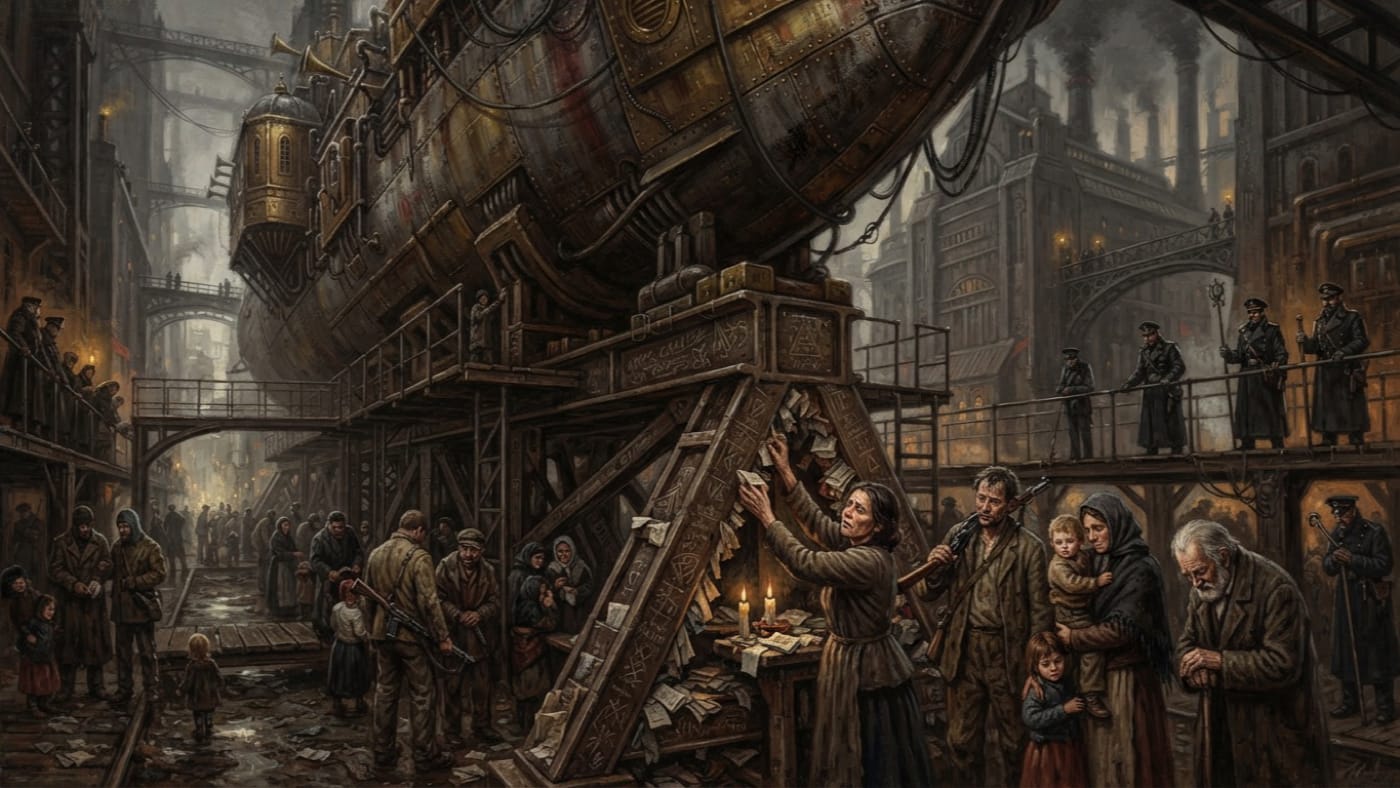
#On the Parish Beneath the Cradle
Surveyed A.S. 201. That year dates this inspection and nothing else. The practice described here has no founding year on file.
The Vigil Ark of Saint Uriel rests in its cradle in the Carrier Yard of the Foundry Quarter, Bastion-Constantinople. Its chapel-gondola hangs above the heads of people who were never meant to stand under it. A vessel in the sky belongs to crews, horns, weather and distant officers with good boots. A vessel in drydock belongs to whoever walks beneath it on the way to the next shift, and in the Foundry Quarter that is a great many people, most of them tired and some of them bereaved.
The files call what goes on down there the Drydock Cult. The name is a convenience of the index, and it is too large for the thing it labels. Nobody has turned up a rule, a superior, a habit, a roll of members, or a founder whose bones Relics could sell back to the Synod at a markup. There is a cradle, and there are papers folded into it.
#On the Origin in Polish and Grease
It began as maintenance Mass. A grounded Ark must still be kept in readiness, because the Bureau of War will not concede that its southern guardian is grounded for good and the Bureau of Engineering has certified that nothing in it is broken. The vessel has made four attempts at ascent and achieved no true flight. Its upkeep goes on regardless. Brass must be polished, cables inspected, winches oiled, Sermon-horns tested against the gulls, and chapel air recited over so that the consecration does not go stale while the Southern Bellway waits in red ink.
Rite said often enough beside a failure starts to sound like a conversation. The men who kept the Ark began to talk to it, or to the tooth inside it, or to the saint whose name the tooth carries. Relics has never settled which of the three is listening. The relic is an upper molar, authenticated, angelic class uncertain, attribution to Saint Uriel probable. Its behaviour remains unresolved, and this survey leaves it that way.
No one wrote down the first petition. No clerk saw it go in, no guard reported it, no artificer will admit to being the first to look away. The survey can't supply that date and won't make one up.
Cross-references filed under the Saint Uriel dossier carried that dossier's A.S. 191 dateline into entries on the drydock petitions.
Corrected. A.S. 191 is the year the Ark was authorised and the Marseille tooth transferred. It is not the beginning of the petitions. No beginning has been established.
#On the Petitioners and Their Requests
The people under the cradle are the people the Carrier Yard already employs, buries or forgets. Workers pass beneath the vessel daily and leave paper on the way. Widows know which guard can be bought with bread. Children slip folded slips through the cradle struts at a height no officer would think to check. Artificers polish brass a hand's breadth from the names scratched into the paint and keep their eyes on the brass.
Their requests are plain. Safe shifts. Healed burns. Debts forgiven. Sons found. Transfers granted. Husbands returned from the sublevels, where the Foundry eats names before breakfast. None of them asks for the Ark to fly. That petition belongs to the officers, and the officers file it through other channels.
The cradle paint is the record nobody approved. It is cut with names, warning marks, route diagrams and children's teeth. It also carries one sketch of the southern Bellway marking three points that War refuses to identify. I record its existence and nothing more, since its maker's sources are not on file and War's reasons are not mine to publish.
The artificers say that taking the petitions out would damage the cradle paint. This is a lie, but an affectionate one, and I have signed off on worse lies with less charity. The paint has been carved into a palimpsest already. One more scraping would hardly be noticed. A removal order, on the other hand, would be noticed by every pair of hands that keeps the Ark consecrated, polished and insured.
The dockyard reading of the saint is its own business, and I give it as the dockyard's. Uriel's older name belongs to warning and to messages that arrive before mercy does. The workers take him for the patron of messages that can't go through the proper office: the transfer the foreman refused, the missing man the roster stopped counting. A grounded Ark is still an Ark, they say. A silent horn is still a throat. Those are their words. I find them better theology than several sermons I have approved.
#On the Bureau's Two Classifications
The Bureau of Purity first classified the practice in A.S. 194 as dockyard sentiment, low risk. The phrase did no harm. It let the petitions go on and let Purity say it had looked.
The account entered for A.S. 197 changed the file. A furnace widow got an answer on the back of her own petition, written in her own hand, though she could not write: He is below the third grate. Her husband was found under Sub-Level Two, folded into a drainage space too narrow for a proper corpse. Purity amended the classification to monitored. Relics confiscated the paper. The widow kept the memory, which is harder to seize unless one pays for more expensive methods.
The file does not say who wrote the answer. It does not say how the widow's hand came to form letters it had never learned, or whether the hand was hers at all, or what the tooth was doing at the time. Doctrine has issued no ruling. The widow says the saint answered. Purity says the matter is monitored. Relics says the paper is in custody. I report all three positions at equal volume, because none of them has been proven.
One answer is recorded. No second is on file. The survey found petitions in pencil, grease, blood and dockyard spelling, and found no certified outcome for any of them. Anyone who folds a slip into the struts expecting a reply is expecting something the Synod has never guaranteed and the saint has never promised. They fold the slips anyway. The Synod can't regulate that habit, and I have stopped advising it to try.
Earlier maintenance summaries stated that civilian devotional activity around the Saint Uriel ceased after Bureau of Purity review in A.S. 194.
Corrected. The activity went on, changed its vocabulary, and moved under the work platforms. The review did not stop it. It taught it where to hide.
#On Present Handling and Official Suspicion
As of this survey, Saint Uriel may be invoked under warning and aerial-prudence forms: in matters of warning, aerial uncertainty, messenger delay, dockyard danger and unresolved ascent. That permission covers devotion to the saint. It does not charter the people under the cradle as a body, and the Bureau of Doctrine would like that difference read slowly. A widow may call on Uriel. A widow may not thereby become an order.
The difficulty is practical. The Ark needs constant maintenance, maintenance needs hands, and the hands belong to the very people who leave the petitions. A clearance of the cradle would cost the Yard its peace and the Ark its keepers in a single morning. So the petitions are watched rather than cleared. Purity keeps its file open. Relics keeps its paper. The artificers keep their excuse about the paint. War keeps a red slash on the daily board and does not ask what the workers are asking for underneath it.
The officers invoke Uriel upward, for lift, patrol and a finished Bellway. The dockyard invokes him downward: warn, locate, hold, keep the cradle from falling, keep the missing from staying missing. The tooth stays where workers can reach it and officers can't use it. Whether it prefers this is a question for Relics, and Relics has said that the relic's behaviour is the relic's own concern.
The Ark is sound and the tooth is genuine. The petitions go on.