
#On the Southern Yard
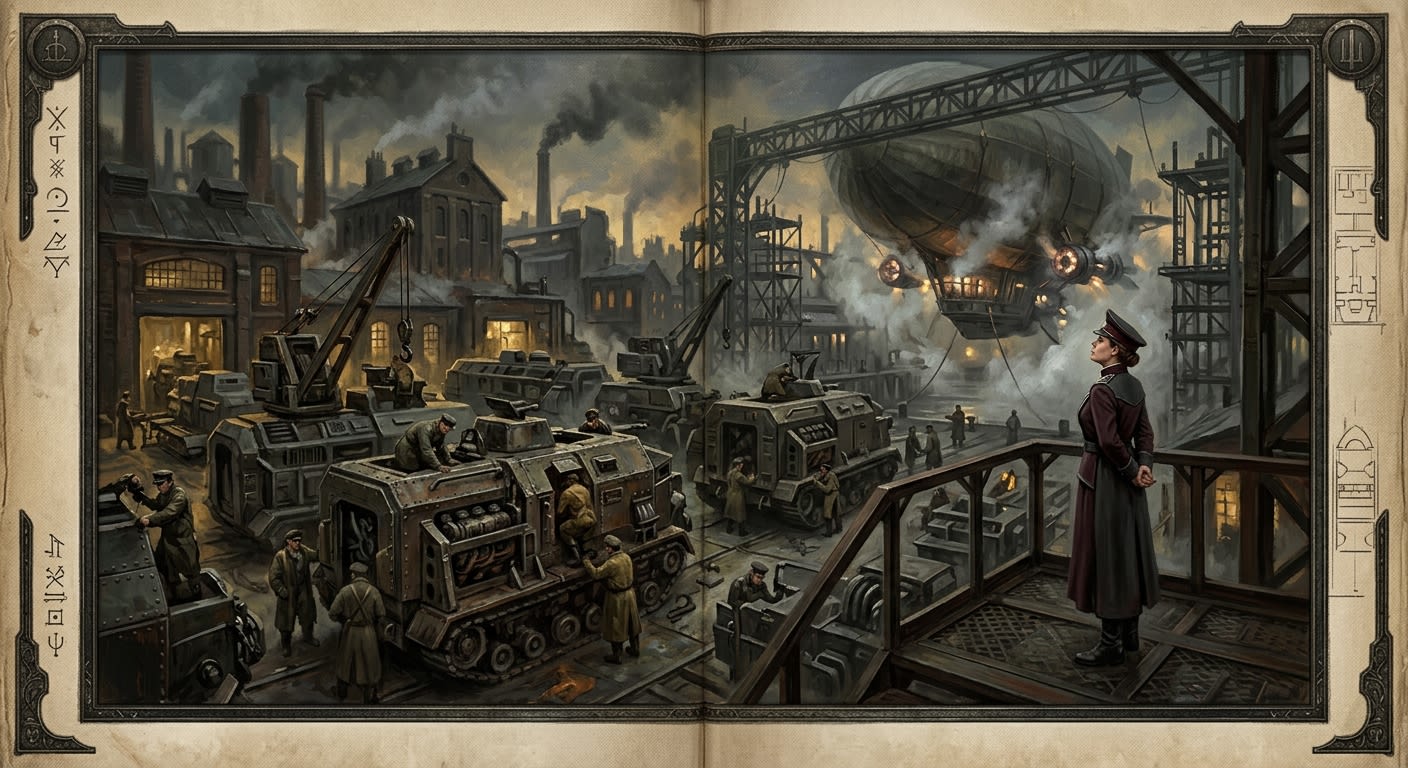
The Carrier Yard occupies the southern strip of the Foundry Quarter in Bastion-Constantinople, pressed between the Ossuary Rings and the Harbor of Chains, where the fortress-city permits iron to become doctrine under smoke thick enough to sign. It is yard, drydock, cradle, repair court, proof apron, ossuary store, labour barracks, rail spur, hymn shed, punishment detail, and one of the few places in the Synod where a man may watch a cathedral learn to crawl.
The official map gives the Carrier Yard a clean rectangle along the waterfront. Official maps are devotional literature for clerks. The actual Yard bulges around old quay walls, dives under forge galleries, climbs over shell stores, narrows beside Saint Vulcan’s chapel annex, and ends at piers whose numbering no longer agrees with distance, use, or sanity. Iron treads score the stone in parallel scars. Chain cranes hang above assembly berths like patient gallows. The air tastes of coal, hot wax, bone dust, salt, and the particular coppery flavour that follows any workshop where men have stopped asking whether the metal should be warm when no furnace is lit.
Here the Catacomb-Carriers are assembled. Here the grounded Vigil Ark of Saint Uriel sulks in drydock. Here the Order of the Shackled Flame takes delivery of housings that Engineering calls incomplete until the Order wakes them and Doctrine calls complete once no one dares inspect the interior.
#On the Making of a Crawling Cathedral
A Catacomb-Carrier begins in pieces, which is the last innocent state it will ever enjoy. Plate arrives by quay under War seal. Tread links arrive by rail, each stamped twice because the first stamp is for inventory and the second for fear. Saint-bone arrives in locked ossuary tins from the Bureau of Relics, certified by provenance, weight, and the willingness of the clerk to meet one’s eye while charging for dust. Powder and black-capped canisters come under guard. Shield-saint mantlets arrive wrapped in grey cloth. Hymn-speaker ribs arrive singing faintly in wet weather, an event Engineering attributes to contraction and the workers attribute to bad manners.
The assembly floor is divided into five strips: plate, tread, reliquary, hymn, and housing. Workers call them Skin, Feet, Bone, Mouth, and the Pit. Workshop slang is crude because truth is crude before a Bureau teaches it posture.
The Bureau of Engineering supplies drawings, gauges, rivet tables, pressure tolerances, and the soothing superstition that measurement washes blood from function. The Shackled Flame supplies the inner housing. Those housings arrive from below on chain lifts at hours selected by no visible schedule. They are iron cylinders, reliquary-banded, wax-choked, cold enough to frost in summer and sometimes warm enough to burn gloves in winter. No one jokes while they pass.
A Yard primer once described the Catacomb-Carrier as “a product of Engineering design and War necessity.”
Corrected. Engineering draws the shell. War demands the result. Relics fattens the conscience. The Shackled Flame puts something inside. The Yard exists because those four truths cannot be printed on a procurement placard without upsetting the children.
The first named carrier, Threnody, was commissioned in A.S. 145 from this Yard or its earlier, meaner ancestor. Older berths remain under the new stone: filled inspection pits, sealed oil drains, a rail notch covered by prayer tile, and the old Canticle rack whose hooks no longer match any authorised hymnal. The workers touch that rack before first ignition. They deny it when asked. Sensible men often preserve themselves by lying to superiors about small pieties.
#On Threnody’s Berth and the Seventh Pier
Threnody is the Yard’s senior embarrassment. She has thirty-seven engagements on record, Belgrade service, Macedonian corridor defence, survival through the Three-Night Bombard, and an eleven-year maintenance berth at Pier Seven of the Harbor of Chains, where mooring fees are paid quarterly by an account old enough to smell of obsolete ink. Her crew is listed as intact. The supplement is missing. Her ration invoices continue with the cheerful cruelty of documents that have no obligation to make sense.
Pier Seven belongs to the harbour registry, but Threnody belongs to the Yard in habit, tool, invoice, and fear. Mechanics cross from Yard to pier at dawn with oil carts and throat lozenges. Reliquary custodians carry seal kits. A damage clerk walks behind them with a slate that has held the same heading for eleven years: routine maintenance. Routine, in this context, means the machinery has not killed enough people this week to require a new noun.
The barnacles on her lower housings offend every category. A land engine does not acquire marine life unless the sea has touched it, the engine has entered the sea, or nature has begun accepting bribes from machinery. Yard mechanics scraped the growth twice. It returned in seven days, denser near rivet seams that pulse during harbour bells. Relics declined authentication. Engineering declined curiosity. War declined interruption. Doctrine, being staffed by men of taste and dread, filed the photographs in a cabinet I have not opened since the last paper cut bled black.
The maintenance logs use “voice” in quotation marks forty-two times across the sealed sequence. Quotation marks do little work against acoustics. On damp mornings, Yard boys claim Threnody hums along with the gantry chains before any worker enters her. Yard boys also claim the best tobacco is hidden behind Pump House Three, so their testimony has mixed value. Still: the gantry chains hum first.
#On the Bombard and the Rebuilt Wound
The Carrier Yard was gutted in A.S. 177 when Velmora’s purchased failures opened the Foundry Quarter for three nights. Powder caches along the Proof Road detonated in sequence. Maldrake’s opportunistic shelling found the northern ravelins while the Quarter burned behind its own walls. The harbour wall cracked for two hundred metres. Four Catacomb-Carrier engines were lost with their ribs open and hymn-speakers pulsing without sound.
By dawn after the third night, the Yard was a field of twisted treads, cooling saint-mortar, split plates, drowned cranes, and men carrying hands that were no longer attached to anyone needing them. Harbormaster Joram Clee recorded certain vessels as temporarily absent. Records accepted the phrase. It is a mercy to have a harbormaster whose lies arrive dressed for court.
Public reconstruction broadsheets described the Carrier Yard as “restored to former capacity” in A.S. 179.
Corrected. It was restored to greater hunger. The Yard returned with deeper chain pits, heavier berths, reinforced housing lifts, additional hymn-lock stations, and sub-level access that did not exist on pre-Bombard plans. Catastrophe is the Synod’s preferred architect.
The reconstruction received four certifications. First: emergency shell press operation. Second: structural safety in the Carrier Yard. Third: doctrinal cleanliness of the Shackled Flame Workshops, a claim history later answered by scorching its name into a wall. Fourth: full restoration to pre-Bombard capacity. The fourth certification did not mention the two additional levels beneath the Yard. Omission is a seal with manners.
#On the Grounded Ark at the Eastern End
At the eastern end of the Carrier Yard sits the Saint Uriel, fully assembled, fully consecrated, fully maintained, and fully grounded. The phrase has acquired liturgical cadence among the clerks. Fully assembled. Fully consecrated. Fully maintained. Grounded. One can hear the little collapse at the end, like a choirboy discovering gravity.
The Ark was authorised in A.S. 191 for the southern Bellway. Its hull is sound. Its envelope held pressure. Its chapel was consecrated. Compound 7 behaved. The tooth attributed to Saint Uriel, purchased from Marseille and authenticated with costly terror, refused lift on four attempts. The fourth attempt rose to mast-height, rang every Yard bell without contact, and descended with the dignity of a judge leaving a room that has disappointed him.
The drydock was built for harbour patrol hulls and modified for aerial apparatus by men whose drawings still refer to “temporary cradle adaptation.” Temporary adaptations in the Synod are like temporary taxes: they become architectural facts by exhausting everyone who remembers the original promise. The cradle struts now carry petitions from workers, widows, furnace boys, coil-winders, shell washers, and one anonymous hand that keeps drawing the southern Bellway with three forbidden points marked in red.
The Bureau of Purity declared the dockyard petition cult low risk in A.S. 194. In A.S. 197, a widow’s petition answered itself in her own illiterate hand and named the third grate under which her husband’s softened body lay folded. The classification became monitored. The workers stopped calling the Ark useless after that. They call it listening.
URIEL DRYDOCK PETITION REVIEW — A.S. 197 Petition hand: widow’s thumb-mark, no literacy record. Reverse inscription: “He is below the third grate.” Body recovered: beneath Sub-Level Two drainage grate, bone state inconsistent with aperture. Additional marks under cradle: ███████████████. Instruction: leave petitions in place pending further holiness or evidence.
The southern sky remains unsanctified by Uriel. The Yard maintains the Ark anyway, oiling winches, polishing brass, testing Sermon-horns against gulls and harbour smoke, replacing ropes that have carried no storm-load. Habit is a form of obedience. It is also a way to keep a refusal visible.
#On Labour, Bells, and Safety Forms
Nine thousand souls work the Foundry Quarter; the Carrier Yard consumes the loudest portion. Plate teams, tread men, ossuary mixers, riveters, crane crews, canticle chalkers, coil girls, oil boys, damage clerks, Yard chaplains, Relics witnesses, War overseers, Engineering inspectors, and Shackled Flame couriers who speak little because their masks have trained them. They live in barracks along the Proof Road and tenements against the harbour wall, where laundry dries grey and children learn to sleep through hammering before they learn their letters.
The Yard day begins with a bell that sounds wrong in the teeth. Workers assemble by strip. Chaplains bless the tools. Foremen read casualty corrections from the prior shift if any correction has survived Records review. The first crane moves at Prime. The first injury usually precedes Terce. The first argument over whether an injury is industrial, devotional, disciplinary, or pre-existing follows with admirable punctuality.
Safety forms exist. I mention this to honour comedy. Every worker entering a housing berth signs Form 19-K, acknowledging risks including heat, pressure, bone dust, falling plate, hymn rupture, relic agitation, unexpected ignition, “motive noncompliance,” and spiritual disquiet. The last phrase has killed more men than falling plate, though plate at least has the courtesy to land in one place.
The Yard bells govern movement. One bell freezes cranes. Two bells clear the floor. Three bells summon Relics. Four bells summon War. Five bells summon the Shackled Flame and send everyone else outside unless chained by rank, injury, or stupidity. A sixth bell is not listed on public charts. Workers have heard it twice since A.S. 198. Both times, the lower lifts came up empty and warm.
#On the Present Yard
As of A.S. 201, the Carrier Yard remains active under War custody, Engineering measurement, Relics supply, Shackled Flame appetite, Doctrine’s blessing, Purity’s postponed disgust, and the simple fact that Constantinople cannot afford purity when engines are needed. New hull work continues on Berth Four. Berth Two holds a reconstruction-pattern carrier with its hymn ribs exposed. Pier Seven remains occupied by Threnody. The Uriel drydock remains lit at night because work does not require it, and because no one likes what the Ark looks like in darkness.
Replacement parts remain scarce after the Bombard, trained crews scarcer, unburned artificers scarcer still. The Hintermark sends iron, men, and sealed containers marked sanctifiedite, industrial grade, which descend toward levels where no Purity inspector has placed a clean boot since A.S. 192. Arch-Artificer Lute Brann’s requisitions pass faster than medicine and slower than fear.
At dusk, chalkers draw the first restraint hymn along a new carrier’s flank. The chalk dust clings to rivets. The Yard cranes settle. The Uriel petitions stir in harbour wind. From Pier Seven, or below it, or under the stone where the Yard’s old drains remember fire, something hums before the bells begin.