

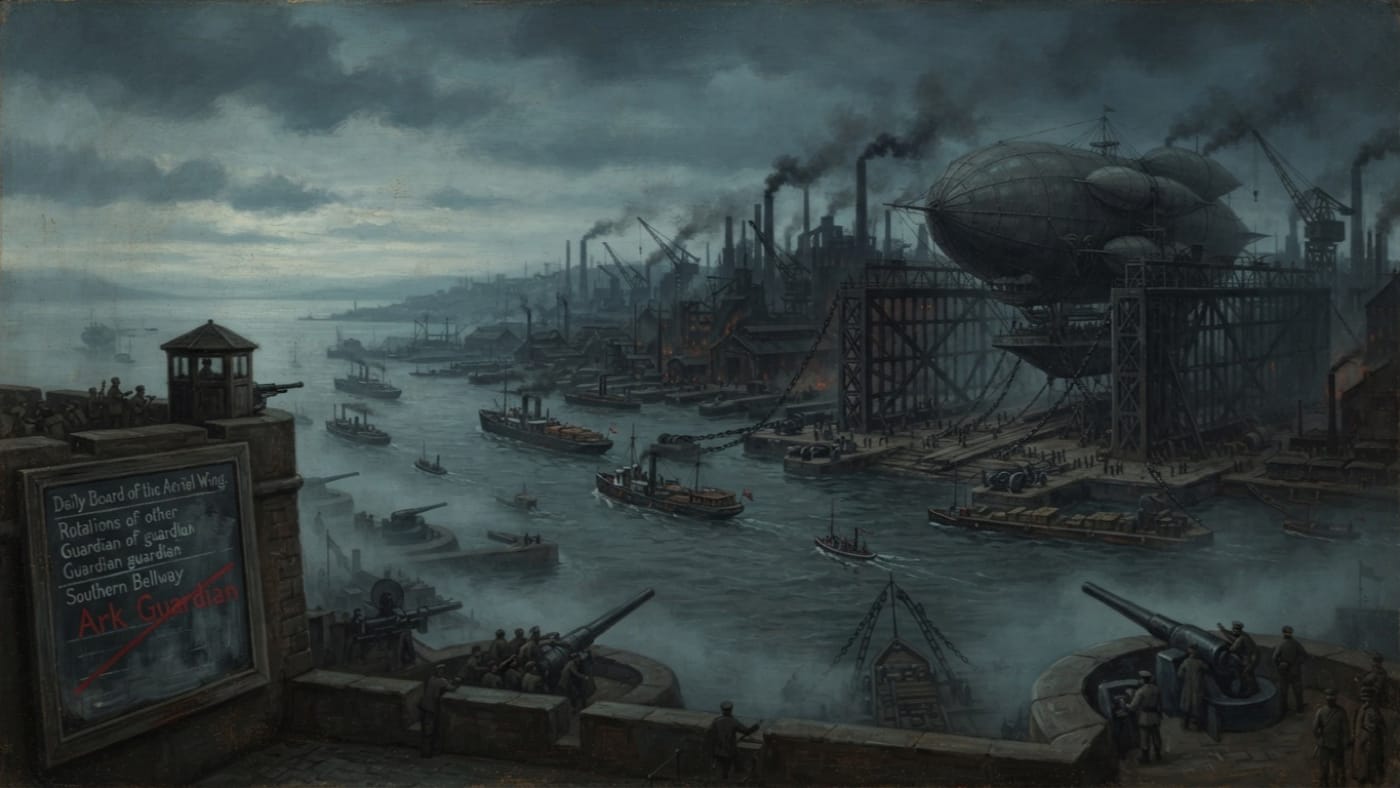
#On the Assigned Corridor
The Southern Bellway is a band of sky over the southern approaches of Bastion-Constantinople. The Bureau of War assigned it to a Vigil Ark that has never taken possession of it. The corridor is on the chart and on the sermon schedule. Most stubbornly of all, it is on the daily board of the Aerial Wing, where a clerk writes the name of its guardian each dawn in red ink and strikes it through with a single diagonal before the ink is dry.
Constantinople is the southern anchor of the Sagittal Line, the last lock at the Bosphorus, where the Line runs out of land and the sea closes both flanks. Its enemies press from the north across Thrace and from the northeast down the Black Sea lane. Its shells, flour and replacement men come mostly from the other direction, up from the Aegean by coastal lane and harbour road. The Southern Bellway was drawn over that side, the side that feeds the city. It was meant to keep the southern flank's air sanctified while the cargo passed underneath.
The corridor has an assignment, a purpose and a name. It does not have the Ark.
#On the Passage Toward the Aegean
In the Church's military vocabulary the word Bellway means two different things, and the confusion has cost a good deal of ink. On the ground, a Bellway is a peal-net: tower answering tower, the First Peal for stand-to and the Ninth for curfew fog, with command carried in bronze from sector to sector. In the high air, a Bellway is a corridor along which Vigil Arks pass with their sermon-horns open, laying sky-sermons over trench, wall and water. The Southern Bellway is the second kind. Its bells were meant to hang from an envelope.
The course runs from the Bosphorus mouth toward the Aegean approaches. I give no length, because the Bureau of War has given me none in any document released to my office, and I will not measure a corridor by the stride of a vessel that has never walked it. I give no width, ceiling or waypoints either. The chart shows a strip of pale blue wash with a saint's name lettered along it in a careful hand. Where the strip ends the hand grows less careful, which I take to mean the draughtsman did not know either.
Under the strip go the coastal convoys. They carry shell-cases packed in straw, relic-crates sealed in lead, flour in tarred sacks, lamp-oil and drafts of young men who were told at the embarkation quay that the southern water is the safe water. Around them work the harbour pilots, the chain-crews and the boom-wardens who haul the great links across the harbour mouth at dusk and stand on them at dawn. The corridor was drawn for these people. They look up more than anyone else in the city.
Elsewhere on the Line, the high Bellways are watched by beacon chains: towers strung with relic-lanterns and lit in sequence when Abominations stir. The files released to me do not say whether the Southern Bellway has such a chain, how many towers it would number or who would freeze in them. I will not supply stations from my own imagination. A corridor that cannot produce its own Ark should not be expected to produce lanterns because a historian asks for them.
#On the Guardian in Drydock
The Vigil Ark of Saint Uriel was authorised in A.S. 191 as the southern complement to the Saint Barachiel above the strait and the Saint Gabriel above the Black Sea approach. With it, the city would have had three guardians covering three directions. It was assembled at the Carrier Yard in the Foundry Quarter, consecrated there and maintained there. It remains there.
Its relic is a tooth attributed to Saint Uriel. It was purchased from a dealer in Marseille and authenticated by the Bureau of Relics. The Bureau of Engineering certified the hull as sound. The Bureau of Rites certified the consecration as valid. Every office entitled to a seal applied one, and the seals agree with each other on every point except the one the Bureau of War paid for.
There were four launch attempts. On some of them the Ark rose a few feet, considered the matter and settled back into its cradle. On none did it hold the air long enough to be entered on a patrol return. Dockyard men who say the Saint Uriel never lifted are wrong, and the artificers correct them sharply, because the artificers have their trim tables to defend. Dockyard men who say it never patrolled are right, and nobody corrects them. The fourth attempt was made in A.S. 191. Its operational classification has been pending indefinitely ever since.
I will not argue the tooth's case here. It has its own file, its own cradle and its own drift of petitions under the struts. The corridor's interest in the tooth is narrow. Authentication certifies what a relic is. The Southern Bellway needed a certificate of what the relic would do, and no Bureau issues that form.
Dockyard summaries circulating in the Foundry Quarter attributed the* Saint Uriel*'s grounding to a counterfeit tooth and to a Marseille transaction compromised by agents of Velmora.
Withdrawn. A Bureau of Purity examination found no Velmoran signature on the relic. The tooth is genuine. The rumour has been retired with nothing to replace it, and the dockyard finds the empty space harder to live with than the rumour ever was.
#On the Work Around the Gap
The Bureau of War does not concede that there is a gap. It funds measures to fill one. These are separate activities and are budgeted separately.
The ground guns of the southern harbour defences cover what they can reach: the water close in, and a cone of fog above it as far as a gunlayer can see. Naval patrols work the coastal lanes. When the wind permits, the Bureau of Bells extends the Saint Barachiel's sermons southward, stretching a strait-guardian's voice over water it was never assigned to bless. When the wind sits wrong, the extension is struck from the schedule. The southern lanes then have their harbour bells and nothing above them.
None of this is a patrol. A gun answers what it sees and a cutter answers what it meets. A borrowed sermon arrives on the wind's terms and leaves on them too. The Ark was meant to pass along the corridor on a fixed schedule whether or not anything had yet come out of the fog to justify the trip. That routine is the thing the south has gone without.
The published account of the Saint Uriel records what has followed. Demonic skiffs test the southern fog more often. Convoy captains ask for northern routing even when the northern water is the worse water. A captain who picks the worse sea has filed their opinion of the corridor more plainly than any memorandum I have read, and has had to sign for every crate in the hold while doing it.
The Black Sea Reliquary Flotilla is moored in the Black Sea, behind its own chain curtain, with its own saints. It is a maritime body and does no aerial work. The same account still reports that when the southern patrol gap lengthens beyond six days, the Flotilla sends chain-saints to reinforce its outer lashings. Six days is the point at which the Flotilla's people stop trusting the south. It is no patrol cycle, and the Saint Uriel does not rise on the seventh. The account does not say when the count of six days begins. I put the question to a clerk, who counted on his fingers, reached four and stopped to consult a superior. I am still waiting for the remainder.
Constantinople's assigned adversaries are Kargath, who rots supply and presses down the Black Sea lane, and Maldrake, whose furnaces stand in Thrace to the north. Both have reasons to want the city's southern lungs squeezed shut. No document I have seen assigns the southern skiffs to either of them, and none connects either of them to the Ark on its blocks. I record the skiffs as skiffs. The chain-crews call them other things, all unprintable and all more precise than mine.
#On the Present Assignment
The daily board hangs in the Aerial Wing. It is a long slate ruled in white, with a line for each aerial guardian of the Constantinople theatre. The Saint Barachiel's line changes with the weather. The Saint Gabriel's line changes with its rotation. The Saint Uriel's line does not change. Each dawn the clerk wets the slate, writes the name in red, draws the diagonal and goes to breakfast. He has done this long enough that the stroke no longer wavers. I watched him once. He did not look at the board while he struck it.
Below the board, out in the harbour, the arrangements carry on. The boom-wardens haul the chain at dusk. The pilots bring convoys in under a strip of sky that is charted, scheduled, assigned and empty of any sermon written for it. The gunlayers watch the fog. Barachiel's voice reaches south when the wind allows it. The cause of the grounding is still unexplained. The Bureaus have stopped offering explanations and the dockyard has stopped asking for them.
The column for tomorrow is already ruled.