
#On the Ark That Does Not Rise
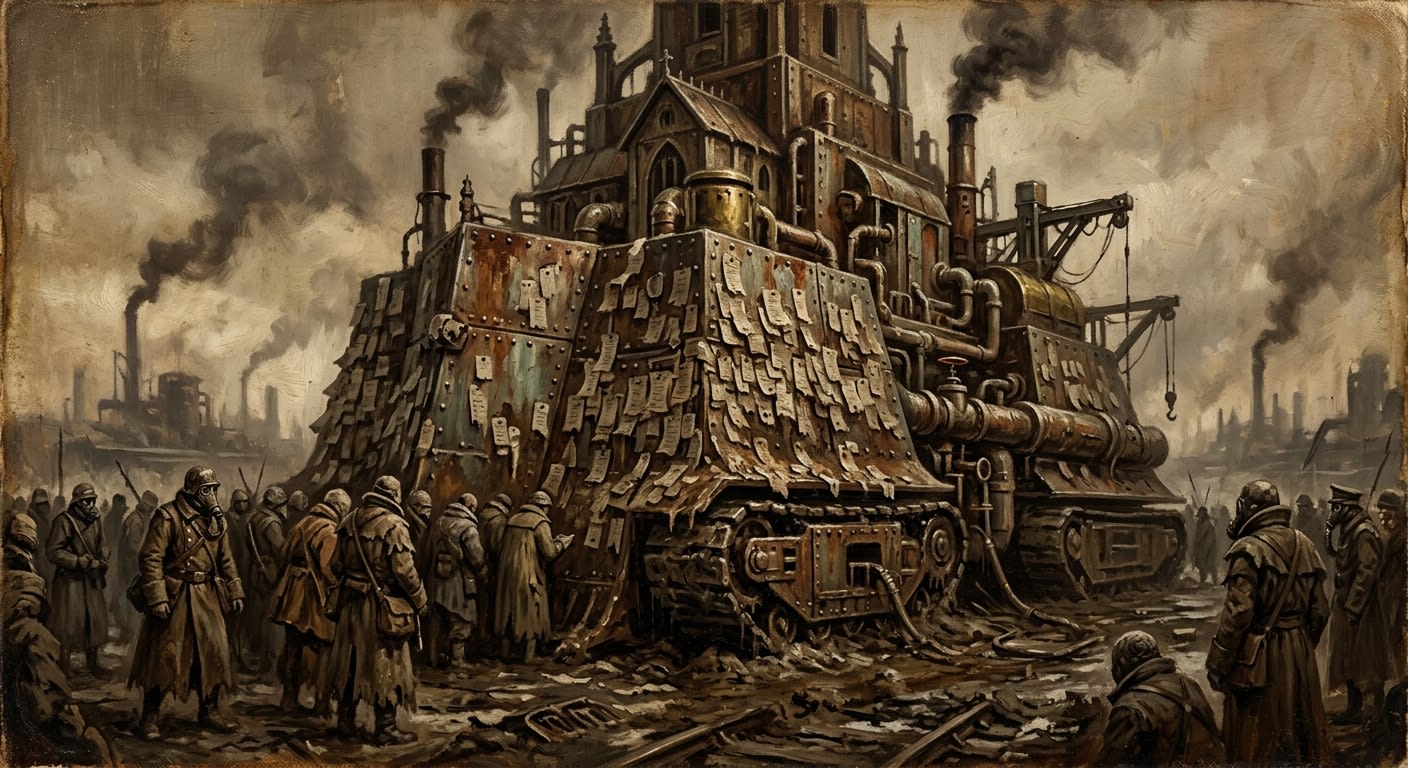
The Vigil Ark of Saint Uriel sits at the eastern end of the Carrier Yard in the Foundry Quarter of Bastion-Constantinople, fully assembled, fully consecrated, fully maintained, and fully grounded. The phrase has become so familiar to the clerks that they recite it as a rosary of failure. Fully assembled. Fully consecrated. Fully maintained. Grounded.
This is the southern Bellway (Unregistered)'s guardian, authorised in A.S. 191 to complement the Saint Barachiel above the strait and the Saint Gabriel above the Black Sea approach. The design plate exists. The budget exists. The mooring mast exists. The crew roster exists in three versions, one current, one provisional, one optimistic. The Ark exists most of all: a lighter-than-air reliquary-cathedral whose great envelope hangs under drydock rafters like a captured cloud, whose gondola chapel smells of wax, brass, and old disappointment, whose Sermon-horns have never preached to anything more distant than gulls on the harbour wall.
The southern sky remains empty. Soldiers on the chain-booms look up at the place where Uriel should pass and see weather, smoke, artillery flash, and nothing sanctified enough to put on a schedule.
#On the Tooth
The relic assigned to the Saint Uriel is a tooth attributed to Saint Uriel, purchased at considerable expense from a dealer in Marseille and authenticated by the Bureau of Relics with the magnificent panic of an office that has already spent the money. The receipt describes it as “upper molar, angelic class uncertain, saintly attribution probable, enamel intact.” I admire the phrase angelic class uncertain. It is the sort of scholarly cowardice that wears gloves to avoid leaving fingerprints on its own doctrine.
Marseille's relic quarter can provide anything if one arrives with coin, urgency, and a willingness to confuse Providence with inventory. Bones of martyrs. Cloth scraps from robes no martyr is known to have worn. Nails from crosses, teeth from saints, tears in sealed glass, ash that rasps under examination, and a thousand other articles whose holiness increases in direct proportion to the buyer's military need. The dealer who sold the tooth remains in business. This is, to my mind, the only person in the affair whose competence is not in dispute.
The Bureau of Relics authenticated the tooth before installation. It authenticated the tooth after the first failed launch. It authenticated the tooth again after the second, with sterner wax. After the third attempt, it issued a nine-page memorandum concluding: “The relic is genuine. The relic's behaviour is the relic's concern.” After the fourth, it stopped attending launch reviews.
A preliminary dockyard rumour held that the tooth was counterfeit and that Velmoran agents had compromised the Marseille transaction.
Withdrawn. The Bureau of Purity found no Velmoran signature, no counterfeit wax, no debt-mark, no serpent coil, no coin-sheen, no ledger-bite. The tooth is genuine. Its refusal graduates from inconvenience to indictment.
#On Four Attempts
The first launch attempt occurred under immaculate conditions: clear morning, low harbour wind, full choir, valid consecration, corrected pressure tables, and enough senior observers to make any machine resent its creator. The Saint Uriel lifted three feet, paused, and settled back into the cradle with the slow courtesy of an archon sitting down before a sermon he intends to hate.
The Bureau of Engineering blamed envelope trim. The trim was corrected.
The second attempt lifted five feet and yawed toward the harbour wall. The crew sang the Antiphon of Ascension; the Ark replied with a groan from the gondola chapel, though the chapel was empty and the reliquary case was sealed. The Bureau of Bells classified the groan as sub-liturgical resonance. The Foundry workers called it a belch. The Foundry workers were closer.
The Bureau of Bells retuned the Sermon-horns.
The third attempt produced no lift. None. The envelope held pressure. Compound 7 volume met specification. The chapel lamps burned steady. The tooth sat in its reliquary like a judge who has heard enough. After nineteen minutes of chant, a single flake of enamel appeared on the altar cloth. The Bureau of Relics declared the flake non-diagnostic and took it away in a lead box.
The Bureau of Rites re-consecrated the chapel.
The fourth attempt, conducted in A.S. 191 under restricted attendance, remains the only attempt sealed above Amber. Publicly, the Ark failed to achieve sustained flight. Privately, it rose to mast-height, held for seven breaths, and every bell in the Carrier Yard rang without being struck. Then the Ark descended. Not fell. Descended. The distinction matters to engineers and cowards.
Extract from Fourth Attempt Watch Transcript, Carrier Yard, A.S. 191: Observer One: “Altitude steady.” Observer Two: “Bell response external.” Chaplain: “The tooth is warm.” [thirteen seconds omitted] Unidentified voice from reliquary chapel: “██████████████████████████.” Observer One: “Descent begins.” Bureau of War notation: no voice present. Bureau of Bells notation: bell response non-actionable. Bureau of Doctrine notation: transcript sealed.
#On the Drydock Cult
A grounded vessel gathers custodians the way a sealed vault gathers rumours. Artificers maintain the Saint Uriel quarterly. They polish brass that has never known weather, inspect cables that have never carried storm-load, oil winches that have lifted nothing but embarrassment, and test Sermon-horns against blank harbour air. Each maintenance cycle ends with a dockyard Mass inside the gondola chapel. Attendance has grown.
At first the Mass was procedural. Then workers began leaving petitions under the cradle struts: requests for safe shifts, healed burns, missing sons, forgiven debts, transfers denied by superiors, wives recovered from fever, teeth grown back in children who had lost them to ration sickness. Uriel, being a saint of announcement and warning in the dockyard mind, became patron of messages that cannot be sent through official channels. A grounded Ark is still an Ark. A silent horn is still a throat.
The Bureau of Purity investigated the petitions in A.S. 194 and classified the practice as “dockyard sentiment, low risk.” The classification lasted until a petition filed by a furnace widow in A.S. 197 received an answer.
The answer was written on the reverse of the petition in the widow's own hand, though she was illiterate. It read: He is below the third grate. The body of her husband, missing since the Shackled Flame preparation works (Unregistered), was found beneath the third drainage grate of Sub-Level Two, folded into a space too narrow to accept a body unless the bones had been softened first. The Bureau of Purity amended the classification to “dockyard sentiment, monitored.”
The petitions continue. The artificers do not remove them. They claim removal scratches the cradle paint. I have inspected the cradle. The paint is already scratched into a palimpsest of requests, warnings, names, and one diagram of the southern Bellway drawn by a hand that has never seen the sky from above and has nevertheless marked three points the Bureau of War refuses to discuss.
Earlier maintenance summaries stated that civilian devotional activity around the Saint Uriel ceased after Bureau of Purity review in A.S. 194.
Corrected. Devotional activity continued, changed vocabulary, and moved under the work platforms. The Bureau did not stop it. The Bureau taught it where to hide.
#On the Empty Southern Bellway
The southern Bellway was meant to carry sanctified air from the Bosphorus mouth toward the Aegean approaches, stitching the southern flank of the Sagittal Line to the coastal supply lanes and the harbour routes that feed Constantinople's appetite for shells, bones, flour, oil, men, and the occasional honest report. It remains unpatrolled by Ark. The map still shows the corridor. The schedule still assigns sermons. The daily Bellway board in the Aerial Wing carries Uriel's name in red ink with a diagonal slash through each entry, renewed every dawn by a clerk whose entire vocation is the administration of absence.
The Bureau of War compensates with ground guns and naval patrols. The Bureau of Bells compensates with extended Barachiel sermons when wind allows. The Bureau of Engineering compensates with memoranda. The soldiers compensate with profanity, which remains the most efficient system yet devised.
This absence has tactical consequences. Demonic skiffs test the southern fog more often. Convoy captains request northern routing even when the northern sea is angrier. The Reliquary Flotilla sends chain-saints to reinforce its outer lashes when the southern patrol gap lengthens beyond six days. The Bureau of War denies that a gap exists, then funds measures to fill it. This is administrative candour in its purest available form.
#On What the Tooth Refuses
The official question is why the Ark does not fly. This question is childish. It assumes the Ark wishes to fly and cannot. It assumes failure lies in a mechanism, a relic, a table, a phrase, a screw, a seal. The more adult question, which the Bureaus avoid because adulthood is expensive, is what the tooth is refusing.
Relics on the Line work. They glow in ravelin niches before assaults. They heat under false oaths. They weep at counterfeit prayers. They have preferences, or something so close to preference that only a coward with a stamp would insist on different wording. The tooth has been placed inside an armed cathedral of wood, brass, gas, rope, sermon, and explosive censer. It has been commanded to lift. It has declined.
I do not call this disobedience. Disobedience belongs to subjects. I do not call it malfunction. Malfunction belongs to devices. I call it witness, because witness is the safest sacred word for refusal when every other word invites a committee.
The Ark sits in the drydock. The tooth remains in the chapel. The petitions gather. The southern sky waits without sanctification. The dealer in Marseille sells relics. The Bureau of Relics authenticates. The Bureau of Engineering certifies. The Bureau of War budgets another review.
Fully assembled. Fully consecrated. Fully maintained. Grounded.