

I've read the continuity file, both style guides and the Sable Court sources; now I'm writing the article.
#On the Office and Its Survey
Every lawful coin struck in Sable Court makes three claims at once. The metal claims a face. The face claims a plate in the Face Archive. The plate claims an entry in the Great Ledger. When the three agree, a citizen may buy bread. When they disagree, a clerk at a desk must decide which of them is wrong, and that clerk is a Face Registrar.
This survey is filed in A.S. 201. The year belongs to the survey and to nothing else. I have found no founding instrument for the Registrar office that I would swear to before a Purity witness, and I decline to forge one to make the page look tidy. The Mint-Chapter's own record places its Face Registry Compact in A.S. 94, four years after the Concordat of Strasbourg. Whether anyone sat at a Registrar's desk in that first year, the record does not say. The Bureau has survived worse silences.
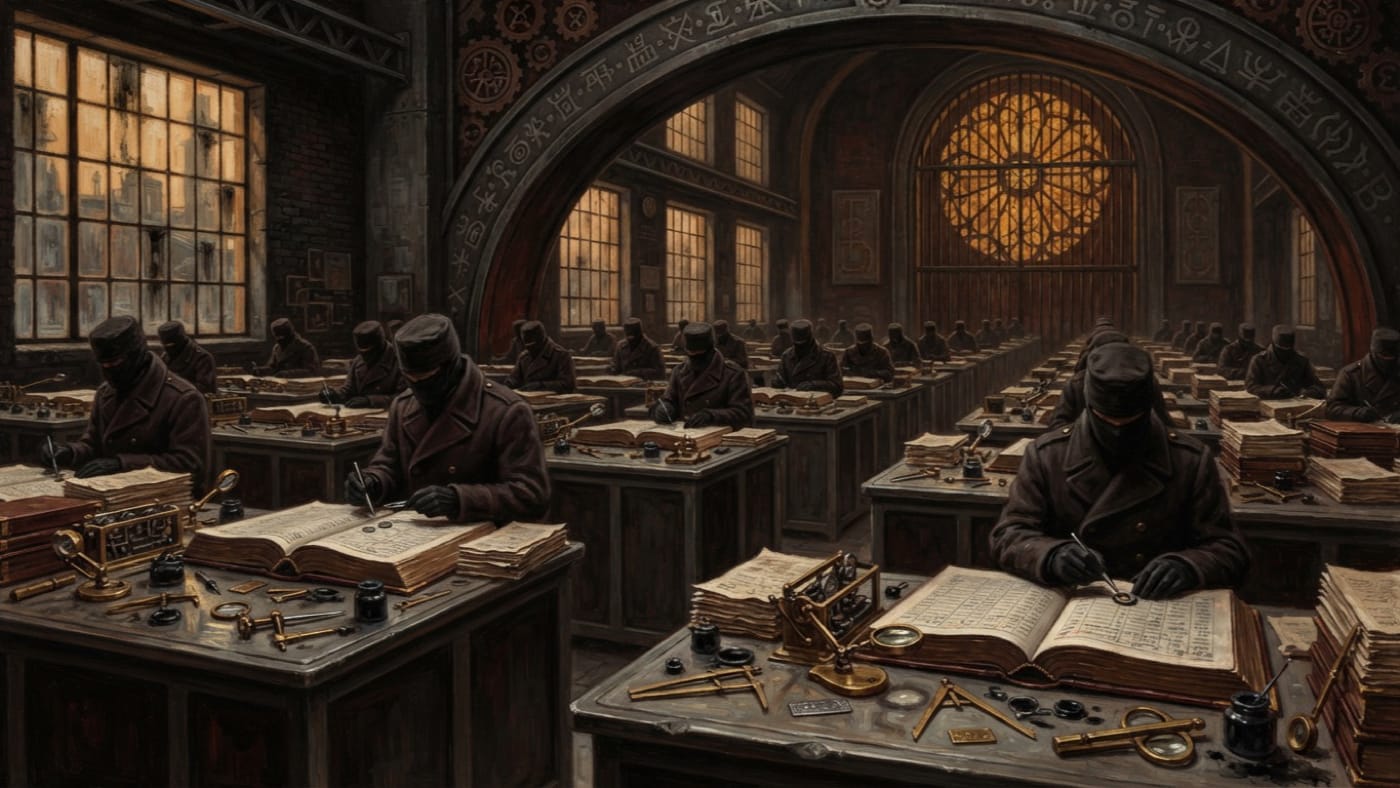
The office works inside the Crownwright Diehouses of Sable Court, the restricted quarter on Cologne's south side, behind black brick and windows mirrored so that every visitor's suspicion is shown back to him. By the Chapter's own description, the Registrars' desks smell of cold ink and finger-veils. The Chapter is rarely this honest about a smell, and I record it with gratitude.
#On Concordance
The word means agreement. In Sable Court it means agreement that has been audited, sealed and charged a fee.
The labour is divided among offices, and the divisions must be kept, because confusing them is how innocent clerks get blamed and guilty ones get promoted. The Crownwright engravers cut the dies by hand. The Chapter Assayers test the metal and the fidelity of the face, using acid reeds, edge calipers, hymn-forks, face-lenses, brass trays, warm-cloth presses and the red HOLD slip. Those tools belong to the Assay Cloisters. The Registrar works with plate, coin and Ledger, and asks a narrower and more dangerous question: does this face belong where the documents say it belongs?
That question carries more than it appears to. In the Chapter's own account, the face confirms the name and the name opens the account. The account permits wage, ration, pension, contract, marriage, debt, appeal and burial category. A Registrar who confirms the agreement lets all of that go on. A Registrar who records a disagreement gives the other offices a reason to stop it.
The Synod is full of clerks who can ruin a life with one wrong stroke. The Registrar is unusual in that the stroke concerns a face, and a face is the one document a citizen cannot leave at home.
#On the Five Classes of Correction
The Chapter's account sets the Registrar's essential judgment on its humblest example, a jawline. When a correction touches a jaw (on the plate, on the strike, in the Ledger's description, the account does not say where), the Registrar decides whether it is cosmetic, punitive, clerical, hereditary or doctrinally dangerous.
Those are the five classes. The Chapter publishes their names. It does not publish what lies beneath them: no criteria, no fixed test, no tariff of consequence attached to each drawer. I have looked for them in the places the Bureau keeps such things and found the shelves bare.
The reader may test the classes against his own face in the shaving-glass. Which of the five covers the scar from boyhood, the father's chin come through in the son, or the slip of an engraver's burin twenty years ago? The Registrar knows, or is paid to know. The Chapter does not say how. What I can certify is that the five names sit side by side on the same page, and that the distance between "clerical" and "doctrinally dangerous" is one word in a clerk's hand and an entire life on the street outside.
The Chapter's account of its offices says of the Face Registrars: "Their intentions become law."
Corrected. Their classifications become entries in a file. Disputes go to the Mint Tribunal, which adjudicates correction, recall, hold and unfacing. Final authority over recall and plate access rests with the Mint-Prelate. A Registrar's intention becomes law the way a scribe's draft becomes a decree, which is to say only after someone better paid has sealed it. The Bureau regrets the poetry. The Bureau does not regret much.
#On What Follows a Disputed Entry
A classification never stays on the desk. It goes on to other offices, and the Chapter keeps three instruments waiting at the far end.
A face recall demands that coins bearing a disputed face be surrendered. A facehold freezes exchange in that face until the review is finished. Unfacing, the last instrument, withdraws the face's plate authority and takes it out of active denominations. The Registrar issues none of these. The Tribunal hears the dispute, and the Mint-Prelate holds final recall authority. The Registrar's part is earlier and quieter. It is the entry that tells the next office there is something to hear.
The published accounts describe what the quarter does once a face falls into doubt. Merchants stop accepting the coin. Employers suspend wages. Landlords question leases. Bread sellers refuse change. None of this requires a verdict. It requires only that a face be uncertain while the people with bread are watching. The Chapter's clerks are said to prefer facehold for exactly this reason: it needs no dramatic sentence, only waiting.
The Chapter's account says the Registrars' errors become widows at Clipper's Market. The market's own record shows how. At the Widow Gate, under a lintel marked PROVISIONAL PETITIONERS, stand women whose husbands' faces were recalled before the pension was released, children whose father exists in the Ledger but not on any coin they can spend, and spouses whose marriage contracts were written in a face now under hold. Not every mismatch ends at that gate, and I will not pretend each one does. But the gate exists, and the line at it is long.
Lower down, the Clipped Choir offers its brokers' unlawful mercy. A widow's husband's coin can, it is said, be warmed to pass for one more day. The Chapter condemns this. It also benefits from it, since every illegal mercy argues for another lawful inspection. Below the official waiting room is an unofficial one, run on bribes, where the queue moves faster.
The Chapter's account adds a further consequence, which I report on its authority and no further. After unfacing, it says, families remember poorly. Witnesses hesitate. A man may stand in his own doorway while his children argue, with growing uncertainty, about whether he lives there. The Bureau of Doctrine classifies the effect as a Category Two Localized Identity-Scribal Anomaly. The Mint-Chapter calls it manageable. How it works, and whether it strikes every household the same way, has not been proved in any file I am cleared to read. Doctrine has named it, and the naming will have to do.
#On the Present Holding
As of this survey, the Mint-Chapter reports that the Face Theft crisis, begun in A.S. 199, is still under way, with Sable Court under an Amber order in A.S. 201. Its published account describes familiar coins appearing with the wrong eyes, the wrong mouths and the wrong griefs, and an emergency recall across seventeen denominations. Who is responsible remains disputed. The Chapter's suspicion has fallen on the Clipped Choir. Purity has expressed doubt that the obvious suspects could manage so wide a contamination. I take no position that the evidence does not take, and the evidence has not yet taken one.
What the crisis means for the Registrar's desk needs no speculation. The office exists to keep plate, coin and Ledger in agreement. Its five classes assume that a disagreement has a cause a clerk can name. In a season when the coin itself appears to have changed its mind, the Registrar must still decide which drawer the change goes in, under Amber orders and in the same smell of cold ink.
I asked one Chapter officer, whom I will not name, whether the Registrars had ever been wrong. He said the office keeps no class for that.