
#On the Locked Reference
"False coin is false soul." — Mint-Chapter proclamation, Sable Court
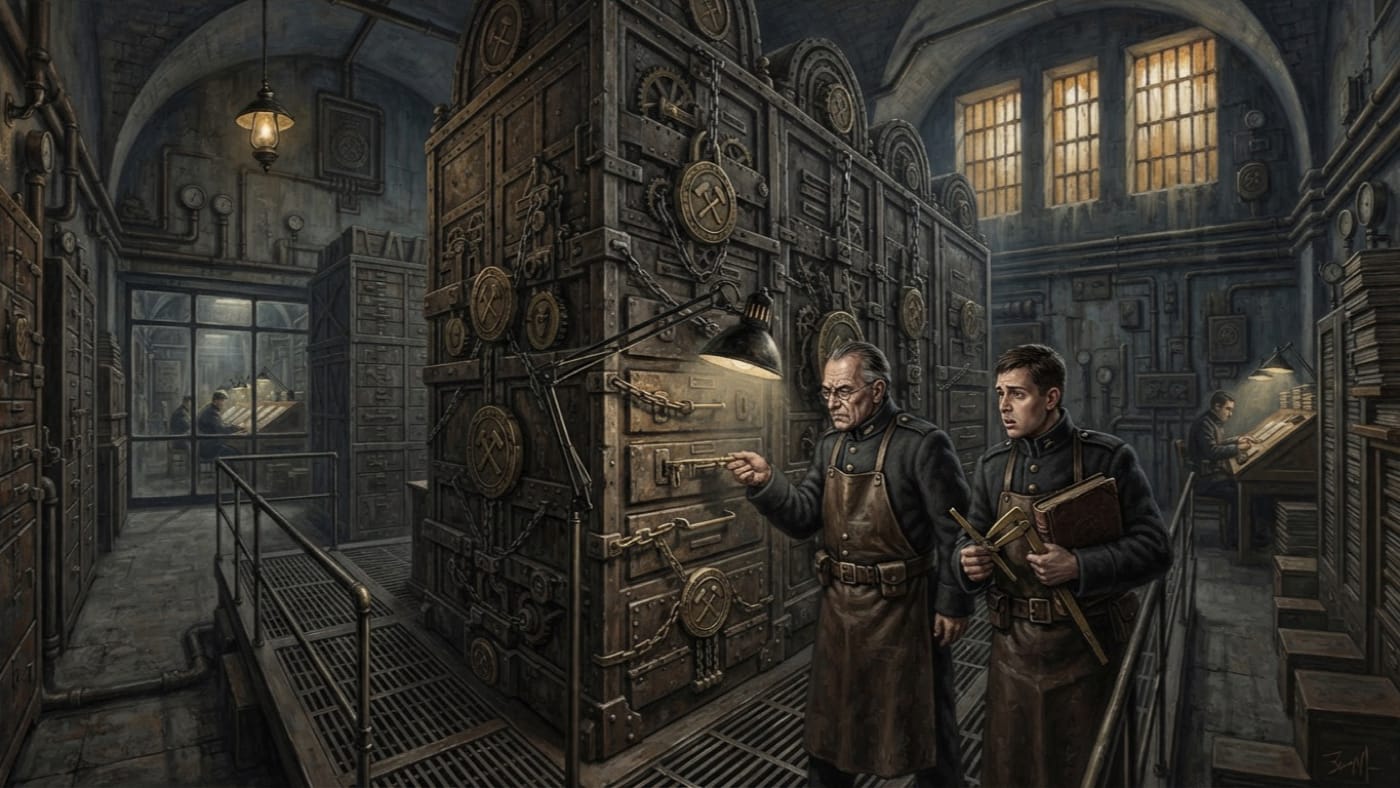
The Face Archive sits at the centre of the Crownwright Diehouses, inside the rings of engraving halls, furnace yards and stamping bays that make up the restricted quarter of Cologne's south side. The rest of Sable Court smells of acid, coal, oil or fear, according to district. The Archive smells of dust and cold ink.
It holds master plates: one for every face struck into lawful coin. A citizen without a plate may own a coat, a trade and a widowed mother. The counting-house will still refuse his money, because in the only sense the Synod recognises, his money does not exist.
Every approval passes through this room. Die Row may cut, the Strike Floors may thunder, the Assay Cloisters may bless, but without the Archive's reference the result is metal and nothing more. The Diehouses' working phrase for the matter is blunter than anything I could compose: no face, no legal circulation.
#On the Mandate and the Concordance
The Concordat of Strasbourg constituted the formal Synod in A.S. 90. Four years later came the Compact of A.S. 94. This Codex has recorded it under both its Mint-Chapter and its Face Registry names. It bound the Crownwright craft to Synodal authority under Mint-Prelate Albrecht Sable and set out the concordance by which coin, face, name and soul answer to one another. Between A.S. 94 and A.S. 100 the old guild district was walled, gated, bridged and given mirrored windows.
The Archive was founded last. The Synod mandated it in A.S. 102, eight years after the Compact had made it necessary.
The concordance is simple to state and ruinous to live under. The Bureau of Records enters a soul in the Great Ledger of Souls and assigns a registry number. The face carries that name, and the coin carries the face. Hand a baker a coin and you have presented him with your face, your name and your standing before the Creator, and asked him for change.
The Archive's plate is the fixed point of that chain. Three objects must be kept apart, and the provinces confuse them constantly. The master plate is the retained, authoritative likeness, and it never leaves the Archive. The working die is cut in steel on Die Row and strikes the batches. The coin circulates through pockets, offering plates and the grip of bailiffs. Dies wear, coins wander and clerks die, but the plate stays where it is.
#On Plates, Hands, and Permission
The order of operations has the dignity of liturgy and the speed of a tax appeal. Records issues the number. The Mint-Chapter commissions and authorises the minting. A Crownwright master cuts the working die by hand, in finger-veils, because the Bureau of Doctrine ruled in A.S. 134 that mechanised cutting produced "spiritually imprecise" currency. The Archive holds the plate against which that hand is judged. Assay and blessing come next, and only then does the face circulate.
Every plate is filed, cross-referenced with the Ledger and sealed under triple lock. The Archive belongs to the Mint-Chapter and always has. Three powers press on that lock. Mint-Prelate Varo Sable controls lawful recognition, which means he decides whose face the economy is obliged to see. Master Engraver Irena Coilhand controls the craft, which means she decides who is struck into permanence and how well. Warden-Captain Joss Kline controls the vaults, the raids and the corridors that lead to both.
An earlier entry in this Codex held that the Crownwright Guild operated independently of Synod oversight.
Corrected. The Guild has always worked under Mint-Chapter authority, as the Compact of A.S. 94 provides. The Archive's plates have never belonged to the engravers. The engravers belong to the Chapter, and so do the plates.
In Sable Court nearly everything can be bought. Correction orders can be bought. Assay delays can be bought. Exchange-rate "errors" are for sale every day of the week and favour the Chapter every time. The plates are never for sale. Touching one without Mint-Chapter authorisation is an annihilating offence. The Diehouses entry records the sanction as follows: the offender's face is struck from every coin in circulation within the quarter-bell, and within the week his name ceases to function in commerce. The Crownwrights call this unfacing. The offender keeps breathing. His creditors stop recognising him, and so does his landlord, and so, after some days, does his sister.
#On Recall and Recognition
Losing a coin costs you the coin. Faces are struck in batches, and the gutter has never been able to revoke anyone.
The facehold is the first true grade of damnation. A disputed face is frozen while the Tribunal deliberates, and an unpaid fine hardens into an identity hold. The citizen's coin is refused at the bakery, the gate and the rent-table. He is still registered, but he is no longer spendable.
The recall is the second grade. The Mint Tribunal orders it when a face is disputed, revoked or "corrected." The coins are gathered and re-struck blank or with a replacement face. Merchants decline the recalled person's custom. Landlords void tenancies that were denominated in his face, and employers find his contract unenforceable. The Bureau of Records classifies the result as "administrative dissolution, non-lethal variant." The phrase is precise. He goes on living in a city that has no further use for him.
Memory goes next. A face that circulates becomes fixed in the minds of those who handle it. You know your neighbour because you have held his face in your palm. You remember your dead by the coins in your drawer. When the face is revoked, the memory comes loose. Merchants stop mid-sale, unable to say who sold them the salt. Witnesses lose the suspect. Families argue, with mounting distress and dwindling certainty, about whether there was ever a brother.
All of this makes the Archive the most valuable reference in the Heartlands and the most coveted target for counterfeiters. The Clipped Choir works in the gap between the plate and the pocket. Its face-swap artists borrow correspondence: a jawline from one recalled merchant, eye-spacing from a dead clerk. Its brokers sell memory wash and portable innocence behind the soap stalls of Clipper's Market. Their work fools tired clerks. No record yet shows it creating a lawful archived face from nothing. The Choir is a parasite on the Archive, and like every parasite it needs its host alive.
#On the Plates That Changed
In A.S. 187 the Bureau of Alchemical Standards made a routine audit of the Archive and found three plates altered overnight. A jawline had been softened, an iris darkened, a hairline advanced by perhaps two millimetres. The faces could still be recognised, but they were wrong. The audit produced a sealed report, and the sealed report produced a sealed sub-report. Neither has crossed my desk unsealed.
That same year, the Bureau of Engineering surveyed older vaultwork beneath the Black Canal, and the Mint-Chapter denied that the vaultwork exists. Two investigations fell in the same year. No document I have seen joins them, and this office joins nothing it cannot cite.
In A.S. 194 the Bureau of Doctrine classified the memory effect as a Category Two Localized Identity-Scribal Anomaly. It has not revised that classification since.
The Face Theft campaign began in A.S. 199. Citizens of the outer districts reported that their own faces had changed on the coin, and changed wrongly: a husband's jaw had acquired another man's eyes. Within months the complaints stopped, because the complainants could no longer remember what they had looked like. The Mint-Chapter ordered recalls across seventeen denominations. The Assay Cloisters began testing fidelity as well as purity. Blind clerks compare the hymn-frequency of a struck coin with that of its archived plate, though none of them has ever seen the face under test.
Every such test assumes the plate is faithful. After A.S. 187, that assumption is an article of faith and no longer a finding of audit.
Three pressures act on the case, and their claims differ. The Clipped Choir did some of the damage and has admitted none of it. The Unface Society, a furnace-tunnel cell that wants every plate destroyed and every coin left faceless, claims responsibility. The Bureau of Purity doubts that six engravers and a disgraced archive scribe could manage it. Warden-Captain Kline carries a pouch of coins he calls impossible: each bears a face that matches no living person and no archived plate. They prove that a discrepancy exists. They do not prove who made it.
Then there is the master die. The Mint-Chapter has denied its existence in four separate depositions, each more emphatic than the last. Rumour describes a cylinder with no face and every face on it, able to overwrite the concordance through circulation alone. Archive porters add, unasked and unsworn, that the plates whisper names at night. I record both rumours. I certify neither.
#On the Present Custody
The documented assessment of A.S. 201 gives the Archive's condition plainly enough. The Face Theft investigation continues. The quarter remains under Amber restriction. The Face Archive is sealed to all access below Mint-Prelate clearance.
The Archive is ninety-nine years old. For all of them it has been the one place in the Church where a face could be checked against the original. It remains the only lawful reference in Sable Court, and the reference is now under suspicion. Every recall, correction and fidelity test runs back to the plates, and the plates can be checked against nothing except themselves. The Chapter has answered by locking the room more tightly. Varo Sable signs the clearances. Coilhand's apprentices cut dies against references that nobody below the Prelate may inspect. Kline walks the rooftops with his impossible coins and reports nothing.
Outside the inner ring, ordinary commerce goes on. Bread is bought with faces, rent is paid in them, and debts are recorded against them. The approvals still come out of the room that smells of dust and cold ink, and the city still honours them.