
#On the Universal Tenth
"Ten is a holy number because it can be counted on the hands. The Bureau prefers holiness that can be counted." — Field instruction attributed to the Palatine Counting House
The Faith-Tithe is the tenth owed by every baptised subject of the Synod to the Church that baptised him. Among the instruments of the Bureau of Tithes it is the plainest: one part in ten, weighed, entered and sealed. Every other levy in the Theocracy has a clever name, a regional pedigree or a scandal. The Faith-Tithe has a denominator.
Its universality ends where the Synod's jurisdiction ends. A child baptised in Lyon owes the tenth from the day his name enters the register. A child baptised in an English chapel owes Strasbourg nothing. The Bureau can tax a widow's grief, but it has never found a way to tax a coastline.
The formal Synod was constituted by the Concordat of Strasbourg in A.S. 90. The Bureau's fiscal charter followed in A.S. 92, and the Bureau states that the Faith-Tithe has been collected without interruption since that year. I repeat the claim exactly as the Bureau makes it. The Church gathered tenths in wartime long before any charter put a seal on the gathering. The charter supplied a ledger, and anything with a ledger can be said to begin.
What the tenth buys is easily listed. Bread for the ration halls. Powder, boots and salt pork for the Sagittal Line. Candles, clerks and counting rooms for the Palatine Counting House. The faithful are told that their tenth feeds Heaven, and it does. In this survey year of A.S. 201, Heaven eats in Strasbourg.
#On Coin, Crop, and Labour
The Bureau accepts four lawful forms of payment: Crowns of Grace, livestock, grain and labour.
The Crown of Grace is iron. Foreign merchants expect gold and leave disappointed, which the Bureau of Doctrine counts as a small sermon. Each Crown bears the Synod's sigil and is consecrated at the mint. Its value comes from the Synod's will, which never tarnishes, rather than from the vanity of precious metal. A household that pays its tenth in Crowns returns coin the Church struck in the first place. I know of no purer circulation. The money goes home.
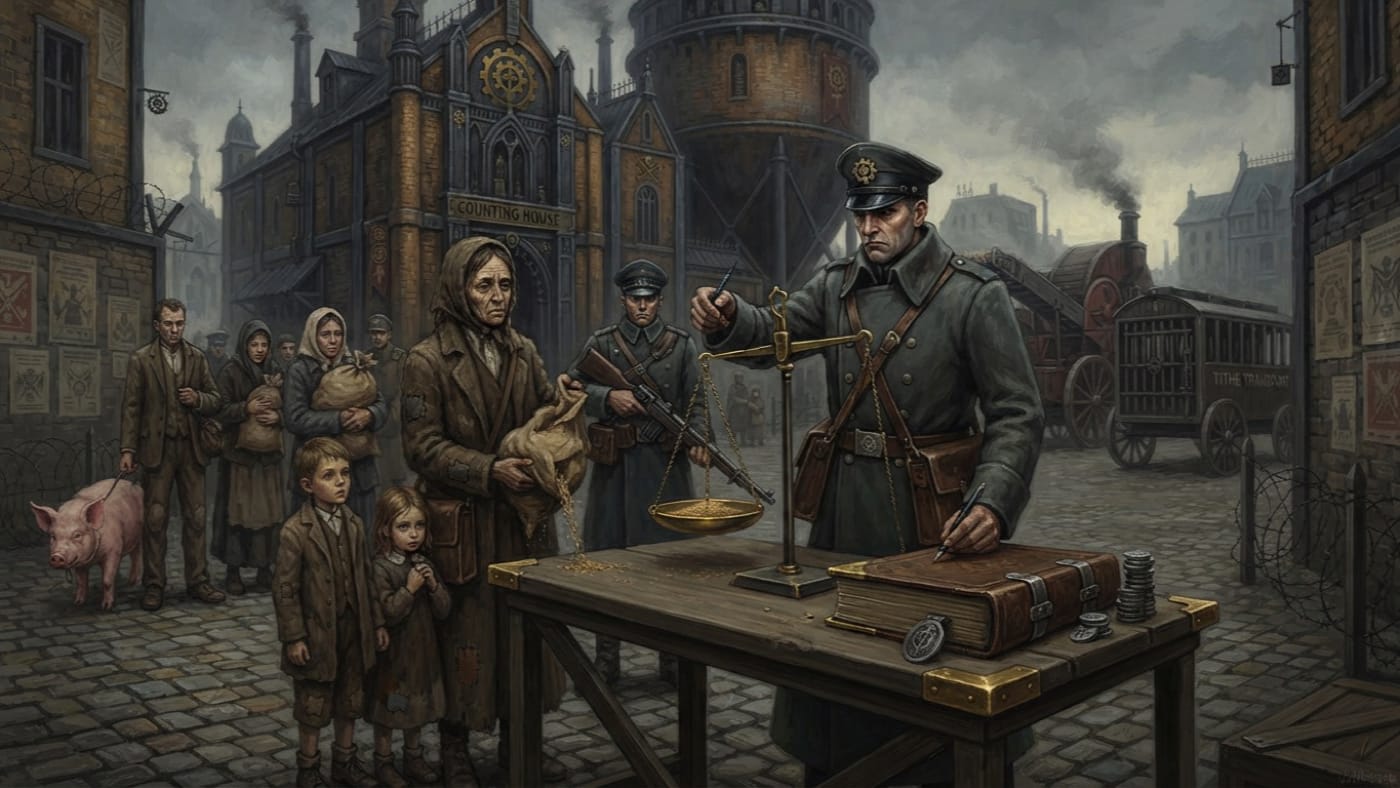
Grain is the oldest form of payment, and the most honest. The household brings its sacks to the square. The Assessor fills the scale pan, reads the beam and pours the tenth into Bureau sackcloth, while the family watches its winter grow lighter by the scoop. Suppose a household's assessed increase came to forty sacks. It would owe four. The forty is my own invention, because the Bureau publishes no taxable base for any household. The four is canonical, because ten is canonical.
Livestock complicates the arithmetic. No Assessor can divide a pig by ten in a village square, and the Bureau has never published the method by which a pig is reconciled to a tenth. The Assessor carries the calculation in his head, and the household absorbs the difference.
Labour serves the parish that has neither coin nor surplus. Its tenth is paid in days of hauling, ditching and carting to the depots, recorded in tokens that a foreman countersigns. A man without a coin or a sack can always be made to carry something.
#On the Hands That Collect
The Bureau of Records says who you are, and the Bureau of Tithes says what you owe. Records keeps the Great Ledger of Souls, with its baptisms, marriages and burials. Tithes keeps the Fiscal Census, where those same names reappear with sums beside them. Before any Assessor knocks on a door, a clerk has already drawn up the household roll from certified copies of the Records entries. Before the Assessor arrives, the estimate has hardened into an assessment.
The collection kit has not changed in living memory. It holds scales and measuring rods, seal stamps, receipt blanks, chalk for door marks and a ledger with gilded corners. The gold leaf on those corners is consecrated before deployment, which makes the ledger a sacred text. Damaging it is heresy. Lying to the man who carries it is blasphemy. Once the household signs its entry, a quarrel over a short sack becomes a quarrel with the Church, and the Church has armed clerks standing behind it in the square.
Payment produces a sealed receipt, the household's only proof that it paid. A family that loses the receipt has, in practice, not paid, and some families have paid twice for the instruction. Non-payment produces an arrears notice, a chalk mark on the door, a flag in the registry or a seizure order for tools, bedding and food stores. At dusk the Assessor reconciles the receipts and the physical collection against the ledger. Any discrepancy belongs to him until he can make it belong to someone else.
The Bureau keeps field practice separate from obligation, and so shall I. The obligation is a tenth. In practice, an Assessor sometimes forgets a spoonful of grain in return for a favour, and sometimes remembers one that was never owed. Archbishop Salome Veyrault, who has governed the Bureau since A.S. 189, is said to have described such men as "imprecise." To an Archbishop of Tithes, imprecision is a graver charge than cruelty.
#On the Parish in Default
When an entire parish fails to pay, the Bureau does not pursue its households one by one. It places the whole parish under spiritual sequestration.
The Bureau of Rites suspends the parish's sacraments. Armed clerks of the Bureau of Tithes arrive to liquidate its assets. By the Bureau's own account the process takes about two weeks. I have found no statute that sets fourteen days. The duration is simply how long it takes to sell a parish.
Consider what that fortnight means for a family. A child born during the sequestration cannot be baptised. No banns are read for a couple who meant to marry at harvest. The dying receive no sacrament. Meanwhile clerks go through the barns, the plough-irons and the church's own candlesticks and enter each item twice, once at its worth and once at its sale price. The Bureau has always reckoned the gap between those two figures as part of the cost of collection.
There is a further detail I admire. An unbaptised child has no entry in the Great Ledger, so Records cannot certify him and Tithes cannot assess him. A sequestered parish therefore owes less in the following year. The Bureau regards this as the only real loss of the whole procedure.
Since A.S. 158, when grain authority passed to the Bureau of Tithes, defaulting has also had consequences at the dinner table. A household that has paid in full receives the standard ration. One that has paid late receives the reduced ration. A household in default receives a courteous letter suspending its rations until spiritual reconciliation. The original charter contained none of these rules. They were added later, the way a lock is added to a door that opens too easily.
#On the Tenth and Its Additions
A household that has paid its tenth has not necessarily settled its bill.
The Meta-Levy is a separate, secondary assessment that funds the collection of the primary levies, the Faith-Tithe among them. It is calculated after the primary assessment and before payment is accepted. A household that arrives with exactly a tenth therefore arrives short. The Meta-Levy has survived a challenge before the Assembly of Thrones in A.S. 138. That hearing and its receipt are recorded under the Meta-Levy's own entry, and I see no reason to pay to have them told twice.
The Faith-Tithe also shares the road with gate and bridge tariffs, salt dues, the Widow's Pennies and the rest of the catalogue kept under the Bureau's entry. The tenth is the foundation of that structure. Every other levy is built on top of it.
The Bureau's total extraction is reckoned at about one-sixth of the Theocracy's gross productive output. Clever readers subtract a tenth from a sixth and announce that they have found the remainder. They have found nothing. One figure measures a nation's output, while the other is a rate applied to a household's assessed increase. The two share neither denominator nor ledger. I forbid the subtraction on grounds of arithmetic. The Bureau forbids it on grounds of public calm.
The Faith-Tithe is payable in "coin, crop, or child."
Corrected. The phrase describes the whole household economy of war-levy and faith-tithe together. The Faith-Tithe has four lawful forms of payment: Crowns of Grace, livestock, grain and labour. Sons are owed under the war-levy, which is a separate instrument with its own ledgers and its own grief. The Bureau of Tithes asks that the two not be confused, since each Bureau wants the credit.
#On Payment and Protection
The Synod teaches that proper tithing protects the faithful against Velmora. A man who has given his tenth to the Church cannot be bought by demons, because a soul that is fully paid up has no price left to name. The Bureau of Doctrine has preached this for as long as I have held office. I have defended it at synods, in seminaries and once at a funeral. The argument is elegant, and I made it more elegant.
The Bureau of Tithes promotes this doctrine with great energy. It costs nothing to print, and every household that believes it pays sooner. An institution that collects the premium and also certifies that the insurance works deserves careful auditing. I say this as the man who drafted the certificate.
Whether the doctrine works is unclear. Velmora's servants deal in contracts, obligations and buried clauses, and the Synod's own studies name counting houses among their preferred points of entry. The Bureau of Tithes is the largest counting house in the Theocracy. No inquiry has yet named a compromised official, and I name none here. Readers may draw their own conclusions about a doctrine that tells the faithful the surest defence against a demon of debt is to pay their debts on time.
The receipt is the household's only proof, and the receipt is all I will certify.