
#On the Weather That Broke the Choir Rate
The Fog Weeks were the season in which the Bureau of Orison and Song discovered, with the astonishment of a bishop finding mud on his own shoe, that a sermon inaudible to the faithful cannot be counted without inventing a lie of exceptional thickness.
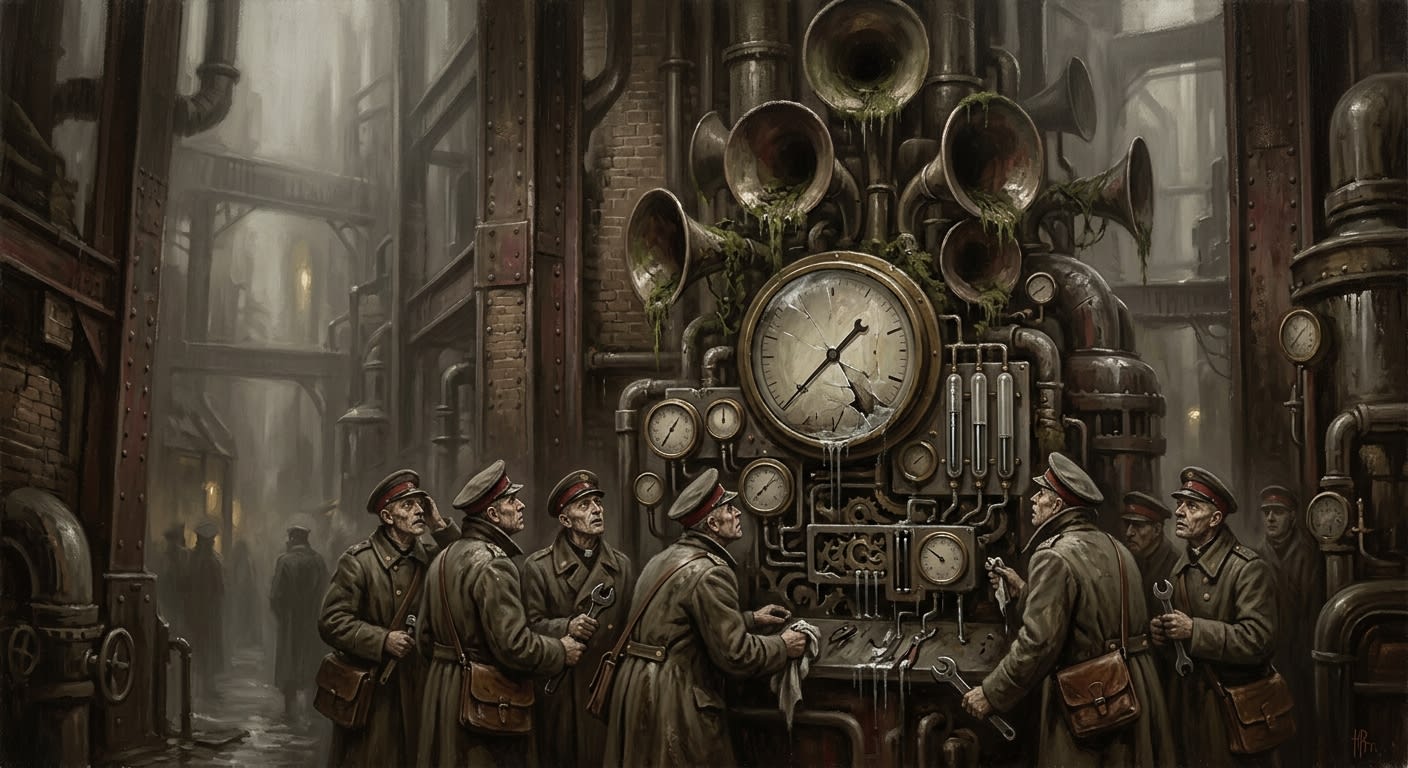
Maritime murk came inland along the western ports, river districts, and low industrial basins. Horns dulled. Receiver shrines coughed static. Rooftop speakers moaned into wet air. Tower relays repeated half-syllables, then prayers in reverse order, then nothing. Households opened windows onto soup-white streets and heard only dripping. Sky-Sermon Attendance Auditors stood in stairwells with testers hissing in their palms, counting silence as though it had submitted credentials.
No single decree created the Fog Weeks. No enemy commander claimed them. They were a failure event, which is to say every office found a different cause and all of them were partially correct in the manner that makes blame unassignable and careers survivable. Orison blamed Signal Engineers. Engineers blamed tower corrosion, drowned wire, shrine leakage, fog density, and insufficient funds. Auditors blamed households. Households blamed the Bureau. Inquisitors blamed whoever was nearest and warm enough to bleed.
The date is given in training manuals as “during late compliance consolidation,” which is clerkly fog laid over historical fog. The event belongs after the Metric Sanctification Edict of A.S. 158, and before the Fourth Compliance Congress of A.S. 171 where the Signal Methodists attempted to make equipment failure legible beside guilt. The practical files place the worst weeks in the A.S. 160s, when the broadcast network had become mandatory enough to punish absence and old enough to fail in interesting ways.
#On How the Fog Entered the Ledger
At first the phenomenon was treated as ordinary weather. This is how institutions invite humiliation into the parlour.
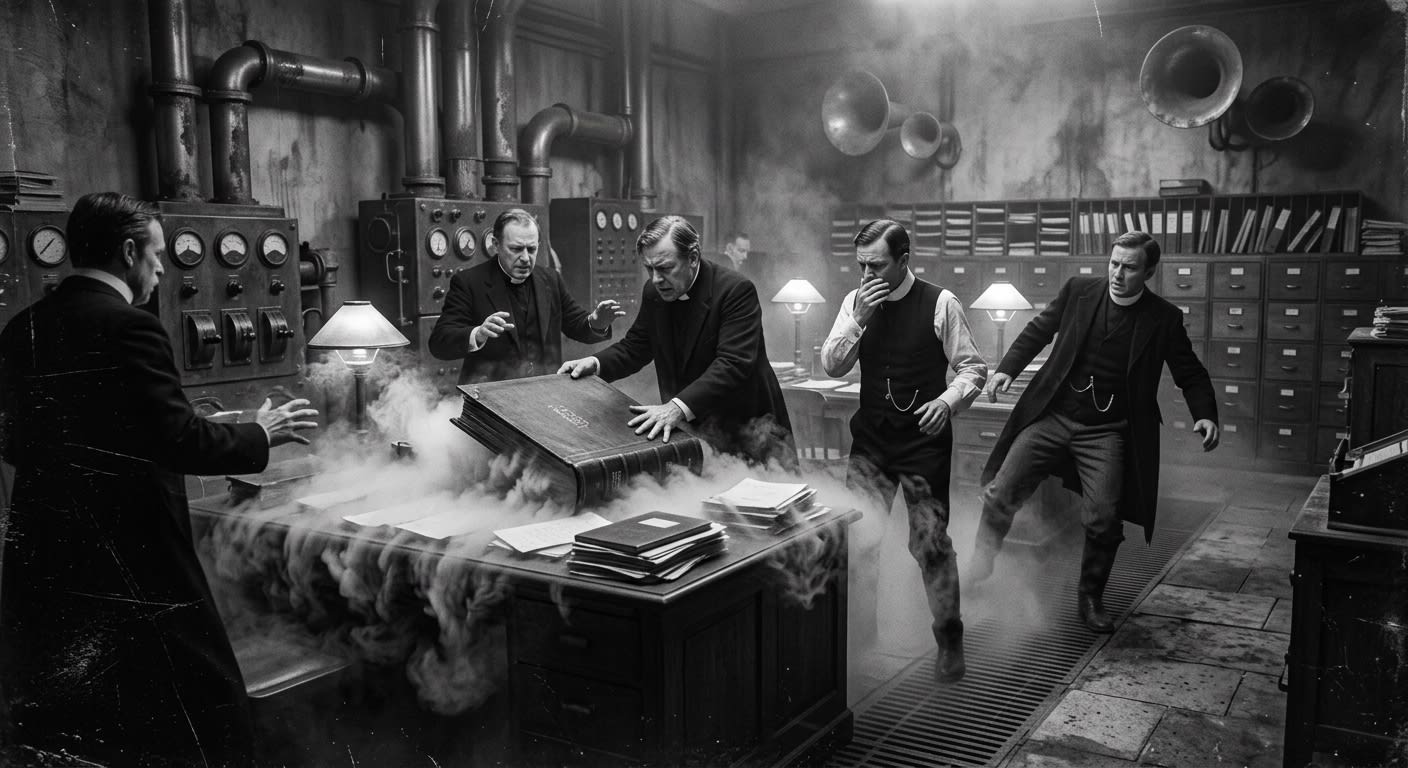
The first port reports came from western docks where salt fog was common enough to tax and too common to fear. Receiver tones weakened in fish markets. Chapel horns lost range. Sector windows opened for the morning Sky-Sermon and received a sermon consisting of one cracked vowel, two bursts of wet static, and a pause so long that several households assumed the Creator had finally decided to answer and was clearing His throat.
He did not. Naturally.
Initial Orison circulars described the affected districts as “experiencing minor atmospheric attenuation without compliance consequence.”
Corrected after fourteen branded sectors, six receiver riots, three engineer suicides entered as maintenance attrition, and one port where the evening sermon arrived at dawn in the voice of a drowned child. Minor attenuation does not require Purity cordons.
The fog thickened through river mouths and industrial basins. It clung to horn bowls, filled speaker shrines, entered relay cabinets, and turned copper contacts green-black in a single night. Auditors found tokens stamped for sermons nobody heard, windows open onto streets where no sound travelled, and household receivers that hissed the same cadence in every room regardless of tuning. Some reported names-in-static. Some reported voices beneath the official broadcast. Some reported nothing, which in a profession paid to hear compliance is the most frightening report of all.
The Choir Rate collapsed. Not everywhere. That would have been simpler and less useful to Hell, weather, or procurement negligence. One district held ninety-four percent while the adjacent ward fell to sixty-eight. One tenement block showed perfect attendance with no working horn inside half a mile. One harbour chapel registered sermon reception in boats already sunk. The ledgers began to look like maps of an invisible appetite.
#On Auditors, Engineers, and the Cull
The quarrel between Auditors and Engineers began before the fog lifted. Auditors accused Engineers of leaving the Word to rot in the wires. Engineers accused Auditors of measuring delivery with instruments last calibrated during a season when water had not learned malice. Both accusations had merit. Merit is useless during a purge except as seasoning.
Branders moved first. Their doctrine was clean: if the token is absent, mark absence; if the window is closed, mark defiance; if the receiver fails, mark Suspicious until repair proves innocence. They branded sectors under fog because fog, to them, was only another excuse that had learned to cover a neighbourhood. Their ledgers stayed elegant. Their districts did not.
Mercy Counters softened numbers where they could. They rounded upward, delayed purple wax, accepted engineer notes written in damp ink, and invented categories such as “probable listening posture” and “visible devotional attention despite signal absence.” These phrases died in review, but several streets ate because they existed for one week.
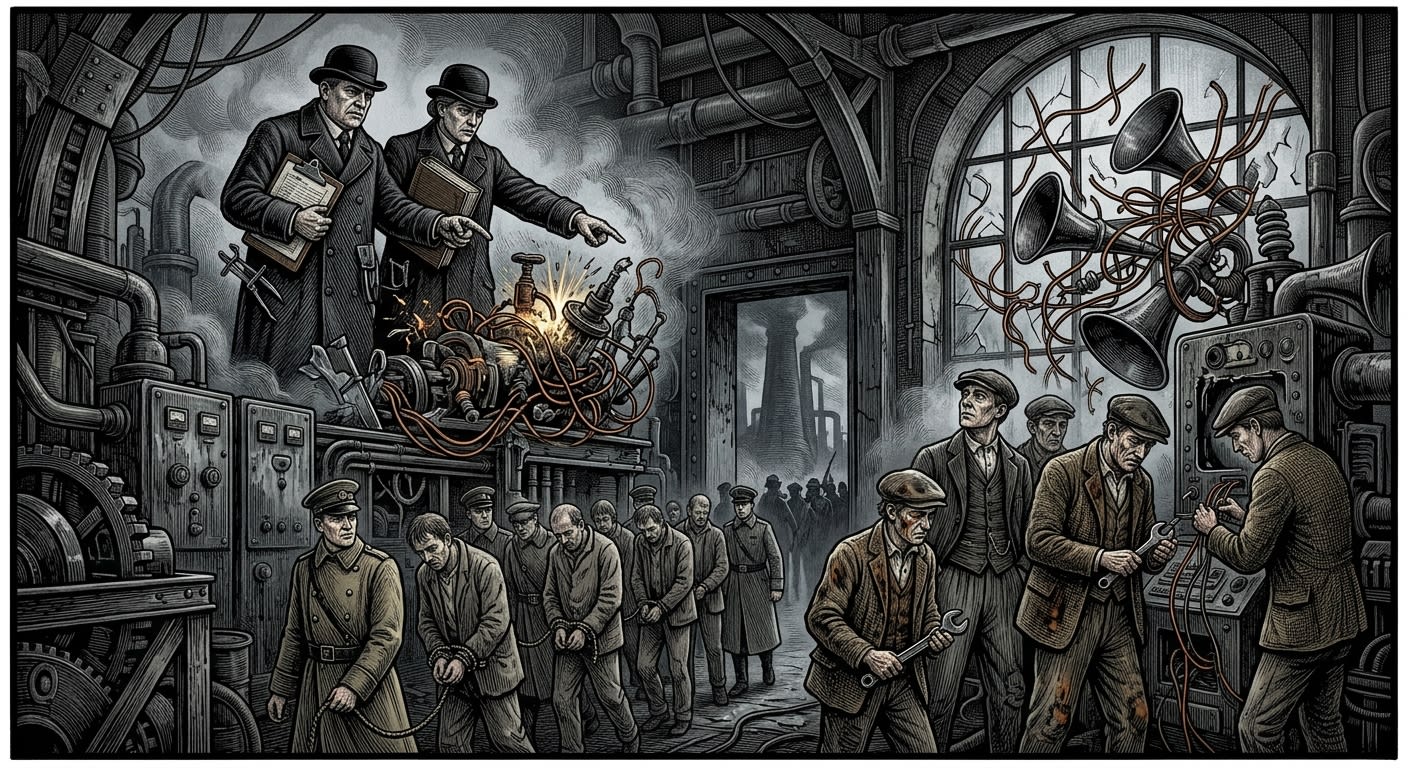
Signal Engineers arrived with tools, ladders, replacement coils, saint-dust filters, and the offended pride of men blamed for instruments nobody had funded properly. They climbed horn masts slick with fog. They opened shrine cabinets and found water pooled in places water had no civic permission to occupy. They replaced contacts. They tuned receivers. They shouted at Auditors. Auditors shouted back with forms.
Then Purity arrived. Inquisitors culled both professions with the elegant impartiality of men who do not understand radio equipment and do not need to. Engineers were punished for silence in machinery. Auditors were punished for silence in ledgers. Households were punished for discovering that the two silences looked identical from a kitchen window.
#On the Environmental Adjustment Protocol
The Environmental Adjustment Protocol was born from official shame and designed to resemble mercy while preventing its spread.
Its public purpose was simple: permit Auditors to modify Choir Rate calculations when atmospheric interference prevented sermon delivery. Fog, storm, horn failure, relay collapse, shrine outage, drowned wire, receiver rot, and certified deadzone conditions could, in theory, reduce penalties assigned to households and sectors. In theory, I may also be crowned King of the Moon by a committee of grateful accountants. Both propositions possess paper feasibility.
Four thousand invocations followed the Fog Weeks. Seven were approved.
Auditor schoolbooks describe the Protocol as “a standing avenue for just correction.”
Clarified. The Protocol is a reliquary for denied mercy: polished, labelled, locked, and displayed to prove the thing exists while preventing anyone from touching it.
Approval required proof of fog density, instrument failure, delivery disruption, household readiness, token integrity, absence of intentional noncompliance, and engineer confirmation filed before the close of the audit window. Fog, being fog, declined to sign. Engineers, being soaked, late, and sometimes dead, filed poorly. Households could prove readiness only by behaving in advance as though the sermon had arrived. Auditors learned quickly that invoking the Protocol attracted review; review attracted Purity; Purity attracted screams; screams disturbed the Choir Rate.
The seven approvals became legends. One involved a bell-hamlet where every horn mouth filled with ice salt despite summer heat. One involved a canal ward whose receiver testers all registered sermons from the previous year. One involved a lighthouse district where the sky-sermon was audible only underwater, an arrangement spiritually generous to fish and useless to widows. The approved sectors were spared purple. Their neighbours were not.
#On the Birth of the Methodists
The Fog Weeks made the Signal Methodists inevitable. A handful of Auditors looked at collapsed hornlines, drowned relays, static-choked receivers, and branded districts, then committed the unforgivable act of drawing a table.
Their proposition had the innocence of a knife under linen: read the Choir Rate beside a Signal Condition Index. Horn reach. Relay integrity. Receiver function. Shrine uptime. Weather impedance. Deadzone risk. A district whose sermon never arrived should not be damned as though it had spat into the horn.
This was technical, modest, humane, and politically suicidal.
At the Fourth Compliance Congress in A.S. 171, the Methodists were defeated, expunged, and retained as vocabulary. Their tables vanished into sealed cabinets. Their terms survived in maintenance appendices with the conclusions removed. “Signal variance” remained. “Coverage expectation” remained. “Weather impedance” remained. The doctrine that those things should protect a household from punishment was executed before lunch.
This is the Synod at its finest: kill the man, keep the measuring stick, invoice the widow for storage.
#On Branders After the Fog
The Fog Weeks gave Branders their favourite sermon. Mercy, they said, cannot be audited after bodies are missing. Delay feeds revolt. Weather provides cover. A district that learns to blame fog today will blame grief tomorrow, hunger next week, and the Creator before the month is done.
Their conclusion was cruel and operationally useful, which is why it prospered. Brand early in fog. Mark Suspicious before explanation hardens into pamphlet. Publish clean rates. Force assembly where the broadcast fails. If the district cannot hear the sermon from the horn, march the district to a square and pour doctrine into it until even the stones know the refrain.
The Fog Weeks also made Branders hated with a sharper public memory. Purple boards appeared in streets where every person had stood ready and heard nothing. Rations dropped because horns had drowned. Curfews lengthened because receivers coughed. Children learned that a closed circuit and a closed soul received the same ink. Some households took hammers to shrine cabinets. Some trained parrots to recite the Orison near open windows. Some became very quiet, which is always worse.
PORT DISTRICT INCIDENT — POST-FOG COMPLIANCE HEARING Sector Choir Rate: 67.4 Engineer report: horn mast failed under salt saturation Auditor finding: Heresy-Adjacent silence Public assembly ordered: yes Casualties after crowd compression: ███ Board mark removed: no Reason: removal would imply prior error
Branders still cite the incident as proof that mercy breeds disorder. Mercy Counters cite it as proof that cruelty breeds lies. Signal Methodists would have cited it as proof that the horn was broken. Their faction does not exist, which makes refutation convenient.
#On the Deadzones the Fog Left Behind
When the fog lifted, it did not leave cleanly. It left deadzones.
Some were ordinary in the technical sense: broken horns, waterlogged receiver shrines, relay nodes corroded beyond repair, roof cabinets stripped by citizens who discovered copper has resale value even when theology does not. Others had no visible fault. The horn worked. The tester hummed. The window opened. The household stood. No sermon arrived. In several districts, something else did.
Names-in-static became a phrase Auditors were trained to fear. Still crowds appeared in tenements where every mouth moved and no sound left the room. One lower ward reported perfect compliance for nine days while all receivers registered only a slow pulse at sermon hour. Purity levelled the block. Records did not reconcile the population count. Tithes adjusted ration draw downward with impressive speed.
The standing order remains. Every Auditor learns it. Every Engineer resents it. Every sensible man obeys it, because a working horn can be repaired and a hungry silence cannot.
#On the Present Use of the Fog Weeks
As of A.S. 201, the Fog Weeks function less as history than as a weapon in three ongoing quarrels.
Branders invoke them to justify early punishment. Mercy Counters invoke them to justify soft numbers. Signal Methodists, being officially absent, are invoked by everyone else whenever equipment failure threatens to become doctrine. Orison uses the Fog Weeks to frighten Engineers. Engineers use them to demand budgets. Purity uses them to enter stairwells. Records uses them to require cleaner columns. Tithes uses them to resist adjustment, because a ration penalty once delayed is a coin arguing with the hand that meant to close around it.
The public catechism says the Fog Weeks proved that vigilance must continue even when the Word is impeded. The private files say the broadcast apparatus can fail catastrophically and the Bureau will punish the listener before it indicts the horn. Both sentences are true. One is printable.
The Environmental Adjustment Protocol remains active, invoked constantly, approved almost never. Auditors still carry testers into wet stairwells. Engineers still climb horns that should have been replaced twenty years ago. Households still open windows when the sky-sermon begins, listening hard for a voice that may arrive as doctrine, static, or a name spoken from inside the rain gutter.
The board waits for colour. The horn waits for breath. The fog waits without hurry.