
#On the Instrument
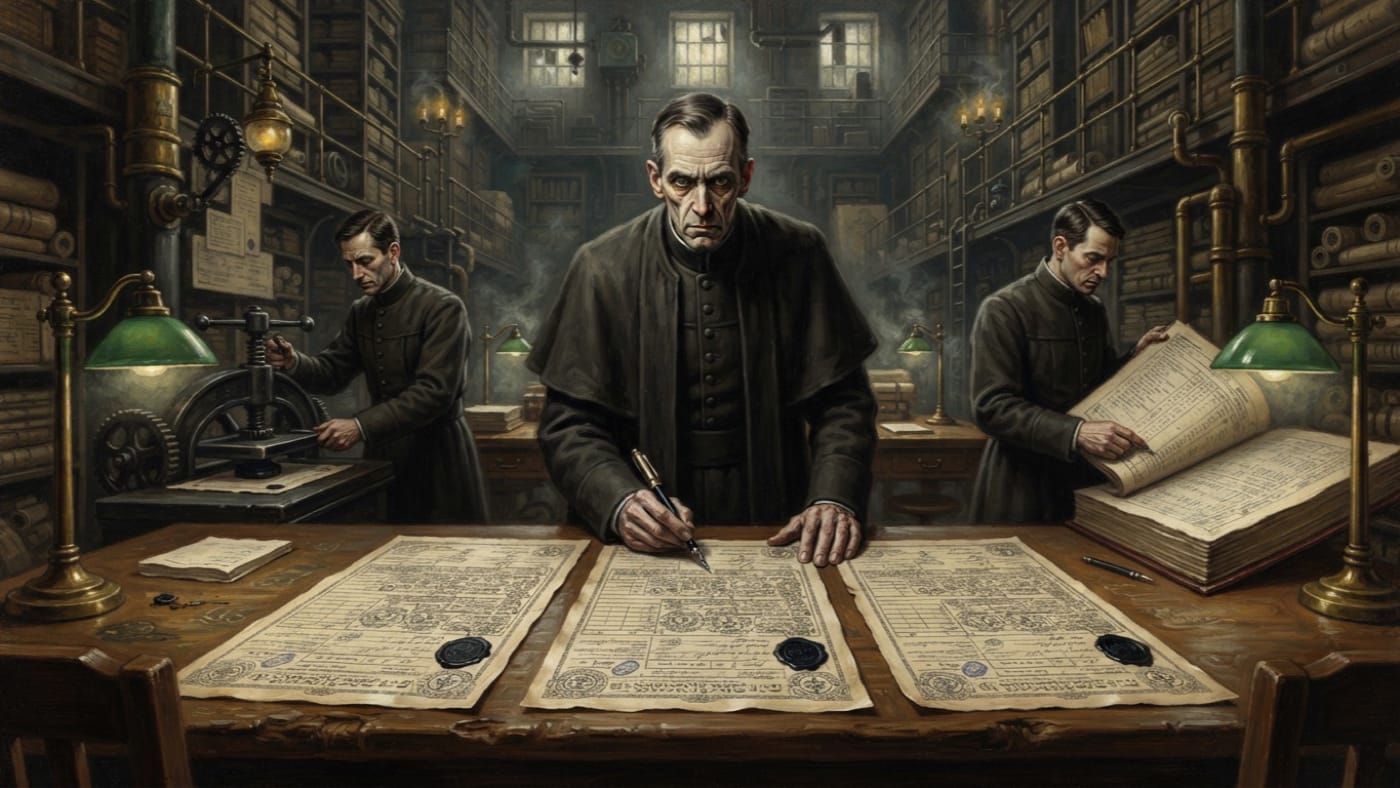
Form 77-D is the Dissolution Writ (Standard) of the Bureau of Records, and it is the most exact sheet of vellum the Church produces. A canon can be argued over for a generation. Form 77-D allows no argument, because nothing on it can be argued with.
The Bureau classifies Administrative Dissolution as a filing action, and the writ is what sets that filing in motion. It identifies one entry in the Great Ledger of Souls. It names the office that wants the entry struck. It carries the signature that permits the striking. Then it goes into a drawer, and a parishioner who rose in the morning as a person on record ends the day reduced to a matter of record-keeping.
The Bureau counts its dissolutions from A.S. 80. It has not told me when this numbered form was first drafted, or by whom, and I have not found an original in any vault I am permitted to enter. What follows is a survey of the instrument as it stands in A.S. 201: its particulars, its route through the offices, and the one thing it refuses to say.
#On the Particulars
The writ asks for five things, and it asks for them in a hand the scribe can read without a glass.
First comes the name to be struck. A name on its own is worth nothing to the Ledger. The parishes of the western heartlands are crowded with Johanns and Maries, and a name with nothing to fix it could land on any of them. So the second particular is the parish of registration, which tells the archive which volume to lift from its iron cradle. Third and fourth are the folio and the line number, and between them they point at one entry and only one. These are the particulars that matter. A clerk may misspell a surname and be forgiven. He may not mistake a line.
The Records Scribes understand why. Their trade is a long war against duplicates: one man entered twice under two spellings, two cousins entered once under the same. Before any striking goes ahead, an Erasure Notary checks the identity anchors, and the notaries have a word for the failure they fear most: wrong anchor. A wrong anchor means the grid has been drawn across a stranger. Folio and line are on the form so that all the Ledger's precision can be turned against exactly one soul.
The fifth particular is the Bureau that originates the request, meaning the office that wants the name gone. That office is a different one from the office that strikes, and the writ keeps the two apart on the page.
Then come the conditions. The writ must be submitted in triplicate. It must also carry the countersignature of a Chief Archivist of at least Third Rank. How many ranks exist, whether Third sits above Fourth or below it, and how a man comes to hold one, the form does not say. It sets a threshold and trusts the archivist to know whether he meets it.
That makes three hands, kept apart. The originating Bureau asks. The Chief Archivist countersigns. Later, and in another room, the scribe draws the grid. None of them performs the whole act.
Three copies are required, and a fourth is a crime. The stamp does not print the penalty, and I have never met a clerk curious enough to look it up.
#On the Separate Reason
The writ does not say why.
It has no field for a reason. Reasons are filed separately, under seal, in the annex of the Bureau of Doctrine. The particulars go through Records and the grounds go to Doctrine, and the two papers need never lie on the same desk.
The writ's silence proves only that the reason takes a different road. A sealed file in Doctrine's annex is still a reason. Whether the countersigning archivist reads it before he signs is a matter between him and Doctrine, and the form neither requires it nor forbids it. What the separation does guarantee is smaller and more useful. The scribe who draws the grid has in front of him a name, a parish, a folio, a line, an office and a signature, and nothing that would invite him to weigh any of them.
As for the annex, I am told it does not open from the outside, and that requests to open it are filed inside it. I repeat this as it was told to me. I have never been invited to test it.
So a writ can be perfect. It can be audited: its copies compared, its seals scraped, its signature held up to the lamp-oil flame. It will pass every time on its own terms. Whether the soul at that folio and line deserved the grid is a question no audit of Form 77-D is built to ask.
#On Execution and Notice
When the three copies agree and the signature meets the threshold, the writ goes to the scribe assigned to strike. He lifts the folio from its cradle and lays it on cold stone. He uses Mortuary Black, an iron-gall preparation thickened with bone ash, and each batch is consecrated by a chaplain of the Bureau of Rites before its jar is sealed. The ash grits faintly under the brush. The work takes eleven minutes: vertical lines first, then horizontal, then a diagonal cross over the name-entry. The scribe changes the marginal status to Ø. The folio goes back to its cradle, and the writ is filed.
That is everything the form makes possible. The striking happens in the Ledger, and no Mortuary Black ever touches the writ. The name stays on the page beneath its grid. No page is torn out and no blank is left behind. This is why the writ demands an existing folio and line. An excommunicate keeps a legible entry, censured but still readable. An unlisted vagrant never had an entry, so a writ has nothing to point at. Form 77-D works only on a soul already on record.
The person, meanwhile, goes on standing wherever he stood. Bureau Circular 221-R calls his condition praesens sed abrogatus: present, but abrogated. The consequences follow from the way the Ledger is indexed. He cannot marry. He cannot pay a tithe the Bureau of Tithes will accept. He cannot confess or hold property, and the Bureau of Mercy will not lay him in consecrated ground. The writ lists none of these. It changes one mark in one margin, and every office indexed against that margin reads the change.
The notaries carry the change outward. Their profession treats it as a duty to send notices on to the dependent registers: ration rolls, gate logs, the lesser parish indices. They dread the ghost right, an entitlement still alive in some subordinate roll after its holder has been gridded. Their slang for a man in that state is double-dead. None of this notice work is printed on the writ. The profession built it up around a form that assumes one mark will be obeyed everywhere.
The scribe recites a prayer during the striking.
The companion entry once said this, and the sentence has been withdrawn there. No prayer is prescribed. The Bureau of Rites proposed one, and Records refused it on procedural grounds.
#On the Related Classification
Records also files certain cases under the designation 77-D(b). These cases begin without a writ. Nobody originates them and nobody countersigns them. They begin with an observation: a scribe tries to record a soul long exposed to sorcery beyond the Sagittal Line, and the quill skips, or the letters refuse to take. The chaplains say such a soul has lost its true name. I record that as the chaplains' reading of the matter. Whether it is an explanation or a pious description of a failure nobody understands, I cannot settle, and I would distrust anyone who claims he has.
The Bureau of Purity has its own views on what fails in the Ledger, and has put them in writing. Records files these cases under an instruction of its own.
The difference between 77-D and 77-D(b) should be stated plainly. The first authorizes an act. The second files a phenomenon. The first is a decision taken by three separate hands. The second is a clerk admitting that some decision was taken somewhere else, by something that never countersigned anything. Putting both under one number is tidy, and the Bureau prizes tidiness above most of the virtues and several of the sacraments.
#On Correction
Form 77-D has no provision for reinstatement. The Bureau holds that a dissolution cannot be reversed, and the form agrees by saying nothing. It has no field for undoing and no counter-writ. The Creator keeps His own books. The Bureau keeps these, and on the question of correction it has kept nothing at all.
The Bureau's certainty, however, rests on its own ledgers. Parish clerks in outlying hamlets, whose rolls are not indexed against the Ledger, sometimes keep a name the central registry has struck. Children hidden by relatives, or carried off by the Pale Kin Runners, sometimes keep their parents' names in their heads. Records calls these archival errors. The Silent Godless call them proof that the Ledger can fail. I call them names written down in places no writ was addressed to. They do not make a cure, and nobody should mistake them for one.