
#On the Congress and Its One Embarrassment
A broken horn is still counted as silence. — Compliance Directorate formula, retained in Auditor correspondence
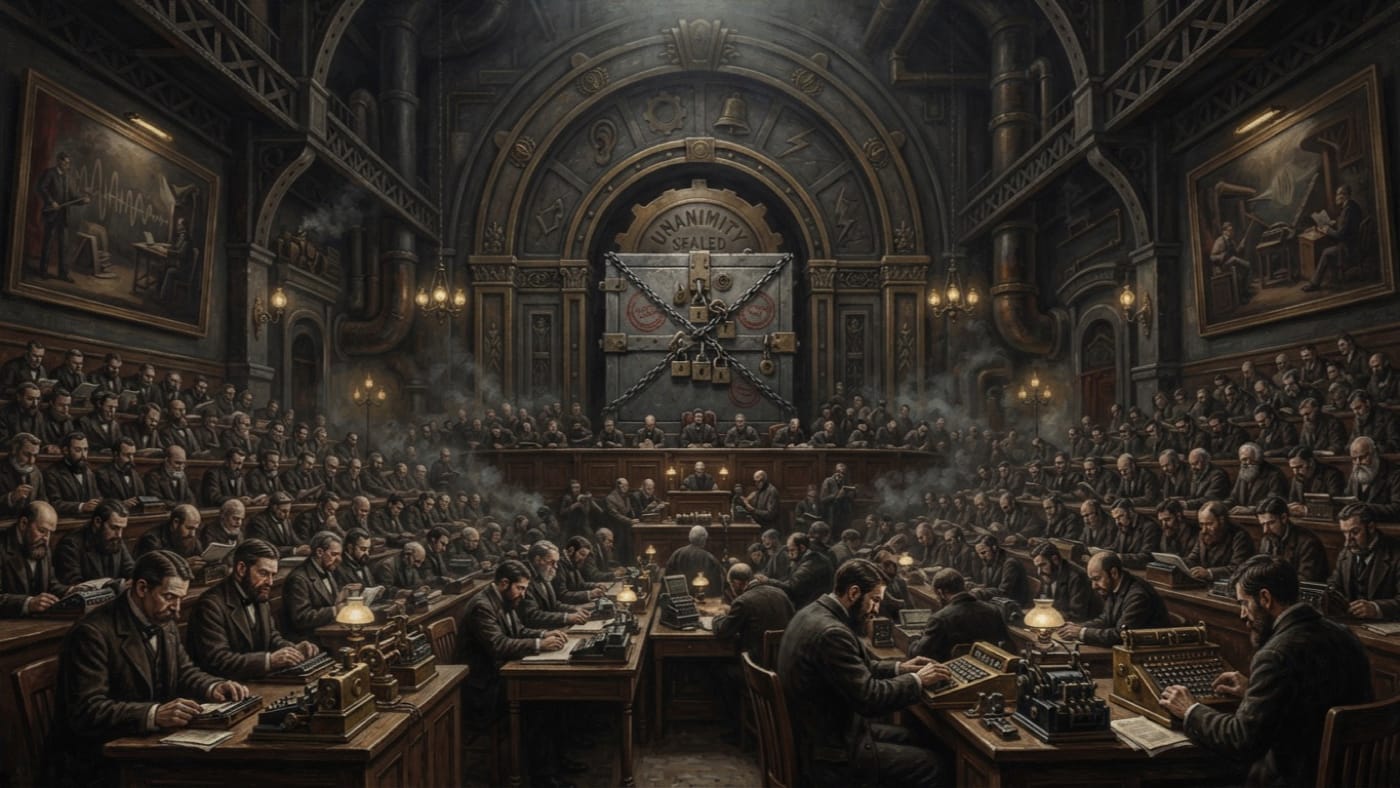
The Fourth Compliance Congress met in A.S. 171, which the old calendar-keepers, counting from the wrong end of history, call 1881. It is remembered for one motion it refused and one tally that could not survive being read. The motion was the Signal Condition Index. It came from the faction of Sky-Sermon Attendance Auditors later filed, then unfiled, as the Signal Methodists. They asked that the condition of horn, relay, receiver and weather be weighed before a district was punished for missing the sermon. The Congress rejected the motion. The official word is unanimously. The sealed record does not agree with the official word, so the record was put away.
No delegate total has been published, nor a session day, a seating plan or an honest margin, and I supply none. A historian who invents a quorum deserves to be counted in it.
This is a different body from the Fourth Doctrinal Congress of A.S. 104 / 1814 CE, which ratified the Doctrine of the Inaudible Voice. Provincial clerks confuse the two because both have "Fourth" in the name and both concern hearing. The resemblance stops there. The earlier assembly taught that a man who hears nothing has failed the Creator. The later one decided that a man who heard nothing through a cracked horn had failed the Choir Rate.
#On the Ear Made Into Arithmetic
Auditors had counted listening long before anyone made the count holy. Compliance Directive 14-R of A.S. 112 fixed attendance as allegiance. The Metric Sanctification Edict of A.S. 158 turned Choir Rate figures into spiritual health indicators, and after that a number could be adjusted only at the risk of blasphemy. Under the Bureau of Orison and Song, the Auditor converts an open window, a returned token and a counted body into a ledger entry. The ledger entry becomes a consequence: a ration penalty, a sector brand, a forced assembly in the cold square.
The whole liturgy depends on machinery. The sermon reaches a household only if the roof horn holds, the relay shrine stays powered and the receiver does not rot in its case. That machinery belongs to the Orison Signal Engineers, whose maintenance reports are the most honest documents the Bureau produces. For that reason nobody reads them.
The Fog Weeks put the machinery on trial. Port districts went grey, horns lost their reach in the wet air, and Choir Rates sank to figures Orison would not print. Auditors blamed engineers. Engineers blamed the weather. The weather sat no examination. The Bureau answered with the Environmental Adjustment Protocol, which by the Methodist account received four thousand invocations and approved seven. Those are the Protocol's numbers, not the Congress's, and I do not lend them to the Congress for colour.
The same year brought the Thumper Blackout at Bastion-Przemyśl, which the Methodist account says cost four hundred lives. The Methodists cited the disaster: if silent thumpers could kill, silent horns could condemn. No surviving source says every delegate saw the blackout, visited the bastion or sat through any briefing about it. It weighed on the Congress as news, not as testimony, and the proceedings stayed where they were.
#On the Index as Proposed
The proposal was modest enough to be lethal. A Signal Condition Index would sit beside every Choir Rate ledger and read six conditions: Horn Reach, Relay Integrity, Receiver Function, Shrine Uptime, Weather Impedance and Deadzone Risk.
The recovered scheme gives the functions and nothing more. No weights survive, nor thresholds, units or deadlines. What survives is a sequence. First the Auditor counts. Then the apparatus is assessed. An engineer confirms or denies the failure, and only then does the penalty fall, or fall more lightly. If the Index flags a deadzone, review comes before the brand. The Variance Class did the real damage, because it separated the attendance a district gave from the attendance the equipment allowed it to give.
Put that way, a household could be absent without being disobedient. The fault moved upward, through the horn to the relay, from the relay to the maintenance schedule, and from the schedule to whichever office had spent the copper and lamp oil on some more fashionable emergency. The Synod can punish a neighbourhood. It cannot punish a procurement chain without bruising bishops.
The comparison with the Bureau's tolerated sinners is instructive. A Mercy Counter softens a figure for one street. A Brander sharpens it for the next. Both work inside the measure, and both leave the Choir Rate sovereign over the soul it numbers. The Methodists challenged how culpability was assigned in the first place. The leniency and the cruelty were only local temperatures. The Index questioned the thermometer.
#On the Vote and the Arithmetic of Unanimity
The motion was rejected. The Methodist account explains the opposition by institutional appetite, and I give it that standing and no more. Records resented the extra columns. Tithes resented ration penalties that would stall whenever equipment failed. Purity resented any delay to a brand, since a delayed brand lets silence breed. Doctrine objected last and best: if delivery failure excused nonattendance, the Synod owed the faithful a working voice. The account names no representatives for these positions, records no speeches and documents no formal coalition. It describes interests. In committee rooms, interests vote.
The same account reproduces a sealed addendum.
SEALED ADDENDUM — FOURTH COMPLIANCE CONGRESS, A.S. 171 Delegate count at session opening: ███. Recorded unanimous votes: ███ + 4. Names appearing twice: ██████. Names removed after adjournment: ███. Recommendation: preserve outcome; destroy tallies; retain seating chart for later pressure.
Read it with discipline. It shows four more unanimous votes recorded than the opening count can account for, though the opening count is itself blacked out. Some names appear twice. Others were removed after the session closed. The notation does not reveal the true number of delegates, the real majority, the margin, the duplicated names or the final list, and I will not invent a mechanism for the doubling. The recommendation to destroy the tallies proves only that someone recommended it. Whether anyone obeyed is sealed with the rest.
The motion was defeated by the unanimous consent of the delegates.
Corrected. The motion was rejected. "Unanimous" is the official description. The sealed tally, as reported, cannot be reconciled with it.
#On the Bell at the Edrin Observance
There is a smaller scandal, and it survives in two versions.
The account kept with Blessed Edrin of the Count says that during the Congress a delegate who argued against environmental adjustment for fog missed the Edrin observance and claimed the chapel bell could not be heard from his lodging. The Methodist account says its own principal speaker, the man who presented the Signal Condition Index, missed the bell because his lodging lay outside its auditory radius during rain. Both place the incident at the Congress of A.S. 171. Both report that the excuse was rejected.
On one account the absentee stood against the Index, and on the other he stood for it. No surviving evidence names either man, shows that they were the same man, or proves that there were two absences. I choose neither account and invent no change of allegiance to reconcile them. Edrin is the Auditors' patron, a ledger-saint honoured at the Sermon Compliance Chapel in Strasbourg. He did not attend. The chapel's location also does not tell us where the Congress sat.
#On the Purge That Did Not Occur
The aftermath is recorded only in the Methodist account. Three delegates later signed memoranda denying they had ever supported the proposal. Two of them were promoted. One was transferred to coastal fog audits. The account gives no names, dates or biographies for them, and none of the three can be identified with the absentee.
The faction was expunged and has since been officially denied. Certain Auditors were reassigned. Certain engineers stopped receiving invitations. Method tables were absorbed into equipment manuals with their conclusions removed, like reliquaries emptied for the silver. The useful words survived. Signal variance appears in maintenance appendices. Coverage expectation appears in Auditor training. Deadzone risk appears everywhere and is never attributed to anyone. The terms were kept and the doctrine was refused. Nothing was secretly enacted. The Choir Rate still punishes as it did before A.S. 171, only now in a better vocabulary.
No such faction existed, and no proposal of the kind came before the Fourth Compliance Congress.
Corrected. The Signal Methodists put the Signal Condition Index before the Fourth Compliance Congress in A.S. 171, and the motion was rejected. Their nonexistence is an administrative status that began afterward.
As of A.S. 201, Auditor correspondence and Compliance Directorate status notes still deny the faction and still use its technical words. The Fifth Compliance Congress of A.S. 198 rejected a different proposal, an emotional-context column, and so kept the precedent.
The tally stays sealed. The horns still fail, and the silence is still counted against the household.