
#On the Graders' Station
"Safety standards." — the Union's public doctrine, recited in full to any official who asks
The Graders' Quiet Union holds no charter, keeps no seal, and appears in no register kept by the Cooperage Compact, the White Steps or the lock provosts. I can certify no founding year for it and name no founder. I have searched. The Bureau of Records has searched. The Union, which has a professional objection to being searched, has outlasted us both.
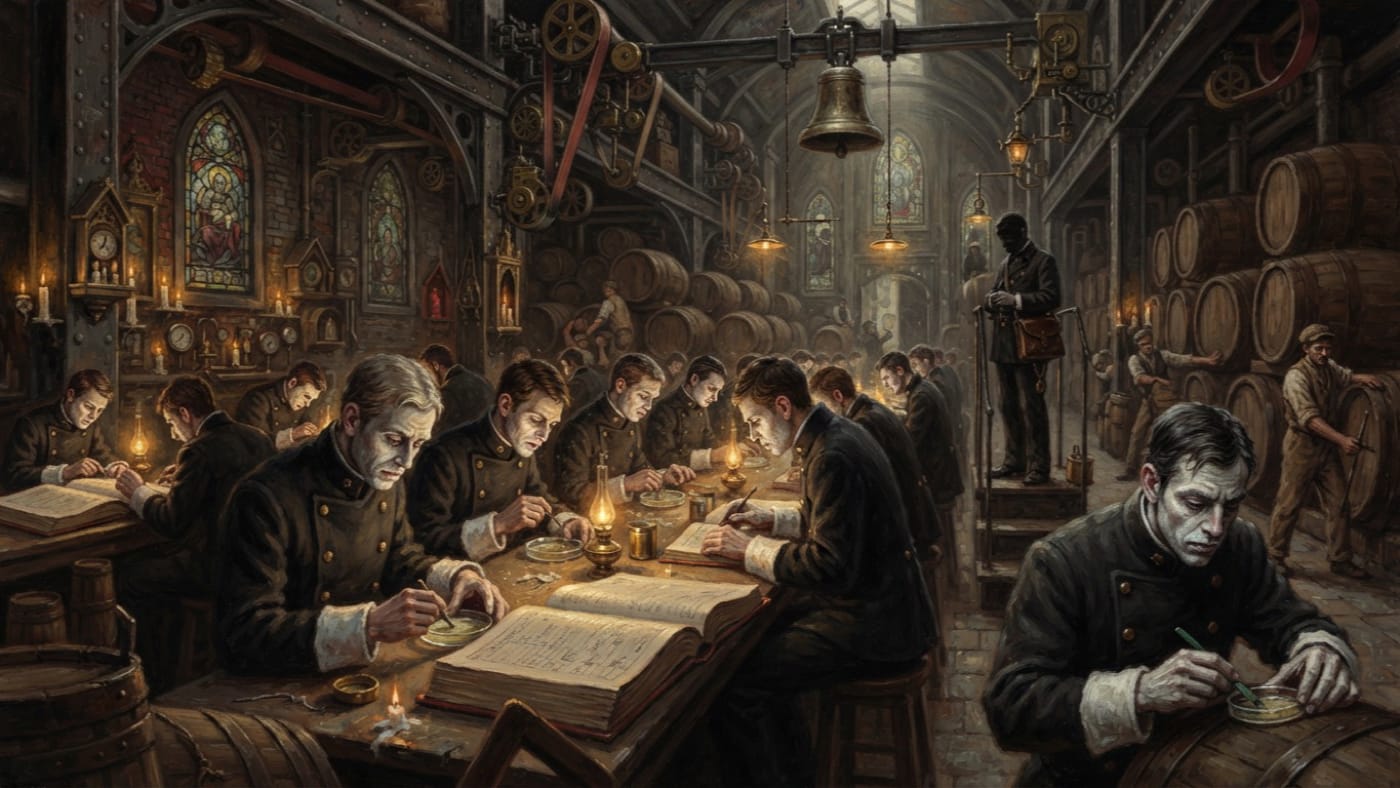
What it does possess is a room. In the Grading Hall of Settled Light at the Saint-Dust Cooperage of Mournwater, samples of saint-dust are laid in shallow glass dishes during the daily settling prayer. Accepted dust falls into rosary strata, ring under ring. Bad dust hangs, drifts, rises, or settles into the shape of a finger and waits to be noticed. A grader in chalk cuffs bends over the dish under a vinegar lamp, measures with callipers, enters the result in a ledger, and reports. That is the full extent of a grader's lawful reach: dish, ledger, report. The seal is pressed elsewhere, on the White Steps, by the office of Purity Prefect Sister Halvein, and the seal is what a lock provost reads.
The Union lives in the gap between seeing and sealing.
Graders occupy the anxious middle of Mournwater's ledger, beneath certifiers and guild masters and above the dock crews and the quarantine poor. They work mandatory rotations. Many work against debt papers. All of them confess. A grader whose hands shake confesses tremor, a grader who hesitates confesses doubt, and the White Steps file both confessions where they can be reread at a convenient hour. Mournwater keeps its graders the way a sacristan keeps candles: counted, trimmed and replaced at the first gutter.
Ask the Union what it does and it will say safety standards. That is true in the narrow sense that a lie on oath is narrowly true. Its actual work is to know where the taint is, to keep that knowledge from the people who would destroy it, and to sell it to the people who will pay.
#On the Quiet Methods
The record lists three methods: silence tests, whistle codes and slowdowns. Lately the casks themselves have added a fourth.
I can describe the silence test only by its name and its venue. The Union does not explain its sacraments to the Bureau of Doctrine, and I decline to invent them on its behalf for the amusement of provincial readers.
The slowdown must be distinguished from the bell. Every day the Settling Bell silences the whole town, and the silence lasts until the dust settles or until the graders can name the cause. That silence belongs to the Synod. A slowdown belongs to the graders. The callipers are held a breath longer. The entry is checked twice. The report travels from bench to White Steps at the pace of a penitent on the knees. Nothing in the procedure has been breached, and every cask in Mournwater waits. The futures clerks notice within the hour, because cask rates move on delay as surely as on condemnation.
Whistle codes carry where speech is unwise, across the Hall and down toward the water. They stop under the bell with everything else. I am told some boatmen repeat what they hear without understanding a note of it, which makes them, in the Bureau's estimation, ideal clerks.
Then there are the marks. Suspect casks now leave Mournwater with private signs scored into the hoop grooves and pressed into the wax ridges. The signs tell a dock crew which cask to avoid, which to sell, which to lose, and which to handle as though it were watching. I will print no reading. No reliable one exists in my files, and an unreliable one printed under a Bureau seal would get loaders killed with official approval.
The crews read unevenly. Some read the marks well, some poorly, and some by superstition alone. Silt-Rook Dema keeps shop in the gap between reading and guessing on the Backchannel Needleway and sells interpretations by the phrase. The same scratch in the same hoop can spare a loader's lungs or improve a speculator's evening. The Union does not appear to have chosen between those uses. It has the habits of a confraternity and the prices of a counting-house.
The graders pay first, as everyone who handles Crumble-Wrong dust pays first. They cough chalk-white over the benches. Their gums go pale. A grader who spends a rotation reading dust breathes some of it, and a grader who breathes enough of it eventually confesses tremor.
#On the Files Against the White Steps
The Union's files hold evidence that Sister Halvein passed tainted dust during the A.S. 197 contamination scare. I cannot describe that evidence. I do not know whether it is a page, a sample, a ledger line or a living witness, and anyone in Mournwater who claims to know is selling something, probably to the futures clerks.
The Mournwater survey of A.S. 201 places the evidence in the Union's files and nowhere else. Its existence binds both parties. Disclosure ruins the Prefect, and with her every seal her office pressed that season. It also proves that a covert net has kept private records inside a Synod facility, so whoever produces the file confesses the net that kept it. The Cooperage Audit will meet the same arithmetic whenever it arrives. It needs the Union's eye. It cannot accept the Union's testimony without reading the Union's marks.
Halvein tolerates the marks. Arresting the people who make them would leave Mournwater without the people best able to recognise contamination, and the Prefect is many things, none of them careless about her own supply. I record this as a dependency. It has no signature, no witness and no term. Either party can end it on any morning the bell fails to ring twice.
Master Cooper Vell Arno heeds the marks that threaten profit and walks past the rest. Dema reads every mark and resells it. The futures clerks pay for the earliest word of taint, because early word of a condemnation is worth more to them than any honest grain of saint-dust.
A.S. 197 contamination memoranda attributed irregular settling to "improper storage humidity and dockside handling negligence."
Withdrawn. By every account, the Union's files hold evidence touching the certification itself. Humidity does not sign for a batch. Handling does not keep files.
#On Missing Graders
The Union names a grader's disappearance as its cause for action. The record contains no instance of that action.
In A.S. 198 three graders submitted sealed reports to the Bureau of Rites concerning whatever grinds the bones upriver. They were later transferred to the Crumble Ward for observation. The reports are dated. The transfer is not. No record states whether they belonged to the Union. Their present condition sits in patient records held by the Crumble Ward Sisters, a separate order that answers to the Union in no particular.
In A.S. 199 Elian Voss collapsed at Dish Twelve after speaking a phrase the record withholds. The silence that followed lasted nine hours. Voss's body is entered as unavailable. Nobody has certified death, survival or abduction, and no record places Voss in the Union.
GRADING HALL INCIDENT 199-SB / DISH TWELVE: Grader Elian Voss spoke the phrase ███████ ███████ before collapse. Body: unavailable. Union membership: not recorded. Union response: no entry.
The danger to the Union is practical before it is sentimental. Each missing grader leaves the benches one trained eye short and leaves a confession file in an office that no longer needs its author. Each disappearance also teaches the remaining graders what a sealed report costs. The A.S. 198 reports went up sealed, and their authors went to observation. The Union now writes in hoop grooves. I draw no conclusion in print.
#On the Work That Continues
As of A.S. 201 the Union has grown bolder and the Grading Hall stays open. The graders know the shapes in the dishes come more often than before, and with more particular anatomy. They know the upstream reports were suppressed. They keep grading. Work still reaches the White Steps, the seals are still pressed, and on most days the bell rings twice.
The joint review by the Bureau of Alchemical Standards and the Bureau of Rites closed in A.S. 200 with second-settling guidance. Second settling catches the obvious taint. It misses dust that settles true at Mournwater and turns in the cask on the way to the Sagittal Line. It also gives way to supply-priority exceptions whenever a quartermaster signs loudly enough. The review is finished. The audit is pending. They are separate documents, a distinction the Compact finds tiresome.
Suspending the grading would empty the trench shrines, starve the field hospitals of salve, and leave the Bureau of Orison and Song without the dust it laces into broadcasts against the unhymns of the Pale Chanters. Continuing sends questionable casks down the river with a scratch in the hoop and a seal on the bung. Either choice fills the Crumble Ward. The Union has chosen the one that keeps the graders employed, the information priced and the Line supplied. It marks the casks it cannot stop.
"Mournwater never ships tainted." — standard certificate clause.
Withdrawn from this office's usage. The clause remains on the certificates. The marks in the hoops dispute it cask by cask.