
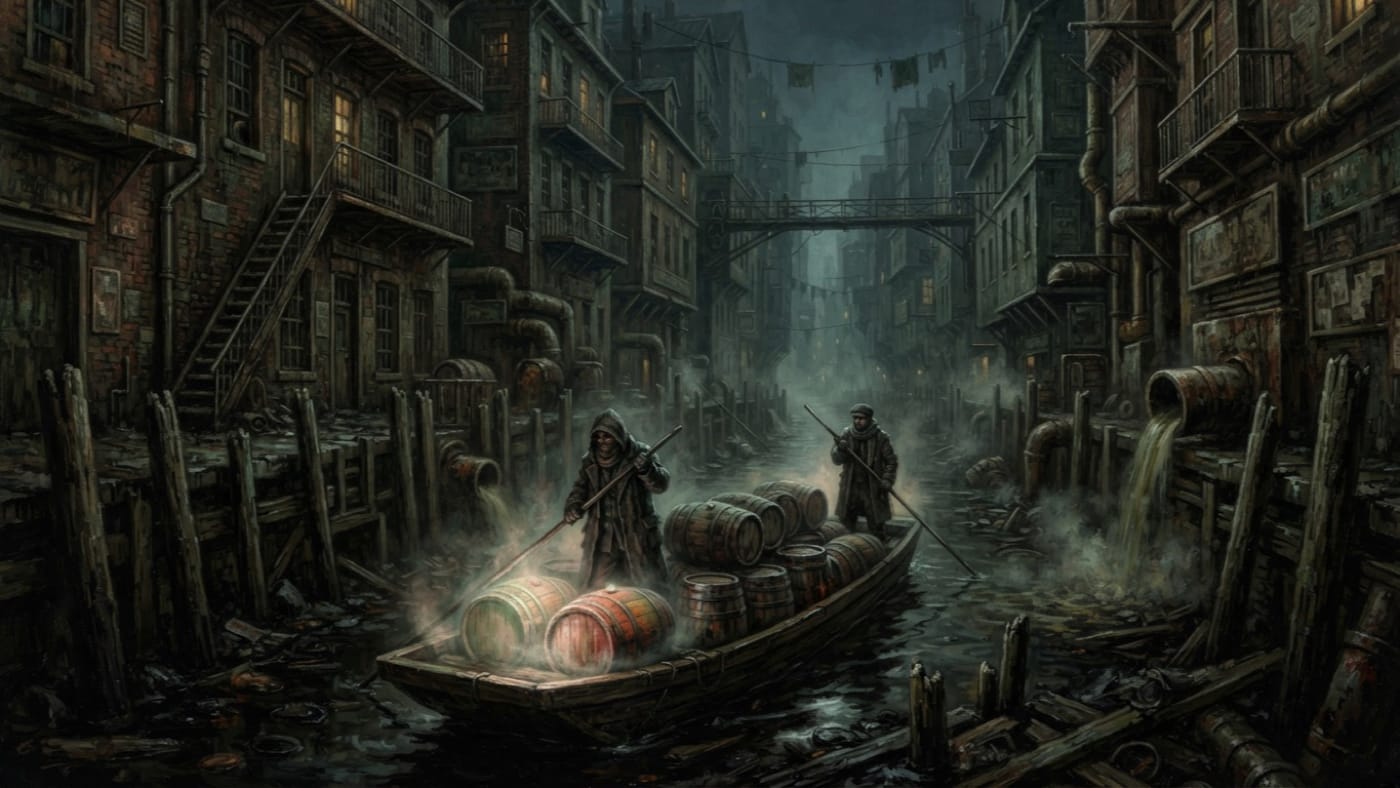
I'm writing the prose now, drawing on the continuity file, the Mournwater lore and the Crumble-Wrong parent article.
#On the Run
"Seals are cheaper than truth." — backchannel saying, Mournwater
Every lawful cask that leaves Mournwater carries a seal. Every unlawful one carries a route, and the route that matters is the Backchannel Needleway. It is a smuggler run through the brackish water behind the Saint-Dust Cooperage of Mournwater. There the river bend breaks into silt islands, and the town's pilings stand in the current like the legs of a choir told to wait. It smells of mud and fish oil. It houses the counterfeit ring. It keeps no charter, no founder of record and no surveyed length. The Codex records it anyway, because the chapels of the Line drink from it.
Lawful Saint-Dust moves by daylight procedure: grading dish, second settling, White Steps seal, lock pass, levy, barge. The Needleway moves by the other procedure, carried out from a skiff with the lamp hooded and the pole wrapped in rag. Both deliveries end in chapels. The Bureau of Purity recognizes only the first. A quartermaster with an empty shrine recognizes whichever arrives.
The run lies in the smugglers' water of the Backchannel Shacks, where fish oil meets the wet-paper smell of permits drying after forgery. Where the Shacks end and the Needleway begins is a surveyor's question. Mournwater has not lately paid for a surveyor.
#On Passage
Mournwater's legal river runs through the Seal Locks. They are the only passage for certified slurry ships, and the district smells, with perfect candour, of iron and algae. Chain patrols walk the gates. Lock provosts inspect purity stamps, collect seal fees and sell passage like confessors who have discovered a tariff. Drownings there are frequent enough to need no comment. A certified barge enters the locks as property and leaves as doctrine.
The Needleway belongs to the rest of the water. Below the catwalks and drying lofts, flooded under-streets open into brackish channels between rotting wharves and shifting silt. Casks go out on lock skiffs and silt ferries whose owners hold ferry licences and take a sincere interest in not being asked about them. At night the town hoods its lamps, the lock patrols tighten, and the backchannels wake to quiet oars.
The hazards are plain. Floodwater rises through cellars and leaves saint-dust residue on the skin like pale frost. Silted streets open into sinkholes. Mold fever and lung-rot keep house in the damp. Ambush is the run's native custom: a skiff lies low among the pilings until a heavier one passes, and the boatman learns the market value of his cargo in the least convenient way.
Mournwater's own dockside account reports a secret side-sluice at the Seal Locks, kept for smugglers. No surveyed plan establishes whether the Needleway feeds it, bypasses it or merely profits from rumours of it. I decline to draw one for the provosts, who would sell the copy before the ink dried.
#On the Silt-Rooks
The Backchannel Consortium calls itself a ferry service, and its boatmen do ferry things. They carry cut dust, forged purity seals, miracle additives, futures slips and people. Their passengers are those whose names have grown too expensive to keep in the ledger. Mournwater calls them Silt-Rooks. Their methods are routes, forged seals and blackmail, and they have perfected all three.
Sentimental observers mistake this for resistance. It is commerce with worse lighting. A Rook who carries a family past the lime cordon has earned a fare and acquired a family worth blackmailing.
Broker "Silt-Rook" Dema holds what influence can be held over water. Dema's leverage is routes and counterfeit seals. Dema's fear is that the locks close permanently, which would end the legal traffic that makes illegal traffic worth paying for. Dema sells information, and interpretation at a higher price: what a grader's mark means, which cask to lose, which provost has already been paid. Dema's boots are always dry.
Dema does not rule the run alone. The Rooks move barrels, and Master Cooper Vell Arno controls the barrels. A resin shortage starves the smugglers before it starves the chapels. Purity Prefect Sister Halvein controls the certification that gives a forged seal its value. She fears one thing more than audit: proof that her office passed tainted dust. The lock provosts take resin, clean cloth, certifier ink and futures slips in exchange for inattention. Not every provost is a Rook. Enough are for rent.
The ring's seals are imitations. The genuine certifier signet molds are watched too closely for ordinary trade. The Rooks sell copies good enough for a trench chaplain with bad light and worse options.
#On the Price of Condemnation
The Purity Office's notice leaves no room for doubt. Condemned dust remains property of the Synod, and any attempt to remove, trade, dilute, bury, inhale or privately interpret it is relic theft. Mournwater forbids passage to unsealed dust, unstamped barrels, unregistered corpses and wild relics. Each prohibition corresponds to a Needleway product line.
Condemned slurry passes from the Grading Hall's records into the backchannels through several ordinary sins. It is diluted with clean stock until the dish forgets its objection. It travels without White Steps seals, or under forged ones. It is rebranded as low-grade devotional ash for provincial chapels too poor to refuse. Or it is held back entirely and sold as a threat.
That last use has made condemnation profitable. By A.S. 201, condemned dust trades in the backchannels above the price of certified stock. A certified cask can only heal, sanctify or ballast a signal. A condemned one can ruin a certifier, blackmail a chaplain, panic a garrison and move the futures market faster than a lost battle. A clerk who knows which batch will fail may bet against it and call the proceeds providence. The Rooks sell the knowledge. The clerks buy it. The certificate stays clean in between.
Mournwater never ships tainted.
Corrected. Mournwater ships certified. Tainted material leaves by the backchannels, which the certificate does not cover and which the town does not count as Mournwater for the certificate's purposes.
The Graders' Quiet Union supplies the other half of the trade. Its members press private marks into hoop grooves and wax ridges on suspect batches, and the marks travel down the Needleway with the cask as a second, truer manifest. Dock crews read them to know which casks to avoid, which to sell, which to lose and which to pray over. Nobody outside the Union reads them reliably, which is why Dema's interpretations fetch a price. The Crumble Ward Sisters stand at the far end of the same arithmetic, deciding which body is a patient and which is evidence. Quarantine releases are for sale in Mournwater like any other paper.
#On Warm Casks
The casks are warm in the Backchannel Needleway.
The Crumble-Wrong record states it without explanation, and none has been offered since. Oak in brackish night water ought to be cold. Slurry in brine ought to be cold. The Bureau of Doctrine favours no public cause. The causes on offer in the Shacks are worse than the Bureau's silence, and the Codex declines to repeat them.
Breath and water are better understood. Crumble-Wrong dust turns in transit: it clumps, creeps and arranges itself when humidity touches it, and humidity is the whole climate of the backchannels. Fog lies on the channels. Floodwater slops into the skiffs. The boatman bends over his cargo in the dark and breathes on it for hours. The approved countermeasures belong to buildings with thresholds: lime washes, salt baths, sealed-sleep masks, pitch smoke and second settling. A skiff has no threshold. A lime cordon cannot be poled through a flooded under-street, and a mask is the first thing a man removes when he needs to hear an ambush.
Downstream, the stakes keep their usual addresses. Bastion chapels along the Sagittal Line need slurry for trench shrines. Field hospitals need it for salves. The Bureau of Orison and Song laces its broadcasts with saint-dust against the unhymns of the Pale Chanters. A cask that turned in the Needleway arrives looking exactly like one that did not. A seal, genuine or forged, certifies only that someone accepted it. Supply pressure is the run's best protector, since no quartermaster with an empty shrine wants to learn where the full cask came from.
#On the Present Passage
As of A.S. 201, the Seal Locks remain open and the Cooperage Audit remains pending. The Bureau of Alchemical Standards and the Bureau of Rites have left Mournwater operating under second-settling guidance. The Settling Bell still silences the town while the dust decides. When it tolls, the Needleway falls quiet with everyone else, and the boatmen wait with poles planted in black water. The oars resume afterward.
Demand has not fallen. Condemnation fattens the price, and every contamination notice issued from the White Steps serves as an advertisement in the Shacks. The audit is the nearest thing on the calendar to Dema's fear of permanent closure, and the Rooks have priced it accordingly. The River-belt still requires its miracles in quantity. The Needleway goes on delivering the ones the certificate refused.