
#On the Banks Upstream
"If it settles, it's true." (Cooperage Compact oath, administered at the Seal Locks since A.S. 104)
Two days above the Saint-Dust Cooperage of Mournwater, the river forgets it was ever in a hurry. It spreads out and slows, and it settles among low banks the colour of boiled linen. These are the Ossuary Shoals. The Codex prints the name because the Codex is a restricted instrument and its readers have already signed for their own discretion. Mournwater does not print it. Mournwater does not say it, and when the subject cannot be avoided a person there points upriver with the chin. Speaking upstream source names is forbidden in that town, and the town keeps the rule with a devotion the Settling Bell might envy.
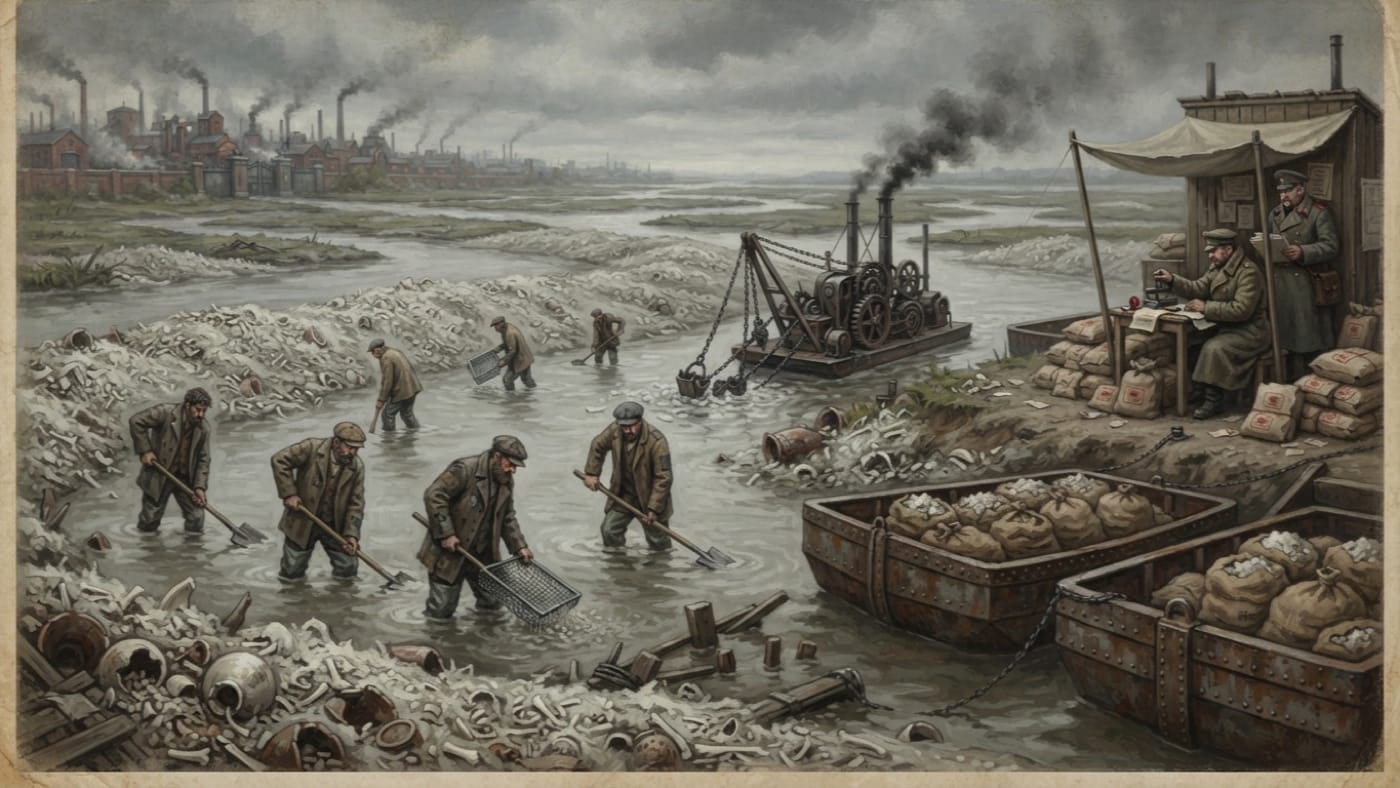
The banks are white because of what they are made of. Relic jars, broken and whole, have settled here among the ordinary silt. So have shattered reliquaries, battlefield ash, chapel sweepings and the overflow of ossuaries that ran out of shelving before they ran out of dead. No clerk can now say where sediment ends and inventory begins. The marsh-edge cemeteries lie along the margins, and the marsh does not respect a sexton's boundary any more than it respects a surveyor's.
The channels between the banks are narrow and shifting, and every account that bothers to mention them calls them treacherous. That is the whole of the published geography: a marsh in the River-belt two days upstream of Mournwater, with white banks and bad water. The public maps show that much.
The source map shows the rest, and the source map is a different document. At Mournwater you can buy testing results, seal allocations and quarantine releases. You cannot buy knowledge of where the dust is harvested. Upstream information counts there as a form of wealth, alongside clean lungs and certification ink. I record that the Shoals exist. I do not record how to reach them.
#On the Recovery
The work at the Shoals is salvage. In the Church's hands, salvage is a legal procedure before it is a physical one. The physical part is bad enough.
Crews go into the slurry up to the waist and sometimes past it, working the white banks with rakes and sanctified sieves. The salvage ordinances call this the recovery of sanctified residue. The men describe it with their backs. Each sieve-load is shaken until the water runs grey and what remains is grit, flake and splinter, with now and then an object large enough to have once had a name. The residue goes into sacks. The sacks go nowhere until the ledger has spoken.
Every pinch recovered is notarized, bagged and stamped in triplicate on waxed vellum before it leaves the field. An unrecorded remnant cannot be claimed. A recorded remnant is property of the Synod. The whole difference between a dead saint and a sack of dirt lies between those two conditions, and that difference is made of ink. In its second revision of the salvage text, the Bureau of Records replaced "silt" with "micro-reliquary substrate." I preferred "bone-reef." Records preferred to be paid.
The crews sing the Receipts of Saint Ephrath to keep their hands steady. The ordinances also warn against breathing in what one is gathering, in the tone of men who learned the lesson at some cost. Nobody has yet survived powdered sanctity in the lungs for long.
The ledger does not record provenance. It records recovery. A martyr's knuckle and the contents of a sacristan's dustpan arrive in the same sack under the same stamp. Downstream, the grading will decide what grade the mixture deserves. Nobody upstream is paid to wonder what it was.
#On the Cargo Downriver
The earliest dated proof of the Shoals' trade is a wreck. In A.S. 98 a barge carrying forty-two reliquary jars from the Shoals capsized upriver of Mournwater. That is upriver of the town; the record does not place the wreck at the banks themselves. The jars broke and their contents went into the water, the silt and the staves of barrels drying on the wharves. The Bureau of Alchemical Standards confirmed residual sanctity in all three. The coopers did the arithmetic. The wreck dates the industry downstream. It does not date the salvage upstream, which was already loading jars onto barges when the river took them.
From that accident Mournwater built a sacrament with a toll attached. The Cooperage Compact was chartered under a joint seal of Records and Purity in A.S. 104, and by A.S. 110 the town had become a reliquary port. The sacks arrive. In the Grading Hall of Settled Light, samples are set out in shallow glass dishes during the settling prayer, and dust that passes descends into rosary strata. The White Steps certify it. Certified dust is suspended in brine as holy slurry, sealed in Compact casks and loaded for the railheads. None of this happens at the Shoals. The banks produce the material, and Mournwater passes judgement on it.
The casks go to bastion chapels and trench shrines, to field hospitals, and to the broadcast houses of the Bureau of Orison and Song, which mix saint-dust into their signals against the unhymns. The Sagittal Line consumes it by the cask. The Shoals are not the Church's only source of saint-dust, since the front grinds plenty of its own. They are Mournwater's source, and Mournwater supplies a great deal of the Line.
Master Cooper Vell Arno holds the barrels. Sister Halvein holds the seals. Silt-Rook Dema holds the backchannels. None of them holds the Shoals, and no record I have seen names a governor, a garrison, a charter or a boundary for them. Nobody in Mournwater governs the Shoals. Everybody in Mournwater governs what comes out of them. The Purity Office, the Compact and the futures syndicates divide the profit with the cordial greed of heirs who have agreed not to contest the will.
#On the Sealed Reports
The official account of what reduces relics to dust at the Shoals is "Providence and the natural action of water upon sanctified calcium." It is a handsome sentence. It has a theologian's subject and a chemist's verb, and it requires nobody to go and look.
In A.S. 198, three graders submitted sealed reports to the Bureau of Rites stating that whatever grinds the bones upstream is alive. The reports are dated. The graders were afterwards transferred to the Crumble Ward for observation. The transfer is not dated, and I will not date it to suit the record. Whether their claim was correct is a separate question from whether they made it. They made it in writing, under seal.
Everything else is evidence found downstream, and I give each item the place where it was found.
At Mournwater, from A.S. 194, the dust in the Grading Hall's dishes has been confirmed to settle irregularly. The condition is classified as Crumble-Wrong, Category Two. The category belongs to the anomaly in the dishes. The Shoals have never been classified at all.
Along Mournwater's waterfront, the river returns jars that no manifest ever shipped. Floodwater leaves a pale residue on skin. Casks stand warm in the Backchannel Needleway. In A.S. 200 a lock gate jammed on a paste that looked like ground bone, and the provost on duty reports that it pulsed once beneath his boot. That is his report, at that gate. It is not a sighting upstream.
In A.S. 199 the Settling Bell kept silent for nine hours over Dish Twelve. In the same year, a shipment to the southern corridor reduced soldiers who were already buried to mobile powder in their vaults. Both events belong to Mournwater and the corridor. Alchemical Standards and Rites reviewed the matter jointly in A.S. 200.
None of this tells me what is at the Shoals. A warm cask proves a warm cask, and a pulse under a boot proves the boot. Local suspicion goes further than I will: it holds that the source is not purely saint, and that the river has begun to learn how to reproduce what it is fed. I print the suspicion because people hold it. I do not print a creature, a mechanism or an operator, because I have none, and an invented one would sell better than this entry deserves.
A.S. 197 contamination memoranda attributed irregular settling to "improper storage humidity and dockside handling negligence."
Repudiated. The explanation placed the fault in the warehouse so that no one would need to look for it upriver. The explanation has been withdrawn. The question upriver has not.
#On the Present Supply
The documented condition is Mournwater's, as of A.S. 201. I have no separate survey of the Shoals to offer and will not manufacture one.
Mournwater ships. Batches are certified under second-settling guidance, and the Cooperage Audit remains pending. The Graders' Quiet Union marks suspect casks in hoop grooves and wax ridges and goes on grading. The alternative is to say aloud that the foundation of the supply is in doubt, and that foundation lies two days upriver under a name nobody in town will pronounce.
So the sacks keep coming. On the white banks a crew stands waist-deep, sieving and singing the Receipts, notarizing each pinch in triplicate for a ledger that will reach Mournwater long after the slurry has dried on their skin. No record says whether the Settling Bell carries two days upriver. The crews do not need it. Their part ends at the stamp.