
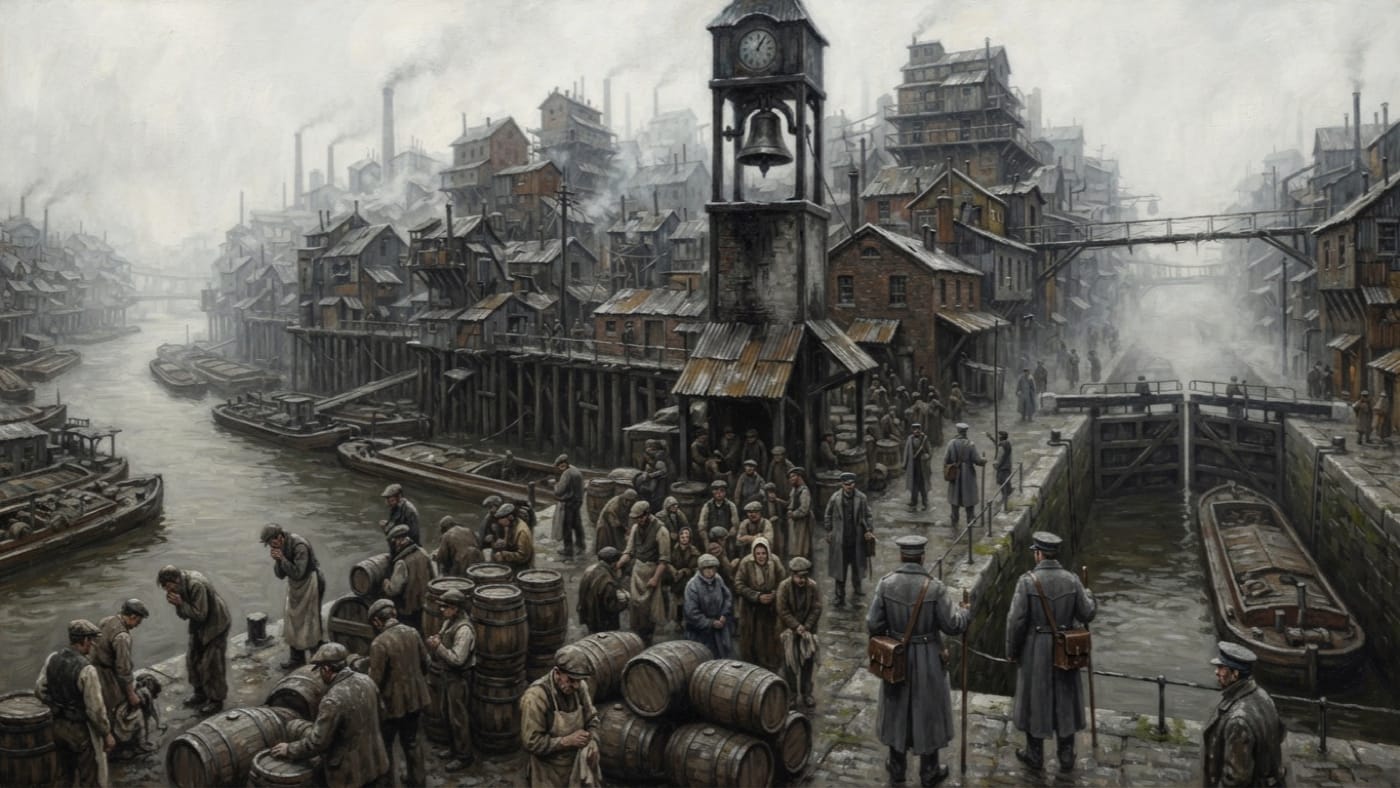
#On the Town and the Water
"If it settles, it's true." — Mournwater saying
Mournwater sits on a lowland bend of river in the River-belt of Zone 2, where the current slackens and drops its silt in pale islands across the channel. Behind the islands run brackish backchannels, which the maps draw as marsh and the boatmen draw as income. The town follows the bank wherever the bank will bear weight. Workshops, lofts and lodgings stand on timber pilings above a flood mark that every child can point to and no adult trusts. Below it are rotting wharves, cellars full of river and streets that only become streets in a dry month. Upstream, past the last pilings, the cemeteries begin at the marsh edge.
Fog comes off the water most mornings and leaves a fine pale dust on sills, rails, hat brims and the skin of standing soup. On grading days it thickens into a drizzle that carries dust, and washing comes in whiter than it went out.
The survey estimate is some eighteen thousand four hundred souls. It stays honest for about a week. Dock labour arrives with the barges and leaves when the quota is filled. Pilgrims come to watch sanctity poured into barrels. Quarantine brings people nobody asked. Nearly all their food arrives by water, with the oak, resin, lime, clean cloth and lamp oil, and certified sanctity leaves the same way. If the cargo stops, the town stops. Mournwater has no second economy beneath the first.
#On Barrels Becoming Relics
No record dates the first cooperage on the bend. It made casks for river trade, for grain and lamp oil, and was too ordinary to deserve a charter.
In A.S. 98 a barge carrying forty-two reliquary jars from the Ossuary Shoals capsized upriver. The residue went into the water, the silt and the staves drying on the wharves. Healings were reported in the yards. The Bureau of Alchemical Standards examined wood and mud and confirmed residual sanctity. The coopers learned they had spent some weeks standing in a reliquary without paying anyone for the privilege.
That was soon corrected. The Cooperage Compact had its charter ratified in A.S. 104 under the joint seal of the Bureau of Records and the Bureau of Purity. The ratification survives in the record. The clauses and signatories are not before me, and the Codex does not invent them.
By A.S. 110 Mournwater had become a reliquary port, and it went on making barrels. A relic port needs something to pour its relics into, and the coopers had found that whoever owns the container gets a seat at every argument about the contents. The town is older than its industry by a span nobody recorded. Pilgrim guides close the gap in the town's favour.
#On the Seven Districts
Mournwater has seven districts. The only reliable way to tell them apart is by who works in each and what the air smells of.
The day begins in the Cooperage Yards, tier on tier of workshops above the water, smelling of oak and pitch, with staves waiting in the drying lofts overhead. Coopers raise staves and hoop-smiths drive the hoops. Pitch runners carry their buckets along catwalks over the vats. The trade rewards a steady foot, though never for long.
Dust goes first to the Grading Hall of Settled Light, where the air is chalk and vinegar and many of the graders are serving debt at the bench on rotation. Their findings go to the White Steps, quarter of the Synod certifiers, which smells of incense and bleach and holds the cleanest hands in Mournwater. The certifiers wear gloves. They have reasons.
Certified dust is suspended in brine as holy slurry and loaded at the Slurry Docks, which smell of brine and sweet rot. The loaders work below the flood mark, beside the jar-makers' crates. Then come the Seal Locks, smelling of iron and algae, where lock wardens and provosts control the only lawful passage for certified ships. The locks are Mournwater's own. The gates at Candlewick share their name and doctrine but none of their masonry.
Two districts stand outside the official day. The Backchannel Shacks smell of fish oil and wet paper and house the boatmen who know the flooded under-streets. The Crumble Ward smells of lime and fear. It holds the quarantined, along with debtors who wash their linen to pay for their own stay.
Entry requires one of four papers: a lock permit, a guild writ, a dust-labour voucher or a quarantine intake. Purity stamps are checked at the gates. Fees are posted. Bribes are not, but everyone knows what they cost. The nearest river city lies one to two days off by barge, a Heartlands railhead three to five by wagon and ferry, and a trench supply bastion four to seven by barge and convoy, depending on water, weather and whose cargo has priority that week.
#On Seals, Wages, and Debt
Mournwater is governed three times over, and each government keeps its own book. The Compact holds the casks, the quotas and the manifests. Its head, Master Cooper Vell Arno, controls the barrel supply and so decides whether anything leaves. The Synod Purity Office, answerable to the Bureau of Purity, holds certification, and its Purity Prefect, Sister Halvein, presses the seal at the White Steps. The lock provosts hold the water. A manifest cannot declare a batch pure, and a seal cannot carry a cask through the locks. Residents learn which office can ruin them before they learn to read.
Two shortages can stop the town, and they are separate. Without resin the yards cannot seal a cask. Without seal authority a sealed cask is wet timber. Arno can answer the first; only Halvein's office can answer the second. Everything else comes on the same barges, so a slow week on the river reaches the yards and the kitchens together.
Wages are paid in coin only when they have to be. The rest comes in ration chits, dust scrip and futures slips. A futures slip is a wager on next season's demand for slurry. The demand comes from the Line, so the holder is wagering, in practice, on how many men the Line will lose. Dockhands buy slips in the taverns because one good season can clear a debt. When the wager fails, the guild bailiffs collect in labour, in names or in quarantine "volunteering." A household can lose its father to the Crumble Ward over a paper he bought with his ale. Graders carry a second debt: compulsory rotations at the bench, and confession receipts recording each doubt and each tremor of the hand. The receipts are taxed, filed and kept.
Others work the gaps between these offices. Silt-Rook Dema controls the illicit routes through the Backchannel Needleway and sells counterfeit seals. The Backchannel Consortium is a separate cartel with its own prices. The Graders' Quiet Union calls its methods safety procedure: silence tests, slowdowns, and private marks cut into hoop grooves and wax ridges that warn dock crews which casks to fear. The marks protect the crews, and they also sell, because knowledge of contamination fetches a price. The Crumble Ward Sisters keep the treatment ledgers that decide who stays a patient and who is entered as evidence.
#On the Bell and the Crumble Ward
The Settling Bell tolls once a day, and the town goes quiet. Mallets stop in the yards. Loaders set their casks down. In the Shacks, mothers put a hand over a child's mouth. In the Hall the dust lies in shallow glass dishes. Accepted dust settles into rosary strata, ring upon ring, which the graders measure and record before the White Steps certifiers issue the seal. If the batch passes, the bell tolls a second time and Mournwater picks up its mallets. If the dust hangs, the second toll does not come, and wages, tolls and suppers all wait with the silence.
Since A.S. 194 the dust that hangs has had a name. Crumble-Wrong was classified that year as the Category Two Irregular Settling Pattern: dust that drifts, gathers and lies down in the shape of bones. The parent dossier gives the cases. The town has reached its own conclusion, which is that on some days the dust does not settle.
"Mournwater never ships tainted." — public assurance, printed on clean certificates
Withdrawn. Shipment reports from beyond the locks contradict it. Mournwater ships certified.
Memoranda of A.S. 197 blamed storage humidity and handling. Later evidence undermined both, because the dust misbehaved on the Hall's own benches. In A.S. 198, by the published account, three graders reported a living source upstream and were then confined for observation. In A.S. 199 the dust in Dish Twelve rose instead of settling, and the town kept a silence of nine hours. A grader, Elian Voss, spoke at the bench and collapsed. The extract gives the body as unavailable, a phrase that proves neither death nor survival. For a working town, nine hours meant nine hours without wages, vats going cold and casks standing on the docks while the tide worked at the pilings.
In the same year a separate shipment of certified casks reached a garrison chapel on the southern corridor, and the garrison's dead underwent secondary reduction into moving powder. No source shows that this shipment and Dish Twelve came from the same batch. The town is not comforted.
The countermeasures are domestic. Households wash lime onto their thresholds, draw salt baths, strap on sealed-sleep masks at night and burn pitch at the door. Each slows the dust. None stops it. Anyone who coughs pale grit goes to the Crumble Ward, where the beds are close, observation has no fixed end, and release is sold. A cooper with a cracked lip learns to hide it from the foreman, the Sisters and the bailiff, in that order.
#On the Present Condition
A.S. 201. The locks are open. In A.S. 200 the Bureau of Alchemical Standards and the Bureau of Rites reviewed the anomaly jointly. Since then every batch must pass a second settling before sealing, unless supply priority overrides the rule, and supply priority overrides it often. The Sagittal Line still wants slurry for its trench shrines and field hospitals. The broadcast houses of the Bureau of Orison and Song still lace their signals with saint-dust against the unhymns. Demand has not slackened, and Mournwater cannot afford to meet it slowly.
The Cooperage Audit is still pending, with no completion date set. The upstream reports are still only reports. The graders' testimony, the Bureau's humidity and the rumours of the Shacks lie in one file with no ruling between them, and I issue none. The fog comes in pale and the bell tolls. Eighteen thousand people hold their breath at the first toll and wait for the second.