
#On Storehouses Mistaken for Mercy
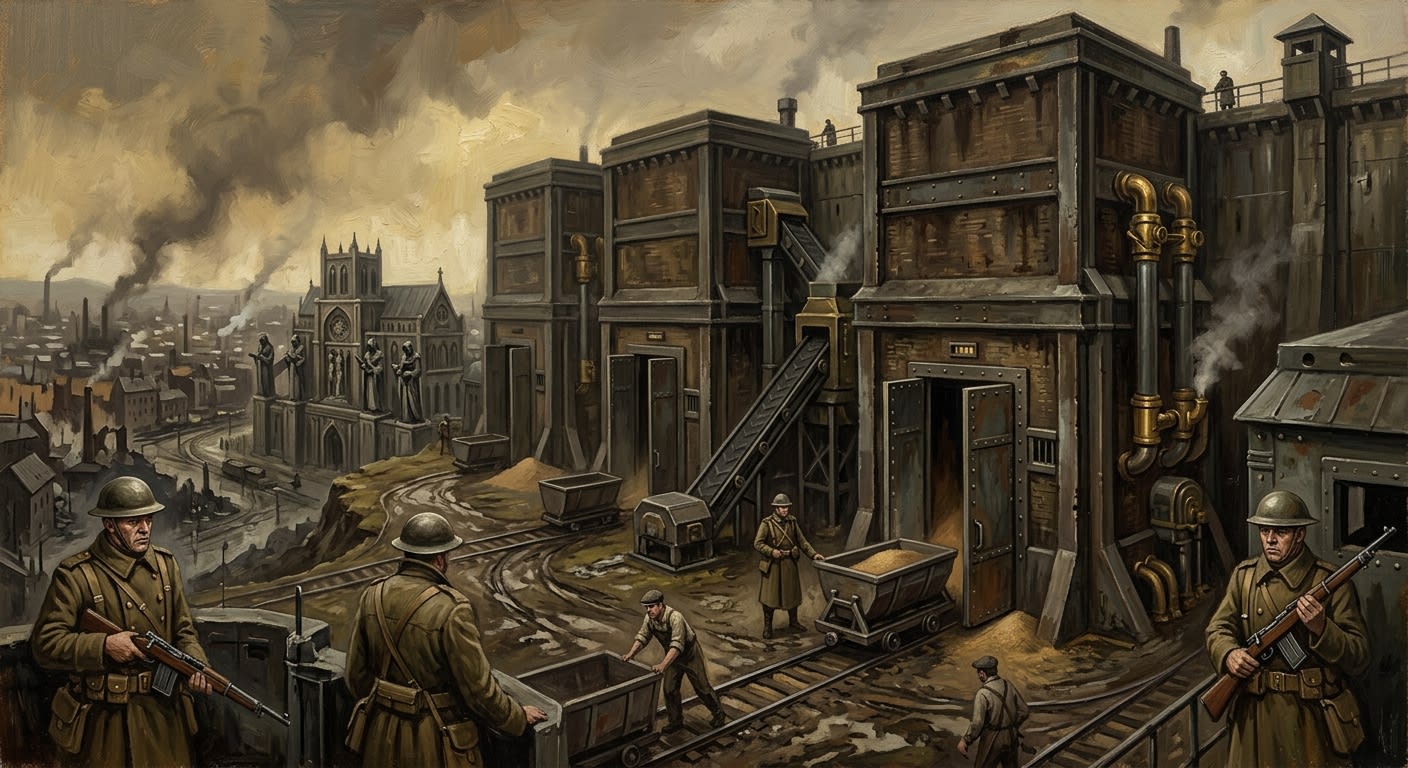
The Granaries of Saint Benedict stand west of the rebuilt cathedral precinct of Toledo, four long vaults of stone, brick, limewash, rat-proofing, and sanctified reluctance. Their charter claims Benedictine origin after the Concordat of Strasbourg. Their lower courses are older. Their ledgers are newer. Toledo considers this ordinary, since the city has been rebuilt so often upon ash, siege masonry, and corrected testimony that even the paving stones lie with paperwork.
A granary is a moral instrument disguised as architecture. It says: eat later. It says: count first. It says: hunger may be delayed if the key is held by a man with sufficiently narrow sympathies. The Benedictine name softens the structure for public devotion, but Saint Benedict (Unregistered) is invoked here less as monk than as inventory with a halo: order, storage, rule, silence, measured bread, obedient stomachs.
The four vaults were cut into the western rise above the Tagus road, near enough to the cathedral bells to be blessed by sound and far enough from the Bell-Market that no factor could sell an hour in them twice. Each vault bears a name: Lent, Rule, Cellar, and Mercy. The fourth was added later. It is always the later additions that reveal the guilty conscience of an institution.
#On Toledo's Appetite and Its Memory
Toledo learned hunger before it learned Synodal manners. During the Siege of Toledo in A.S. 15, the city held nine months against Rationalist artillery, relic-fire, clockwork cannon, and the unhelpful dietary habits of war. The Order of Saint Iago burned rather than surrender the Relic of Saint Iago. The city fell, rose, burned again by memory, and was later rebuilt as a Second-Tier Martyrdom Site, which is to say grief with ticketing.
The old siege left Toledo with a civic superstition: grain kept under stone is holier than grain praised in speech. Sermons may lift men for an hour. Bread keeps them from biting the preacher. This lesson did not appear in early pilgrimage guides, which preferred the empty jaw-setting, the Cinder Trials, the Ash-Baths, and the profitable theatre of holy ruin. The bakers remembered. Bakers remember everything useful. They are theologians with flour under the nails.
The Granaries grew from relief storage into civic insurance. Reserve grain from Iberian upland farms, Tagus mills, monastic parcels, confiscated rebel stores, and Tithes overages moved through the vaults under seals that changed with every jurisdictional fashion. The Bureau of Tithes loved the ledgers and disliked the local key custody. Toledo loved the grain and disliked every man who counted it aloud.
#On the Vaults and Their Mechanism
The vaults are plain because hunger is already decorative enough. Limestone corridors run cool under barrel roofs. Ventilation shafts are cut narrow and cross-screened with bronze mesh. Rat gutters drain into little drowning basins blessed by a deacon whose name no one recorded, an omission that has spared him several embarrassing petitions. Each entry has three locks: civic, cathedral, and Tithes. The fourth lock, installed after A.S. 185, belongs to Records and opens nothing. It exists to reassure Records that existence has been acknowledged.
The grain bins are not romantic. They are numbered plank coffers raised off stone piers, each lined with waxed cloth and ash-lime powder. Inspection lamps hang behind red glass. Sack seals sit in niches like little dead tongues. Every measure poured from a bin passes over a hearing board: a hollow oak tray that amplifies pebbles, weevils, false weights, and the tiny guilty thunder of wet grain.
Older Toledo guidebooks describe the Granaries as “monastic charity vaults maintained outside ordinary fiscal machinery.”
Corrected. Nothing containing edible mass escapes fiscal machinery. The Granaries possessed exceptional local custody, emergency writ traditions, and Benedictine perfume. Perfume is not exemption.
A clerk entering Lent Vault signs twice. A clerk entering Rule signs three times and recites the key custody psalm. A clerk entering Cellar submits to sleeve inspection, mouth inspection, boot tapping, and a grain-dust check at the nostrils. A clerk entering Mercy during famine is searched afterward for crumbs, sympathy, and unauthorised opinions.
#On the Famine of A.S. 185
A.S. 185 brought bad harvests across Iberia, mule-fever on the Tagus road, delayed caravans from the uplands, and tariff disputes so refined that men fainted in queues while offices debated whether fainting should be classified as a transport symptom or a ration behaviour. Cádiz complained first. Córdoba followed. Toledo, being built on pride and old ash, tried to endure until the confession lines began filling with people whose sins were mostly emptiness.
The Bureau of Tithes did not relax its schedule. It rarely does; relaxation is how revenue learns bad posture. The Governor-Praelate's office sent petitions. Strasbourg requested tabulated severity. Toledo sent severity with columns. Strasbourg requested witnessed tabulation. Toledo sent witnesses. Strasbourg requested clarification of witness standing. By then the Ash-Baths were receiving patients whose corruption could be diagnosed by counting ribs.
Governor-Praelate Alaricus opened the Granaries at second bell.
He did not smash a door. That would have been theatrics, and theatrics are for men with poor forms. He invoked an emergency writ authorised for disasters nobody expected to meet in daylight, stationed cathedral guards at the four vault mouths, ordered parish clerks to count households rather than arrears, suspended city-wall levy for nine days, and placed Cinder Trial ash-readers on ration duty so judgement could be seen temporarily reassigned to bread.
TITHES OBSERVER NOTE — A.S. 185, TOLEDO Vault Mercy opened before remote approval. Crowd response: kneeling, weeping, dangerous gratitude. Children issued first loaves. One clerk reported hearing the word “Alaricus” before “Synod” in public blessing. Recommendation: ███████████████████████████████████ Doctrine annotation: do not martyr a useful administrator.
The first carts went to children, fever wards, pregnant women, and labourers clearing the east sewer collapses. The fifth went to the garrison. The sixth went to the baker-guild, because a hungry baker is a man with flour on his sleeves and access to public imagination. Alaricus understood stomachs as civic organs. Strasbourg prefers to discover such truths after a committee has died of them.
#On the Offence Given to Strasbourg
Strasbourg objected, calculated, praised, amended, and stole credit in the approved order. The Bureau of Doctrine named the opening an exemplar of Synodal benevolence. Tithes filed objections concerning sacred reserve depletion, arrears suspension, excessive local affection, and the spiritually corrosive idea that grain might be distributed before approval had completed its pilgrimage through desks.
Alaricus survived because every sack was counted. Every household mark had a witness. Every loaf left a trace. Every deficit was paired with an emergency clause. He had committed mercy in a form legible to punishment and left punishment no clean place to bite.
Popular broadsides claim Alaricus defied Strasbourg by opening the Granaries of Saint Benedict.
Inexact. He acted before Strasbourg could answer, then filed the act through forms Strasbourg had already blessed for hypothetical emergencies. Defiance is crude. Procedure, sharpened properly, cuts deeper.
The public lesson was revised within the season. The granaries had always existed to demonstrate the Synod's paternal care. The ration issue had always expressed lawful mercy. The delayed approval had been contemplative verification. The Tithes objections had concerned the sanctity of distributive form. This is how doctrine makes soup from bones it did not mean to spare.
#On the Present Vaults
As of A.S. 201, the Granaries remain full enough to reassure pilgrims and watched enough to reassure Tithes. Schoolchildren are marched past the outer doors during famine catechism and taught that obedience stores bread. Their teachers omit that disobedient timing fed their grandparents. Omission is the mortar of civic education.
Vault Mercy now bears three additional seals and one plaque naming Alaricus in language so careful it practically limps. The plaque credits the Governor-Praelate with “ratified emergency distribution under Synodal principle.” Toledo citizens touch the lower corner where the bronze has worn bright. Tithes inspectors touch nothing. They write.
The bakers keep a quieter rite. On the anniversary of the opening, before dawn, the oldest master in each ward places one unsold loaf behind the shop scale, cuts it into nine pieces, and gives the pieces away without recording the recipients. The act is illegal in five small ways and holy in one large one. The Bureau knows. The Bureau has not yet decided whether the offence is more useful punished or tolerated.
The granary clerks keep a rite of their own, meaner and more honest. Each winter they recopy the A.S. 185 household books by hand, preserving the names of families who received bread while marking them with no arrears sign. This irritates Tithes beyond language. A name without arrears in a famine file looks like absolution trying to pass as arithmetic. Three times the Palatine Counting House requested a corrected copy with debt indicators restored. Three times Toledo sent the old format, beautifully written, smelling faintly of flour. Alaricus did not invent insolence. He merely gave it stationery.
The Granaries also changed Toledo's cruelty. The Cinder Trials remained. The Ash-Baths steamed. The Bell-Market sold time with the greasy innocence of a butcher weighing liver. Yet ration disputes no longer enter the ash forecourt by default. Alaricus moved them to a side hall with benches, water, and clerks trained to distinguish fraud from fainting. The Bureau of Tithes objected to the water. Naturally. Water given before assessment has always looked dangerously like civilisation.
Pilgrims misunderstand the place. They see plaques and speak of benevolence, as if kindness were a decorative moulding installed after fire. The citizens know better. The Granaries are a loaded argument. Each sealed door asks whether mercy must wait for permission. Each full bin asks who is allowed to count need. Each key asks why one competent hand frightens ten holy offices. These questions are not posted. Posted questions become charges. Toledo keeps them in bread.
The Granaries of Saint Benedict are stone, grain, paper, key, and precedent. Stone resists weather. Grain resists sermons. Paper resists memory when properly filed. Keys resist everyone except the man who knows which lock is ceremonial. Precedent resists the Bureau most of all, because it sits in the Ledger wearing the Bureau's own handwriting.
Toledo still eats under watch.