

I've read the continuity and voice files and the Antwerp, Gray Week and Receipt Reform sources. Writing the article now.
#On the Observance as Surveyed
This survey is dated A.S. 201 / 1911 CE. That is the year of the survey and of nothing older. The founding of the march is not on file.
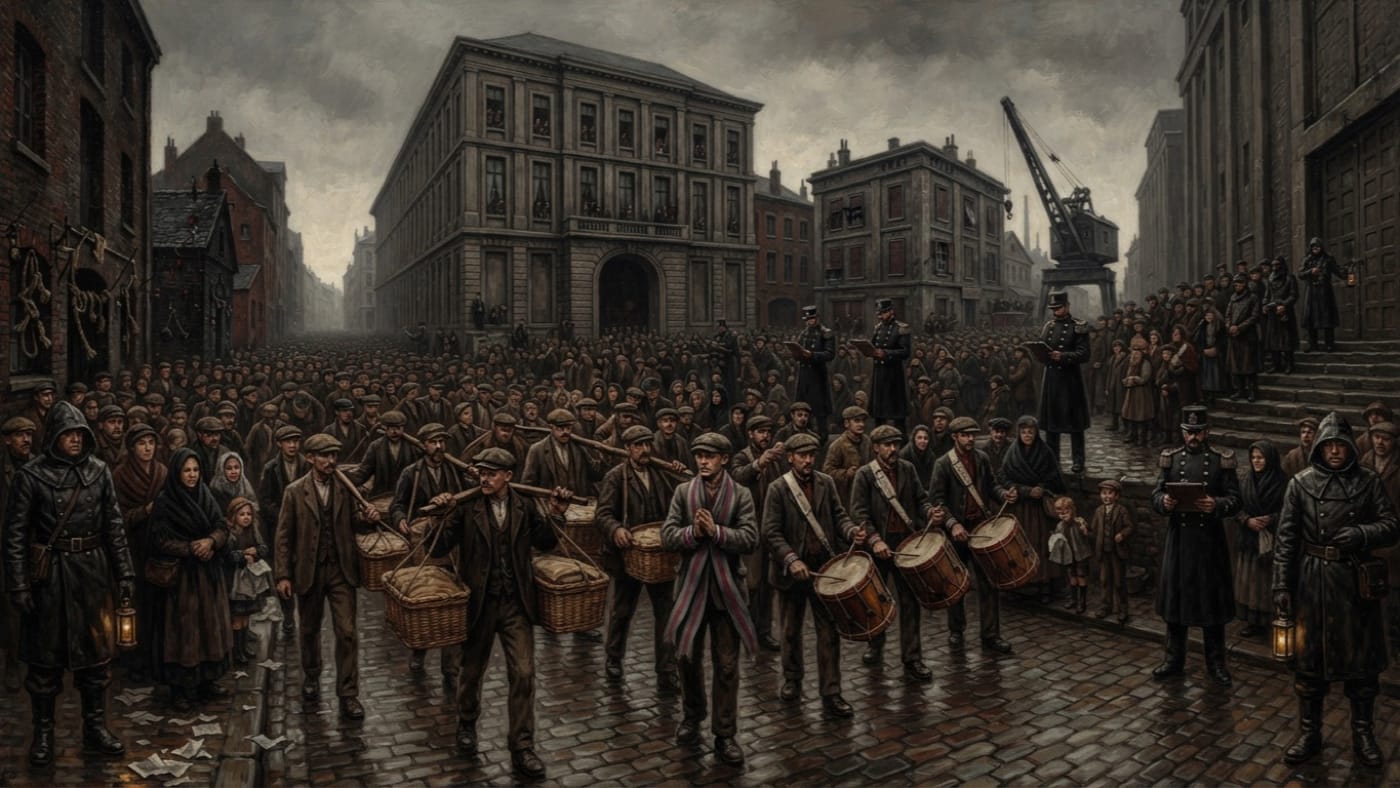
Each Ashwane, the dock wards of Antwerp turn out for the Gratitude of Restored Flow. The standing Antwerp file lists what appears in the streets: ribbons, drums, sealed bread baskets, and the old dock families standing, in the file's words, where their grandparents threw stones. That phrase belongs to the file. I hold no roll proving any grandmother's aim, and a survey that certifies a family's descent from one good sentence deserves to be shelved at floor level by the Scheldt.
The local settlement takes two lines. The observance is annual. Wrist-ribbon compliance is compulsory for the dock wards. Read the second line slowly, because it rewrites the first. In the general teaching of the Church, gratitude is a disposition of the heart toward the Creator. In the dock wards of Antwerp, gratitude is a disposition of the wrist toward the Bureau of Festivals. The heart remains voluntary. The wrist has been spoken for.
#On the Route as Documented
The documented Festival route runs from the Dock Chapels through the Hall of Corrected Measures, past the Scheldt Annex, across the Grain Court, and down to the east granary steps. The file gives that order and nothing more. It names no streets, gives no distance, and does not say where the route bends, halts or narrows. It does not record the year the route was fixed. I copy it as filed and will draw no map.
The order alone repays reading.
It begins at the Dock Chapels. These are small, blackened, practical rooms full of votive hooks, where sailors leave rope knots and broken seals and grain porters leave pallet splinters. The Bureau has condemned that custom six times and tolerated it six times. These are the chapels where the dock wards already pray for themselves. The march collects them there, at their own altars, before it asks anything of them.
Next is the Hall of Corrected Measures. It is the old merchants' hall where Rationalist lecturers once weighed relic bones on diamond scales. It is now a countinghouse under Records supervision, where grain weights, shipment seals and merchant oaths are checked beneath the painted text MEASURE OBEYS MEANING. A procession of thanks for grain passes under the words that govern how grain is weighed. Nobody on the route needs this pointed out, and the painters were paid to make sure of it.
Then it passes the Scheldt Annex, the Records house near the old crane, where dock manifests sit in raised cabinets. The march goes past the Annex and does not go in. The archive watches the crowd from its windows, and the crowd keeps its feet below the cabinets.
Then it crosses the Grain Court. The file says no more about the Court than its name, so I say no more either.
The route ends at the east granary steps. In the Antwerp account, this is where the open audit met the crowd and the crowd taught the auditors to duck. The Gratitude of Restored Flow finishes at the scene of the stoning and calls it thanksgiving.
The Antwerp file also records how the procession is worked. Lantern escorts hold the edges. Ribbon Runners work the wrists. Children chase confetti made from shredded duplicate returns. Their parents clap on time and watch the grain doors. According to the same file, Pageant Captains love Antwerp and fear it. The streets are narrow enough for counting, rich enough for bribery, wet enough to spoil paper, and musical enough to hide three unauthorised refrains inside an approved hymn before the second drum turn. The file names no Captain for any year and assigns none to any stretch of the route. I assign none either.
#On the March That Was Scheduled
The history is short, and I keep it short.
The Antwerp account places the city's riot at the east granary courts. It followed eleven days of shrinking rations, bone-broth and warehouse rumour, and it began when an open audit arrived with clerks, escorts, portable scales and household return forms. In that account three grain stores were opened, receipt slips burned in the dock square, and a clerk from the Salt-Scale House read warehouse names aloud while the crowd answered with the number of missing sacks. The file describes the Synod's answer as silence, then choreography.
Antwerp's first gratitude march was then scheduled six months after the riots, under the title Civic Thanks for Restored Flow.
Scheduled is the word on file, and I keep it. The file does not say the march was held on that date, held late, or held at all in the form planned. The riot itself carries no confirmed local date, so six months after it is not a date either. Anyone who adds the interval to a guess has produced a guess with a larger number.
In the Antwerp plate I wrote that flow meant grain, traffic, obedience and blood pressure. I stand by that. I also wrote that the title was admired by no one except its author, who was promoted. The file records the promotion and leaves out the author's name. That is how Records usually keeps a man it has rewarded.
When Civic Thanks for Restored Flow became Gratitude of Restored Flow is not on file. The shorter name has dropped Civic and kept Restored. A city may stop calling its thanks civic. It may not stop agreeing that something was restored.
The wider file is a separate matter. The Gray Week Famine is the famine-riot sequence of Strasbourg, Marseille, Munich and a fourth city. Doctrine accepts A.S. 138 as its year for public instruction, while Records and Festivals still dispute the reckoning. The fourth city is disputed too. Records prefers Antwerp. Festivals files Lyon. A sealed Tithes memorandum holds that the fourth requires no naming due to reconciliation hazard. Antwerp's riot belongs to Antwerp's file. Whether that riot is Gray Week's fourth belongs to a quarrel the three offices have not settled. The instructional year of the wider sequence does not date the local march.
"In A.S. 138, during the Gray Week Famine, Antwerp became the fourth city nobody wished to name." (Antwerp plate, Section I)
Corrected. The public formula is disputed fourth city. Records prefers Antwerp. Festivals files Lyon. Tithes declines to name any city. My sentence was written in Records' voice and given the authority of the Seal. Records may hold its preference. The Codex may not print it as settled.
#On the Ribbon and Its Law
The ribbon came before Antwerp's settlement and does not belong to it alone.
Under Receipt Reform A.S. 138, Synod Directive 88-F replaced paper receipts at Bureau-sanctioned processions with wrist-ribbon stamps. The published jurisdiction of the Directive covers sanctioned celebrations, feast routes, ration-thanks ceremonies and gratitude marches. The same reform made the Pageant Captain a licensed profession. The year after, the Lantern Brotherhood was folded into the parade structure as an official escort. Those are the general rules of the Church. They hold in every sanctioned procession, and the Antwerp dock wards are one place where they apply.
The Antwerp file ties its settlement to that reform and adds one local rule: in the dock wards, ribbon compliance is compulsory. The file does not say how the ribbon is fastened, what the stamp reads, who examines it, at which point on the route it is examined, or what follows when a wrist turns up bare. Other files in the Codex disagree on whether the reform's punch passes through skin or close beside it. This survey leaves that question open. It records the ribbon, the stamp and the obligation, all three of which are in the file.
Paper burned in the dock square. The Synod drew its conclusion and put the receipt on the arm. It never claimed the arm was more devout than the paper. It claimed the arm could not be dropped in a fire without its owner following.
#On Present Custody
As of A.S. 201, Antwerp remains under ordinary Synodal custody, with enhanced observation by Records and Festivals. The Scheldt Annex has been raised twice against flood. The Hall of Corrected Measures still carries its painted text. The Dock Chapels still collect knots and splinters. Every Ashwane the route fills from the chapels to the granary steps with drums, ribbons, sealed baskets and the families the file has placed on the stones.
The city sends its tithes, certifies its manifests and turns out on time. Its children throw paper that no office will miss. Its parents clap and keep watching the grain doors, because those doors are the part of the procession that has never been explained to them.
The fourth city is not named in public.