

#On the Survey and the Building
This survey of the Hall of Corrected Measures is filed in A.S. 201 / 1911 CE. That year belongs to the survey. It does not date the building, its conversion, its first supervision, or any inspection, consecration or ceremony held inside it. None of those dates is on file, and a clerk who fills an empty column because it looks lonely ought to be shelved at floor level beside the Scheldt and left for the spring tide.
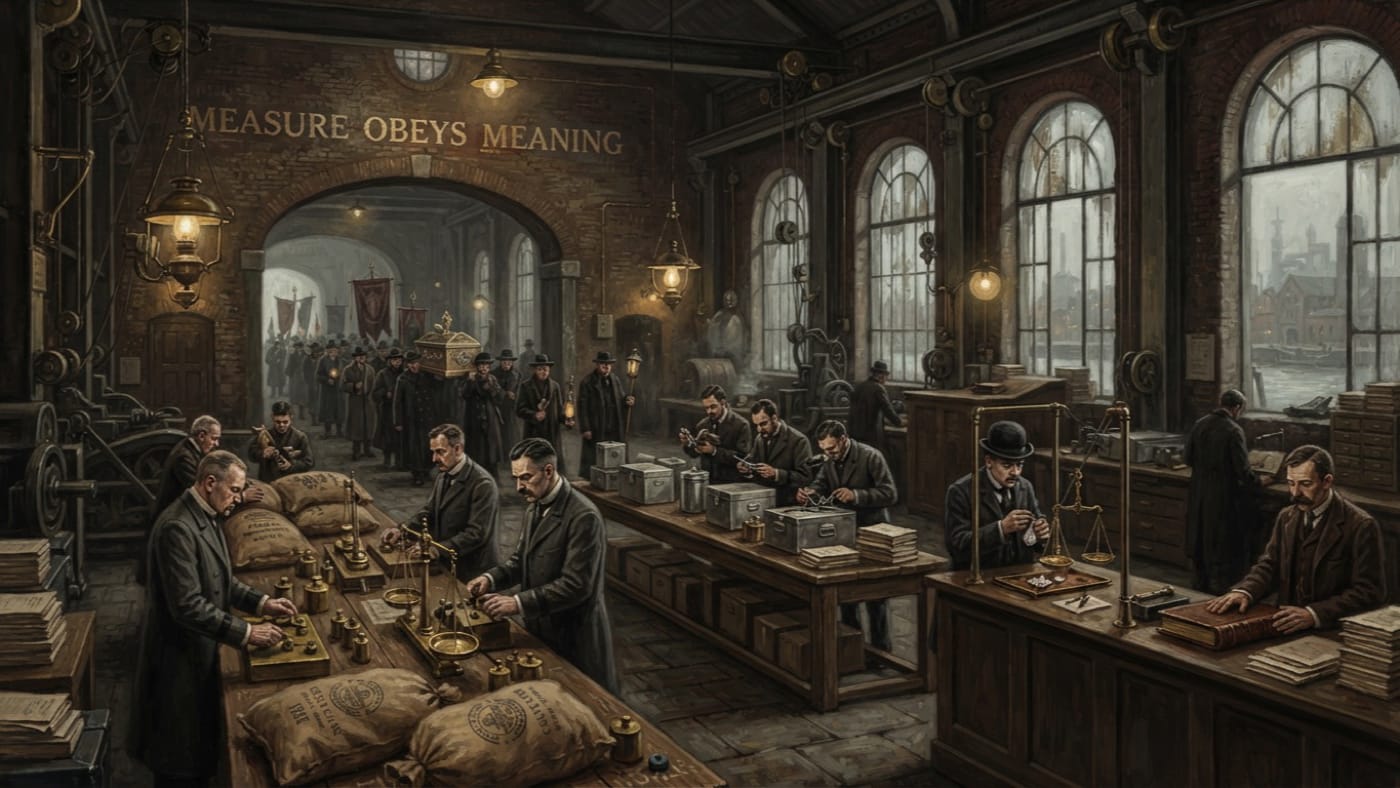
The Hall stands in Antwerp, the Synodal port on the Scheldt, in Zone 1. It began as a merchants' hall. Today it is a countinghouse under the supervision of the Bureau of Records, and four things are verified there: grain weights, relic shipment seals, diamond scales and merchant oaths. Above the work runs a painted text:
MEASURE OBEYS MEANING
The Antwerp file adds a detail I would not trade for a bishopric. The merchants paid for the painting, and they negotiated the gold leaf down by seven percent.
#On the Merchants' Hall and the Counting Table
The building was already in the habit of measuring holy things before anyone set a supervisor over it.
The Antwerp account tells the story this way. During the Atheist Wars a bishop was brought into this merchants' hall under a promise of disputation. Records gives his title and withholds his name. Rationalist demonstrators set reliquary fragments on a counting table, measured them with calipers, weighed them on diamond scales, wrote the results on a slate, and mocked him in front of a crowd. The Antwerp plate and its timeline row date the mockery to A.S. 27 / 1737 CE. The same account calls the occasion staged and records that the relics were handled without lawful custody. Elsewhere in its errata it notes that the calipers were later entered as profane instruments.
Some things the file does not supply: the hall's former name, the demonstrators' names, the bishop's name, any use of the building before the merchants had it, and what became of the slate. I leave them as blank as I found them. The Rationalists were fond of numbers they could not justify, and I decline to be caught in that company.
According to the Antwerp account, letters carried the incident to the First Council of Cologne, which sat for nine days in September of the same year. Its opening and closing days are unknown. The file links the mockery to the Council and gives no interval between them. I give none either. When two entries share a year, the Ledger does not shorten the gap between them to make the story read better.
"Kratz saw its value at once." (Antwerp plate, On the Rationalist Stage)
Corrected. That judgment belongs to the Antwerp account, and it is printed here as the account's. In September A.S. 27 the founders were nineteen. Augustinus was an ordinary auxiliary, and there would be no formal Synod for another sixty-three years. No founder's act at this hall is documented. Whatever value Cologne found in a mocked bishop, the Codex will not have a nineteen-year-old found an institution on the strength of one sentence I wrote.
The Bureau of Doctrine later taught the episode in seminaries under the heading On the Limits of Public Disputation With Men Who Own the Room. It is the only lesson in the curriculum that a merchant could have written.
#On the Four Verifications
The furniture never left the trade. In the Antwerp account, diamond scales once weighed relic fragments in this building so that a bishop could be humiliated. Now diamond scales are verified under Records supervision in the same building. The file does not say why the countinghouse was put here, who decided it, or whether anyone appreciated the joke. I appreciate it, and I am on the payroll.
Each of the four entries names something exact. A careless reader will widen them, so I list them as filed.
Grain weights. The file says the weights are verified. It says nothing of the grain. Whether a sack weighs what its paper says is a question for the Hall. Who eats the grain, who sells it and who hoards it belong to other offices and other folios. In a port that receives grain for half the heartland, a false weight is a lie told to a city in installments, and a true one is the only sermon a dock porter will sit through.
Relic shipment seals. The Hall verifies the seals. This survey has no finding on whether any relic behind those seals is genuine, because the file does not claim the Hall certifies relics. That question has its own bureau and its own vocabulary. The Antwerp file's joint dock custody stamp gives Doctrine relic-handling oversight "in corrected measure cases." It does not say those cases are heard in this building, and I will not move them here merely because the names rhyme.
Diamond scales. The Hall verifies the scales. Whether it appraises stones is not on file. The cutters hold that precision is its own devotion, and they hold their stones farther from the clergy than devotion requires. Verifying the instrument while leaving the gem alone is the only arrangement under which an Antwerp cutter and a Records clerk will share a room without one of them sending for a lawyer.
Merchant oaths. The Antwerp file puts the oath beside the scale and uses the same verb for both. It does not say how an oath is verified, by whom, against what, or what happens to the merchant whose oath fails. I have been asked whether the oaths are weighed. That question came from a seminarian, and he has been reassigned to Cologne, where the archives are drier and nobody will hear his theories. The file gives no method, so this survey supplies none.
Some readers will want a walkthrough: the clerk at the door, the brass pans, a nervous widow with a dowry diamond, a sealed crate of finger-bones from Lisbon. I could write one. Every bell in Antwerp could ring the hour and still not make it true. The Hall's record is four nouns and a painted sentence, and I copy what is filed.
#On the Route Through the Hall
The Hall lies on the procession route.
The Antwerp file gives the Festival route in one order: from the Dock Chapels, through the Hall of Corrected Measures, past the Scheldt Annex, across the Grain Court, and down to the east granary steps. The Hall is the only landmark the procession is recorded as passing through. The Annex is passed. The Court is crossed. The file does not name the doors the marchers use, the direction they face beneath the inscription, or how long a pageant takes to clear a countinghouse. It names no streets and gives no distances. The Scheldt Annex and the Salt-Scale House are separate offices in the file and are not rooms of the Hall.
The account fills the route with people. Lantern escorts hold the edges. Ribbon Runners work the wrists. Children chase confetti made from shredded duplicate returns, and their parents clap on time and watch the grain doors. In the account, the Pageant Captains adore Antwerp and fear it. The streets are narrow enough for counting, and musical enough to hide three unauthorized refrains inside an approved hymn before the second drum turn.
The route ends at the east granary steps, where, in the Antwerp account, the crowd once taught auditors to duck. That lesson belongs to the Gray Week file of A.S. 138 / 1848 CE, and the file is disputed. Records prefers Antwerp as the fourth city. Festivals files Lyon. A Tithes memorandum declines to name any city on grounds of reconciliation hazard. I do not settle it here. Nothing on file says the Hall hosted the riot, the audit or the Receipt Reform that followed. The present procession, which the city calls the Gratitude of Restored Flow, passes beneath MEASURE OBEYS MEANING on its way to the scene of the stoning. Antwerp chose that order. Antwerp may explain it.
#On Present Custody
As of the A.S. 201 survey, the Hall of Corrected Measures stands, Records supervises it, and the four verifications continue under the painted text. The record does not hold the supervisor's name, the clerks' number, the fees, the hours, or the date of the last repainting. The Records Scribes who work in Antwerp may know some of this. The Codex does not.
Merchants who once paid a building to humiliate the Church later paid it to instruct them, and they bargained over the gilding on both occasions. Records keeps the invoice and the Hall keeps the sentence.
FILED — A.S. 201 SURVEY. Gold leaf as invoiced.