
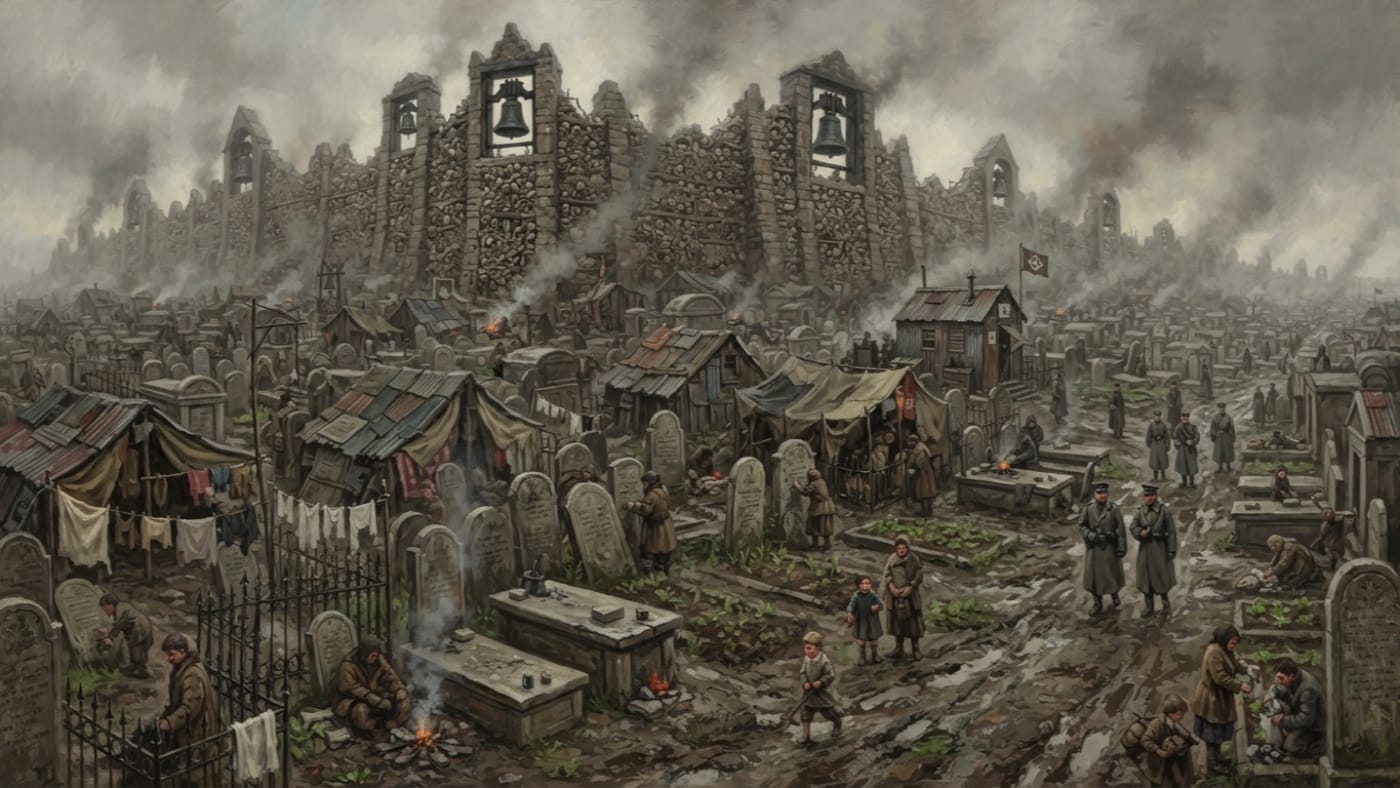
#On the Ground Outside the Wall
“Every headstone sanctifies its plot.” (Doctrine, as recited at intake)
Grave-fields are cemeteries in which people live. The Synod's official vocabulary prefers several longer phrases, and I have signed most of them. The shorter version will serve a reader with muddy boots.
They lie beyond the ossuary walls of the bastions and around the other places where the dead arrive faster than they can be shelved: medical ports, plague grounds, pilgrim stations. A grave-field begins where the wall's geometry of niche and seal gives out. It extends as far as the dead have been planted and the living have followed them. Some front the enemy. Many face the rear, toward the wagon roads, because refugees reach a fortress from behind far more often than from in front.
The arrangement is constant enough to describe once. Headstones lean in rows the ground stopped respecting long ago. Between them run lanes trodden to slurry, with drainage cuts dug by whoever was wettest last spring. Older households keep garden plots in which a grandfather's marker stands among the cabbages, and the family's newer dead lie in the front plot where they can be watched. Further out, patched canvas and timber shanties crowd the newer pits. Mausolea, where they exist, hold soldiers. Above it all stands the wall, bone-mortared and belled, close enough to see and far enough to matter.
Clerks keep confusing two things, so I will separate them. A family slotted into a catacomb bunk lives inside the ossuary, under the Allocator's corridor chalk. A family in the grave-field lives outside, under weather, with a tag. The ledger counts both as ossuary housing. Only one has a ceiling.
#On Temporary Residence
Since the Sundering, war and plague have produced the displaced in numbers no wall was built to hold. The retreat that hardened into the Sagittal Line pushed whole parishes rearward, and every outbreak since has pushed survivors out of tenements the Bureau of Mercy judged unfit. They came to the ossuaries because ossuaries have walls, patrols and bells. Most were refused. Interior wall-space goes to the tithed, the useful and the patronized, in roughly that order of public acknowledgement and the reverse order of truth.
The refused stayed. They pitched among the tombs to await admission. The waiting became residence, and residence became a lane with a name only its residents use. Officials still recall the First Grave-Field Winter, when tents froze upright outside bastion walls. Nobody now agrees on the year, and the Bureau has not volunteered one. That winter settled the procedure: grave-field occupancy would be assigned, tagged, counted and called temporary.
It is still called temporary. Children born under tarred cloth have raised children under it. Grandmothers who arrived as refugees have buried husbands in the plot beside the cookfire and renewed the family's permit at the same counter every season since.
Ground within a grave-field is unequal, and residents know its gradient to the inch. High ground drains. Low ground floods the graves, and the graves give back what floods them. Lanes near a patrol route are safer from robbers and less safe from inspection. Plots within reach of a sanctioned bell command a premium in every currency the field possesses. Any clerk will confirm off the record that bell coverage thins at the margins. The outermost lanes take what they hear.
#On Stones, Permits, and Rent
Two authorities divide the ground, and neither concedes the other exists.
The first is the Allocator. From a perimeter hut the clerk issues or refuses plot permits and hangs occupancy and compliance tags at the throat. Each tag is bound to a ration link and a curfew rule. Boundaries are amended with chalk and stakes. A relocation notice may arrive overnight, and so may quarantine. The official map of a grave-field and the actual spread of its residents know each other the way two cousins at a funeral do.
The second is the Shanty Broker. Building on consecrated burial ground is forbidden, so a trench spur or a new depot cannot simply be laid across it. The Broker sells that prohibition. He acquires interment rights, by purchase where possible and by forgery where not. He anchors a lane with legitimate graves at either end and leases the space between as caretaker housing for those who tend them. The family in the lean-to are caretakers. They keep the stones upright. The stones keep the surveyor away.
Rent is paid in rations or fuel, with transfer fees and protection cuts on top. Clerks are paid in wax, oil, medicine or cloth. The Bureau of Tithes collects its marrow-tithe from anyone it can find sleeping near bone. No single tariff governs the grave-fields. Anyone who quotes one is selling something.
When an inspection approaches, the Broker moves families from block to block by night. Stones occasionally walk as well. A headstone shifted ten yards before dawn takes its legality with it. Duplicate paper trails ensure that an auditor who follows any one of them ends at a respectable grave.
Consecrated ground buys friction, not immunity. Rites may declare a lane profaned. Records may find more residents than graves, or more graves than deaths. War may need the ground for evacuation routes and obtain a dispensation before the residents hear the rumour. Purity supplies the escort. Each office acts lawfully and each demand contradicts another. The residents survive in the gaps until the gaps are audited.
#On the Inhabitants and Their Precautions
Not everyone in a grave-field is a refugee. Burial crews live there because their work does. Caretakers live there, genuinely. Small traders sell lamp oil, lime and boot nails from crates set on flat tombs. Soldiers billet in mausolea. Officers have been known to quarter men beside their own ancestors' coffins, on the theory that it improves the fighting. Patrols pass through, and some stay longer than their orders allow.
Domestic life goes on among the dead. Meals are laid on gravestones because gravestones are flat. Laundry dries on iron fences. Children use markers as goalposts and slates. Supervisors require that anything carved or chalked on a stone be devotional or patriotic. The result is a great many hymn-fragments in childish hands, and a great deal of smudging when a mother dislikes what her son has drawn.
The physical dangers need no theology. Wet ground fails. A grave collapses under a cot, or a sinkhole opens across a lane and shows what was buried there and how carelessly. Disease travels from shanty to shanty faster than tags can be changed. Winter kills the old and those in the outermost lanes. Fire takes canvas in minutes. Violence follows scarcity, and nothing in a grave-field is scarcer than a dry plot near a bell.
Residents keep candles low, partly against patrols and partly by custom. They tend family graves with an attention that visitors mistake for piety and residents call precaution. Field lore holds that buried kin guard the harvest, and that a grave whose name fades turns against its plot. The Bureau's position is that neglected graves are dangerous. It declines to say to whom.
Residents report cold that ignores the weather, murmurs at the edge of hearing, and inscriptions they insist were rearranged overnight. Every billet passes around accounts of soldiers dragged into crypts by unseen hands. The rolls record such men as absent. I record that the accounts exist. What The Dead intend, if they intend anything, is not a matter for a housing survey.
Grave-field residents are transitory persons awaiting assignment to interior ossuary accommodation.
Corrected: most grave-field residents are not awaiting interior assignment and have not been for some generations. The classification “transitory” is retained so that their permits remain renewable.
#On the Present Condition
A.S. 201 finds the grave-fields fuller than their maps. Casualties, ration pressure and fever rumours keep pushing the living outward against the walls and the dead outward into new pits.
At Marrowgate, the inland medical port, casualty wagons come in along three roads and the ossuary yards fill to match. The old cemetery terraces above the river spur hold both the processed and the people who process them, and they flood with the season. At Constantinople, grave-field households have renewed temporary permits beneath the ossuary's shadow for three generations. The renewals are current and the households are counted. Several of them have better gardens than I do.
The Allocators chalk. The Brokers bury, sometimes for real. Clearance orders are drafted, deferred and redrafted with the season.