
#On the Western War That Pretended to Be Housekeeping
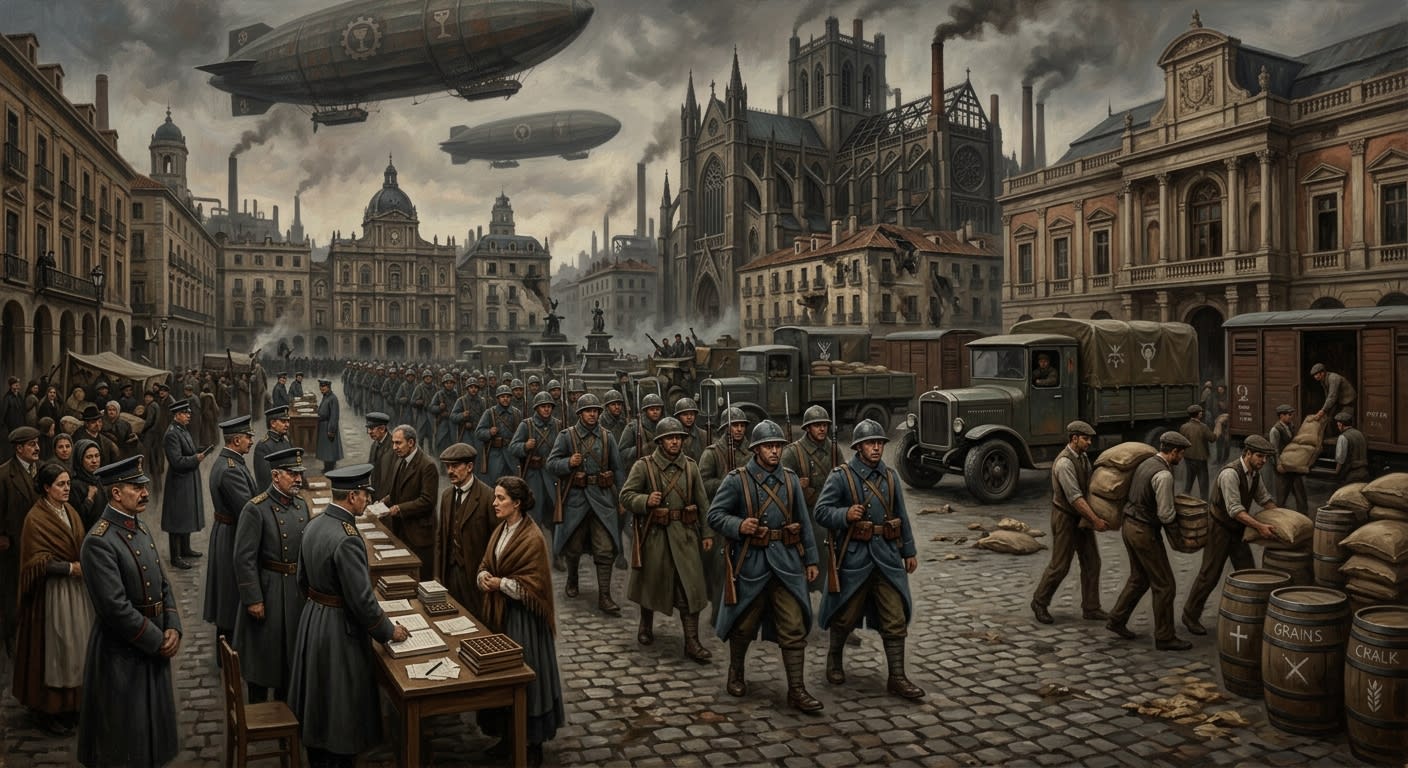
The Iberian campaigns were the Synod's long correction of the western peninsula: a century of inventories, punitive processions, harbour levies, calendar amputations, grain seizures, tongue discipline, and military action so perfumed with incense that later clerks mistook conquest for administration. Their famous public hinge is the A.S. 155 Subjugation of Seville. Their fiscal ghost is the A.S. 92 Salt Dues of Marseille. Their private truth is that the Synod learned in Iberia how to make distance obey.
The peninsula had always troubled Strasbourg. It was loyal in liturgy, irregular in practice, proud in its saints, amphibious in its trade, slippery in its calendars, and fond of local privileges preserved in parish cupboards like pickled sins. Spain sent grain and sailors, yes. Portugal sent salt, rope, wine, pilots, and letters written in a diplomatic register so oily that even the Bureau of Records used sand twice. Yet Iberia sat at the western edge of necessity, far from the Line, close to the Atlantic, and near enough to independent merchants to confuse profit with autonomy.
The campaigns did not begin with Seville. No campaign worth fearing begins where the histories say it does. The first machinery was fiscal: salt assessed through Marseille, maritime passage priced, pilgrim embarkations counted, southern stores surveyed, and western grain entered into tables whose columns leaned toward the east. By the time War entered plazas with banners, Tithes had already entered warehouses with ink.
#On the Salt That Paid for Piety
The Salt Dues of Marseille were born in A.S. 92 as a temporary surcharge to secure Iberian supply. Temporary is a fiscal miracle: it dies in theory and collects in practice. The Dues applied to salt cargo, salted cargo, preserved cargo, cargo suspected of having benefited from salt, and cargo whose owner spoke too quickly when denying salt. They gave the Bureau of Tithes its cleanest southern instrument because salt, unlike coin, leaves a taste.
Marseille was the mouth through which the western sea entered Synodal arithmetic. Iberian grain, Atlantic fish, North African (Unregistered) phosphite, Sardinian (Unregistered) iron, Sicilian (Unregistered) sulphur, pilgrim bodies, military barrels, brine hides, relic crates, and the usual harbour congregation of smugglers and repentant liars passed under its ledgers. The Bureau looked upon this traffic and saw, with holy clarity, a war chest that could be described as a purity measure if anyone became sentimental.
The first justification was supply. Iberian detachments required cured meat, salted fish, clean barrels, brine-treated hides, and maritime victuals. The second justification was pilgrimage: ships carrying penitents needed preserved stores and orderly harbour facilities. The third justification was the Line, because every argument in the Synod becomes the Line if stretched hard enough. By A.S. 94 the Bureau of Pilgrimage was protesting annually. By A.S. 201 it still protested. Such consistency almost deserves a medal, provided Tithes can tax the ribbon.
The Dues mattered because they turned the Iberian theatre into a ledger before it became a battlefield. Western ports found their supplies priced by a war not yet fully named. Merchants began passing due-pressure into contracts. Pilgrims paid penance in freight rates. Local councils discovered that ancient exemptions had expired in the presence of brine. The campaign's first soldiers were not infantry. They were weighers.
Provincial histories describe the Salt Dues as an auxiliary measure attached to later Iberian operations.
Corrected. The Dues preceded the famous operations and made them administratively possible. A campaign begins when the first clerk learns where the bread is kept.
#On Laughter, Seville, and the Conversion of Noise
Seville made the campaigns visible. The Laugh Riots of A.S. 153 taught Strasbourg that a city could turn merriment into formation. Tavern rhythm became signal. Public humour became cover. Laughter, that filthy little animal, ran through shutters and courtyards faster than provost boots. Purity reclassified the disturbance from disorder to civic insurgency expressed through unauthorized mirth. Festivals sharpened its pencils. War opened contingency files. Tithes looked at the western granaries with an expression no granary should ever see.
In A.S. 155 the procession entered Seville through three gates at second bell. The Ledger did not call it a siege. It called it a procession of cleansing, attended by reluctant converts. The phrase remains one of the more accomplished crimes in official prose.
War came first. Purity followed with white mantles and knives that edit speech. Festivals carried blank calendars. Tithes carried scales. Records brought ledgers large enough to require mules. Doctrine arrived where truth is safest, in the rear, with the sentence that would bless the debris.
The operation corrected the plazas by raising permit booths where musicians had stood. It corrected the mouths by extending the Fast of Silence and standardising hand-signs for laughter. It corrected the calendar by striking thirty feast days from the civic year. Joy was reduced to licensed quantities, like lamp oil, funeral salt, or orphan bedding.
Seville did not fall in the old heroic sense. It was made to stand differently. That distinction fed a century of Synodal practice.
#On Granaries and the Arithmetic of Hunger
The fourth day at Seville belonged to Tithes. The western granaries were inventoried, sealed, reopened, inventoried again, and declared more urgently needed elsewhere. Grain moved eastward through the southern corridor and coastward through maritime routes toward Bastion-Constantinople. The justification was clean: the bastion before the city, soldier before singer, war before harvest. Clean justifications often leave the dirtiest hands.
The transfer tables remain among the most fragrant documents in Strasbourg. Hot dust, mule sweat, spoiled orange, old wax, and the sourness of a clerk realising that bread has become doctrine. The campaign expanded at that moment from punitive correction into imperial digestion. A city was disciplined; a region was eaten.
TITHES TRANSFER ANNEX — WESTERN RESERVES, A.S. 155 Reserve reduction: ██████████████████ Civilian shortfall projection: ██████████████████ Assumption: obedience after hunger Mitigation: prayer, ration discipline, widow levy if mortality exceeds model Secondary note: “Seville must be quiet before the stores are noticed.”
The Famine of A.S. 157 arrived by wagon schedule. It did not howl from the east. It wore seals. Granary doors opened onto legal emptiness. Official stores rotted through jurisdictional quarrels over ventilation. Hidden grain kept districts alive. Grain Keepers became criminals by feeding people the ration system had failed to feed. The Bureau of Agriculture produced a report recommending patience and prayer, proving that uselessness may be written in seventeen pages when the author has an office.
The Famine of A.S. 157 is sometimes treated as an unfortunate environmental consequence following the Iberian campaigns.
Corrected. Weather may have supplied discomfort; policy supplied the wound. The western stores had been stripped by requisition, rerouted by schedule, and defended afterward by nouns.
In A.S. 158 the Bureau of Agriculture was dissolved. Its records moved to a Records sub-registry. Its staff went where failed offices go when the Synod wants silence with paperwork: Ulm, annexes, side desks, graveyards without plaques. Grain authority passed in practice to the hands that had already seized it.
#On the Other Cities That Learned from Seville
Seville was the exemplar, not the whole account. Iberia received correction through roads, quays, feast calendars, tithe offices, confessional registers, salt depots, and military chapels. Toledo, Valencia (Unregistered), Cádiz, Córdoba, and the Tagus towns all learned different versions of the same lesson: distance from Strasbourg is no defence against a form carried by horse, ship, or hungry neighbour.
Along the Tagus, mills and bridges became fiscal measuring points. Flood courts turned wet damage into taxable proof. Pilgrim water acquired custody marks. Portuguese treaty ambiguity gave both sides enough words to continue trade while pretending the other had conceded principle. The Atlantic customs seam remained profitable precisely because it was unclear. Clarity is useful in doctrine and ruinous at harbours.
Cádiz and the coastal watches endured Purity sweeps after smugglers moved forbidden tomes, Rationalist pamphlets, relic fragments, and demon-glass packed under fish-stink. Córdoba's guild calendars were shortened under Seville precedent. Valencia's orange levies acquired a devotional handling fee after inspectors discovered that fruit could conceal letters, coins, and extremely small bones. Toledo's old saints were re-indexed with Isidorean ash custody notes, because no Iberian saint may be left alone once a clerk has located the reliquary.
The peninsula developed a new civic instinct: perform submission loudly enough that auditors record it, preserve local memory quietly enough that grandchildren inherit it. Processions grew more exact. Public weeping became professional. Iron garlands appeared at Feast observances. Candles multiplied. Behind shutters, cups tapped twice before drinking: short, short, long. In Seville I heard it three streets away in A.S. 193. I said nothing, which shows uncommon restraint and should be entered somewhere flattering.
#On the Bureaus That Profited
Every campaign enriches the Bureau best positioned to call its appetite duty. In Iberia, Tithes emerged stronger than War. This offends soldiers, who imagine that banners are the true instruments of conquest. Banners are cloth. Receipts endure damp if properly treated.
Tithes gained the Salt Dues, the grain precedent, expanded brine testing, maritime surcharge logic, and a southern revenue class whose annual yield continues to warm Strasbourg's fiscal fingers. Festivals gained the calendar-reduction precedent. Purity gained speech and laughter protocols. Records gained population corrections, widow classifications, and enough contradictions to occupy a monastery of clerks. War gained obedient routes and fewer songs in taverns. Doctrine gained phrases.
The Widow's Pennies returned during the famine, drawing tax from bereavement under the name of relief. Military widows received exemptions pending verification, which means they received hope with a docket number. Heretic widows paid double. Clerk widows paid triple, on the theory that clerks should have planned better. No satire improves this. It sits there already sharpened.
By A.S. 201, the Iberian campaign apparatus survives inside normality. Temporary levies renew. Feast restrictions remain. Harbour fees compound. Pilgrimage protests in Marseille; Tithes returns the protest with handling charges. Seville's calendars remain shorter. Western granary policy still assumes the Line eats first. The old campaign has become environment. People born inside a cage often call the bars architecture.
#On Present Pacification
The official position is victory. Iberia is loyal, productive, penitential, maritime, and correctly folded into the Synod's western body. Its ports supply. Its pilgrims board ships. Its salt pays. Its grain obeys. Its festivals weep on schedule. Its taverns laugh indoors with the caution of men who know sound has a criminal record.
The unofficial position is quieter and better informed. Iberia remembers the year the granaries emptied after the processions. It remembers the quarter-tone bells. It remembers the calendar days that never returned. It remembers the Salt Dues as the white bite and the Seville entry as a siege in silk. It remembers that Agriculture died after failing to protect bread from arithmetic. It remembers because memory, unlike a provincial office, need not submit annual budget requests.
Strasbourg tolerates Iberian memory when it kneels in public, pays in full, and does not coordinate across too many parishes at once. The Bureau of Doctrine calls this successful incorporation. The Bureau of Purity calls it monitored compliance. The Bureau of Tithes calls it yield. I call it a locked drawer with something breathing inside.
At Marseille the salt stones still change colour under brine. At Seville the cups still tap short, short, long. Along the Tagus the mill courts weigh floodwater as if rivers owed arrears. Cádiz watchers spit into the Atlantic before naming Strasbourg. Valencia hides letters in oranges less often than before, which is not the same as never. Toledo's saints continue to acquire footnotes.
The campaigns ended because the Ledger says they ended. The measures they birthed collect, police, count, sing, tax, and correct in the present tense.