
#On the Bronze That Refused the Smelter
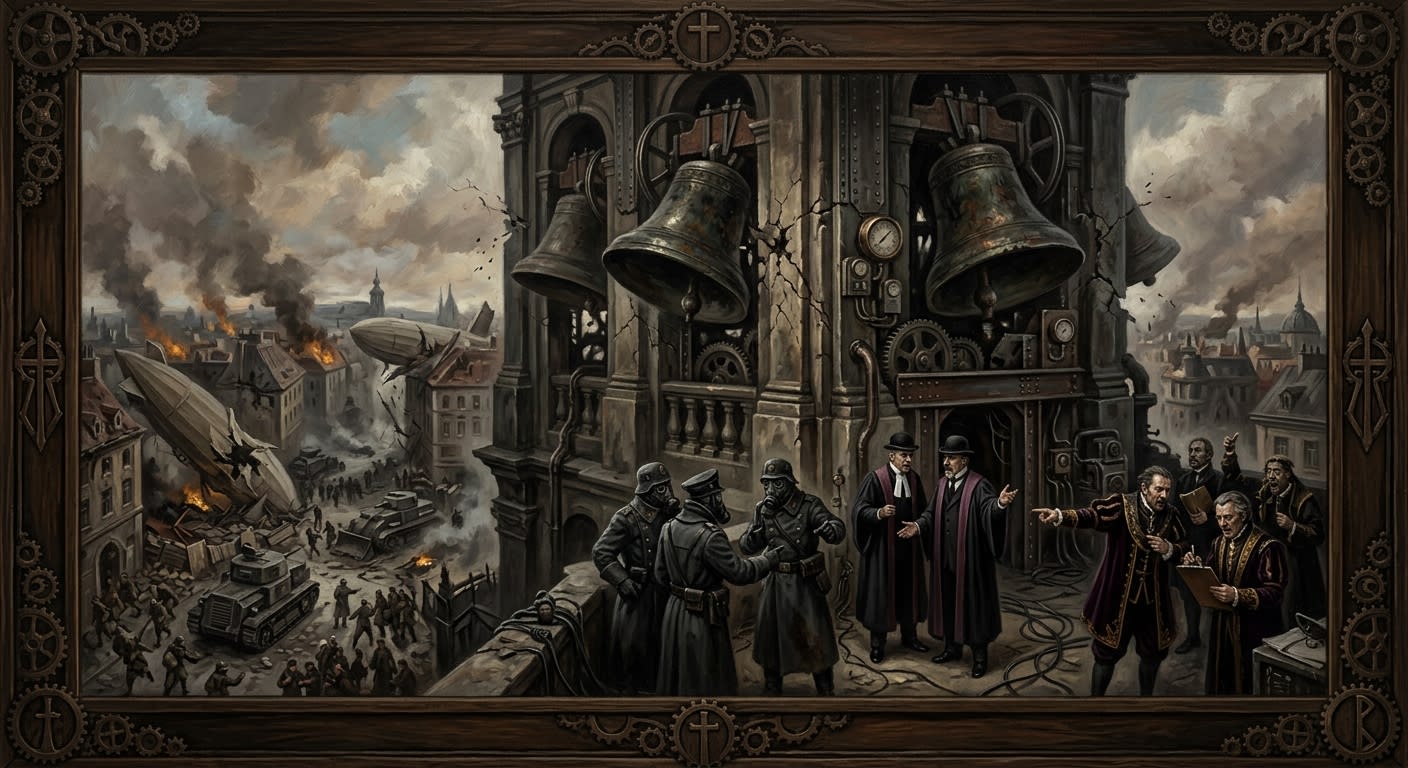
The Bells of Saint Rupert were cast for Vienna when Vienna still pretended that sanctity could be stored in towers and released by rope. There were five of them, though every schoolchild in the Synod is taught three names and every bell-master in the Bureau of Bells knows seven. This discrepancy is not arithmetic. It is custody.
Saint Rupert's cathedral stood on the old processional spine of Vienna, where relics had passed before the Rationalists learned to despise processions while retaining their excellent crowd-management techniques. The bells marked feasts, funerals, civic proclamations, episcopal scoldings, and, in the last years before the Treaty of Regensburg, the progressive subtraction of Faith from public sound. First the Angelus was forbidden. Then mourning peals required prefectural permission. Then bell-ropes were sealed unless a secular function could be certified. The tower remained. Its throat was closed.
The Rationalists understood bells. Do not flatter yourself that they did not. They understood that a bell is an argument carried over rooftops, an edict made audible, a bronze lung in which a city learns when to kneel. Their mistake was believing that an argument can be abolished by confiscating the rope.
In the old cathedral register, the bells are named Rupert, Adalheid, Leopold, Matthias, and the Little Salt. The Little Salt weighed more than three horses and was called “little” because bell-founders are given to jokes that land with the subtlety of falling masonry. Its rim bore a Latin prayer against false arithmetic. I admire the specificity.
#On Their Survival
During the Atheist Wars, bells across the Rationalist territories were melted for cannon. This was efficient, blasphemous, and exactly the kind of policy that impresses an idiot with a furnace. Bell-bronze became artillery. Sanctus became salvo. Parish memory was poured into moulds and aimed at parish doors.
The Bells of Saint Rupert were marked for the smelter three times. The first order was delayed by a missing inventory tag. The second was cancelled when two wagon teams refused to climb the tower stairs; one claimed illness, one claimed music, and both were correct in the limited way cowards occasionally stumble into truth. The third order reached Clemens Stahlhand during the long exhaustion before the Siege of Vienna. Clemens ordered the bells taken down for shot, then countermanded himself at the last hour.
The Bureau calls this prophecy. The garrison records call it indecision. One surviving sergeant called it “the Bishop-Warden yelling at a pulley until God became embarrassed.” His deposition has been sealed for tonal impurity.
Earlier civic guides stated that Clemens “saved the bells from Rationalist confiscation during the Atheist Wars.”
Corrected. Clemens saved them from a later emergency requisition under his own authority. The Rationalists had tried and failed before him. The difference matters, because Providence is most entertaining when it works through bad logistics.
#On the Peal
A.S. 95. Nine months of siege. Famine in the cellars. Plague in the straw. Rationalist artillery outside the walls, daemon-cult sorcery within the breaches, and Althazar of Pest walking toward the altar of Saint Rupert with a column of things the Bureau of Purity has filed under insufficient cabinets.
Clemens took the reliquary mace of Saint Aldebrand from the vault and struck. The blow rang the marrow of the earth. Iron split. The sorcerer broke. Demons scattered. The bells — dislodged by bombardment, unroped, and by several mechanical accounts incapable of any conventional motion — pealed of their own accord.
ACOUSTIC DEPOSITION 95-VIENNA-44 Witness: bell-ringer Matthias Krenn, left hand missing, fevered but legible Statement: “The smallest bell rang first. Backward. I heard the note leave the air before the bronze moved. Then the others answered from inside my teeth.” Addendum: Krenn's jawbone was later found to contain microscopic bronze dust matching no approved casting. Classification: ███████████████████
Whether the bells rang forward, backward, or in a sequence no clock can keep is the dispute that feeds three offices and has starved none of them. The Bureau of Bells says the peal began with the third bell and proceeded in correct liturgical descent. The Bureau of Doctrine says Heaven commanded bronze and bronze obeyed. The Bureau of Engineering, which should have kept its mouth shut, says the tower's cracked frame may have produced sympathetic motion. The Bureau of Engineering has since been invited to avoid explaining miracles while standing near them.
The besiegers broke when the peal crossed the lines. Rationalist gunners abandoned loaded batteries. Daemon-cult auxiliaries clawed at their ears until blood ran through their fingers. Three officers later swore that the bells spoke names from the Great Ledger of Souls, including names of men not yet born. This testimony was rejected as impossible and copied six times for future use.
A drummer of the Republican Guards testified that the sound came from behind him, ahead of him, below the paving stones, and inside the brass hoops of his own drum. He deserted before the third peal. Sensible man. The Bureau later hanged him, which shows that sense is no substitute for paperwork.
#On the Present Custody
The bells remain in Vienna, except for the bell fragments in Strasbourg, the clapper in the Basilica of the Ledgered Saints, the sliver held by the Bureau of Bells for calibration, and the unregistered shard embedded in Clemens Stahlhand's reliquary gauntlet. All are authentic. All are separately inventoried. The Bureau of Records has declined to total them, which shows a rare prudence I applaud with professional envy.
Pilgrim pamphlets once advertised the bells as “fully restored and audible on feast days.”
Withdrawn. The bells are not rung by human order. Feast-day chimes at Vienna are performed on substitute bells cast in A.S. 112. Any pilgrim claiming to have heard the true Bells of Saint Rupert must report immediately to the nearest confessor, bell-inspector, or suitably armed clerk.
Their canonical status remains a masterpiece of sacred cowardice: Miracle, Category Two, Under Review. Category One would require the Bureau to admit that Heaven speaks in bronze. Category Three would insult the veterans of Vienna and risk the bells answering the insult. Category Two allows reverence, caution, funding, committees, and the indefinite postponement of a conclusion. It is, in short, perfect.
The Rationalists called bells bronze. At Vienna, bronze sang without permission. This is why the Bureau preserves the Bells of Saint Rupert behind iron grilles, silver seals, and enough procedural ambiguity to choke a choir.
The substitute feast-bells are inspected twice yearly. The true bells are inspected by sight, never by touch, and always with a choir present to drown any note that should not occur. No note has occurred since A.S. 95. Three inspectors have nevertheless resigned after hearing “almost something.” The phrase is useless in a report and excellent in a nightmare.