
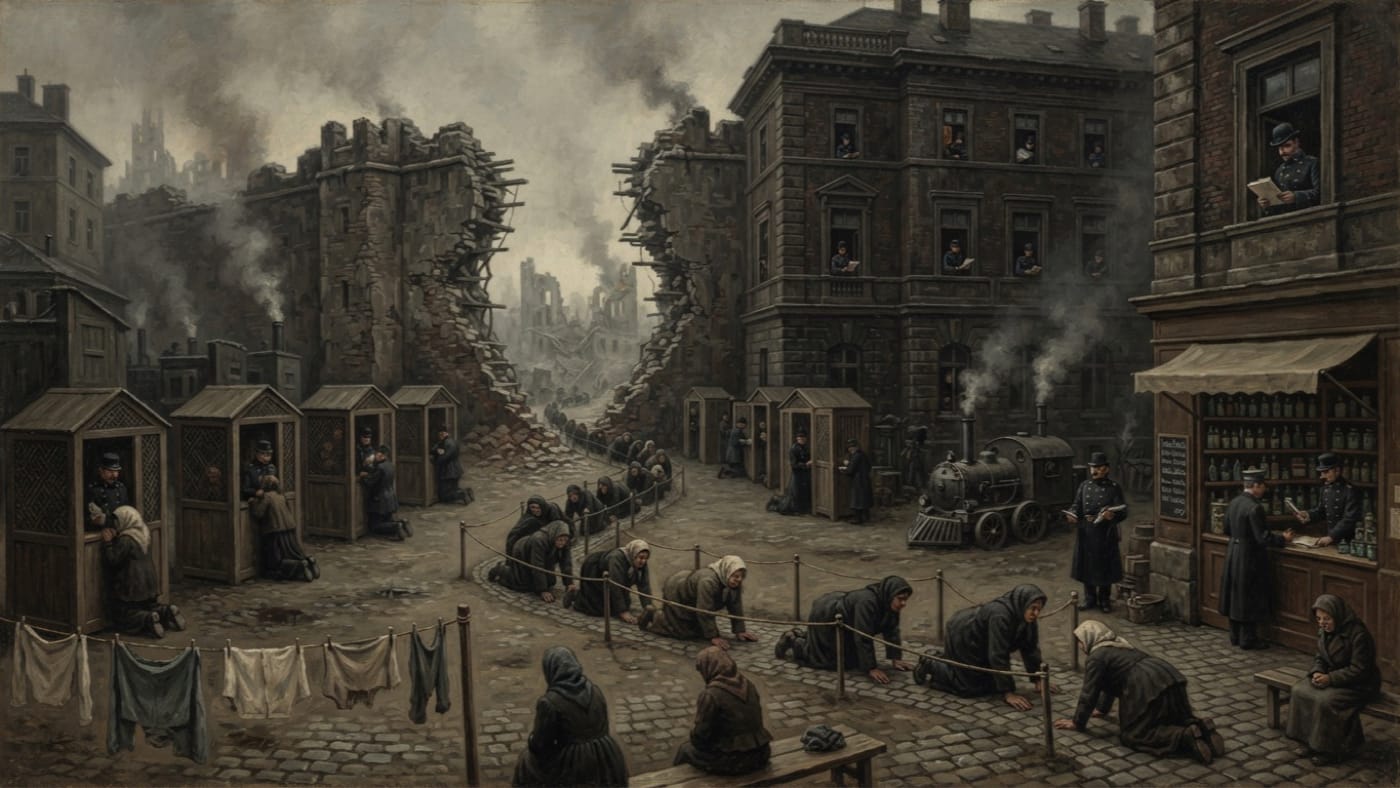
#On the Headquarters' Station
The Central Corridor headquarters of the Bureau of Pilgrimage stands beside the Kärntner Gate breach in Vienna-Ruins. It occupies a former customs house that now spends its second life taxing a different kind of traffic. The Bureau manages the Via Stahlhand from its counters. The Via is four hundred and eleven metres of sanctioned crawling, running through the breach and ending at the Impact Plate before Saint Rupert's altar. The road commemorates the Siege of Vienna of A.S. 95 / 1805 CE. That siege lasted nine months and ended when Clemens Stahlhand destroyed Althazar of Pest with the reliquary mace of Saint Aldebrand. The headquarters commemorates nothing. It processes.
Vienna lies on the Central Corridor, the middle artery running from Munich through the ruins to Bratislava, Budapest and the forward works beyond. It is a Zone 3 shrine-town and supply hinge, grown up around the rubble and the last great stop before the Carpathian approaches. Carters, quartermasters and whole companies pass the customs house on their way east. The office lets them pass. Divisions are commanded from Budapest by the Bureau of War, which counts men by the regiment. Pilgrimage counts them by the knee. Visiting colonels sometimes confuse the two offices. Widows never do.
#On the Customs House and Its Annexes
The customs house was built to stop carts at a gate, lift their tarpaulins and assess what they owed for the privilege of entering a city. The Bureau inherited that posture along with the masonry. The old purpose still shows in the frontage: a counter at the height of a merchant's purse, a yard laid out for waiting, and a door that admits nobody until an official has looked them over. I do not know whether any customs clerk ever handed his stool directly to a pilgrimage clerk, and I do not need to know. The building testifies to a continuity of temperament. The Church has never asked more of a building than that.
The Bureau has built around this core everything a successful shrine accumulates. Annexes lean against the original walls with the confidence of younger sons. Counting rooms sit where the light is best for wax and worst for the men reading it. Confession kiosks line the approach in screened rows, varnished outside and damp inside, each one a small wooden argument that a soul may be cleared at a window. At the corner stands the shop, because Heaven keeps no closing hours and neither may the till.
The result is crowded. Ledgers pass through doorways cut long after the walls around them. Pilgrims waiting for their file lean against the counting-room glass and watch their own admission being totted up. Knee-cloths dry on lines in any yard a queue has not already claimed. From the front step the breach is plainly visible, raw and unrepaired. Doctrine keeps it that way over the long objections of the Bureau of Engineering, so the whole institution can be read in one glance: the wound, the counter and the clerk between them.
#On Admission and Recorded Contrition
Pilgrims enter the Via in files of forty. Each pilgrim receives a knee-cloth, a wax token and a printed caution against theatrical bleeding. An ordinary passage takes about forty-five minutes. The elderly may request the longer mercy interval, which stretches the crawl toward an hour and is charged accordingly. Every one of those sentences produces paper.
The arithmetic is simple, which is why it is never finished. A file is a column. Forty tokens go out against forty names. Forty cloths go out to the knees and must come back to the launderers. Each mercy interval is an extra line with its own fee beside it. The counting rooms reconcile all of this between files while the next forty already shuffle in the yard. The work smells of tallow, wet linen and ink cut with too much gall.
The wax token belongs to the Via alone. It is soft, local and easily counted. It should not be confused with the calibrated metal bell-hour tokens that route-stampers cut for travel elsewhere in the Synod's lands. A pilgrim may arrive in Vienna with a perfectly lawful travel token in their purse and still find that it admits them to nothing here. That pilgrim then learns two jurisdictions at once.
Admission is divided by hour and by kind, and every division needs a clerk to judge it. The dawn file belongs to veterans and widows, so someone must decide who is a veteran and who is a widow. Sext belongs to foreign delegations, so someone must decide what counts as foreign. Vespers belongs to affluent contrition, and it carries a surcharge. That category checks itself.
The confession kiosks stand along this traffic. Their clerks work behind screens with rubric cards, receipt blanks and a stamp heavy enough to be heard from the yard. They take down what is said, sort it under the proper heading and issue proof that the thing was processed. Forgiveness belongs to an ordained confessor, and the kiosk keeps no such officer on its stool. Pilgrims seem to find the receipt sufficient. A receipt can be folded into a prayer book and shown to a sister.
Every file ends at the Impact Plate. The headquarters therefore admits pilgrims to a representation of the strike, and it should describe that representation correctly.
Earlier guidebooks identified the Impact Plate as the original stone struck by Clemens's blow.
Corrected. The plate is a contact substitute installed in A.S. 112 / 1822 CE. It marks the authorized contact site. The original strike-stone, cracked into three, was removed to the Basilica of the Ledgered Saints in Strasbourg. The guidebooks were written by other men. The correction was written by me.
#On Fees, Exemptions and the Steel Hand
The office lives on its distinctions. The mercy interval is mercy measured in minutes and billed in coin. The Vespers surcharge buys lamplight, lowered voices and stone that the day has warmed. Each exemption from kneeling is a licence, and each licence must be written, sealed, entered and produced on demand at the breach. A guide without papers is just a man standing upright among the penitent, and the penitent notice.
The guides walk upright because the work requires it. A crawling guide cannot manage the file, correct a posture, catch someone fainting or stop a pilgrim pocketing authenticated grit. Ward-surgeons walk upright because a surgeon on their knees sees the wound too late. Persons of doctrinal office walk upright because their knees are reserved for other purposes. I wrote the reason for that last category myself.
I walked the Via upright in six minutes. Pilgrimage complained, and the complaint went to Strasbourg. It came back bearing Doctrine's notation: "No corrective action. Knees reserved." The headquarters keeps that notation on file, I am told, near the licences it later began to issue. I have never asked to see the drawer. I know what it contains.
Then there is the shop. It sells knee-cloths, candles and the small comforts of wound care. Its pride is blister salve, bottled under the steel hand of Clemens. The salve works poorly. The label works splendidly. Pilgrims buy three bottles: one to use, one for kin, and one to set before a local icon once the knee has become satisfyingly ugly. The shop clerks keep stock lists, track breakage and refill the shelf between files, timing the restock so it meets the dawn file's widows, who buy carefully, and the Vespers merchants, who buy by the crate. A good shop clerk knows that a bottle sells best in the minute after the knee-cloth is returned.
The ruin-town has a whole commerce of bruised flesh: launderers, candle-sellers, blister surgeons and a tavern whose ownership the Bureau of Tithes denies in exquisite punctuation. The headquarters shop is only the part of that trade with a counter and a seal. The pilgrim kneels outside, pays inside and bleeds in the approved quantity somewhere between the two.
#On the Present Office
In A.S. 201 / 1911 CE the headquarters goes on doing what it was arranged to do. It sorts the forty, inks the wax, licenses the upright and sells the hand of Clemens by the bottle. The breach remains unrepaired beside it. The Bureau of Records receives the tallies. Doctrine receives the complaints. Engineering receives nothing and complains anyway. Each office reads the same columns and finds its own grievance confirmed.
The building cannot classify one thing. On the first of November the stone of the Via hums. The guides pretend not to hear it. The pilgrims hear it. The clerks in the counting rooms, who have a heading for widows, delegations, affluent contrition and the knees of men of doctrine, have no heading for a road that makes a sound on a date nobody scheduled. The shop sells nothing for it. The kiosks issue no receipt. No file is admitted to it, no wax is pressed for it, and the Bureau has never once charged a pilgrim for listening.
The customs house was built to decide what entered the city and at what cost. It still does. The items are pilgrims now, and the tariff is paid partly in coin and partly in skin. The building's purpose has never changed, only its traffic.