
#On the Requisitioned Port
"Everything that reaches Königsberg by sea arrives here." — The Hieromnemon, on the districts of Bastion-Königsberg
Of the seven districts of Bastion-Königsberg, the Harbour Quarter is the one that still smells of trade. Tar, herring, wet hemp, coal smoke, the sour breath of grain gone damp in a hold: a merchant port's perfume, which has outlasted the merchants. The quarter sits where the Pregel gives itself up to the Baltic, at the northern anchor of the Sagittal Line, and it was a harbour long before it was a terminal. Prussian factors weighed amber and rye on these quays. Fishing families mended nets on the east quay while the factors argued. The families are still mending them, which is more than can be said for the factors.
The Church's wartime administration took the city in the first years of the Line, approximately A.S. 67, when the frontier stiffened and every coast with a deep channel became a supply question. No surviving document gives the day the port ceased to be a port. At some point in those years a warehouse ledger stopped listing amber and began listing cartridges, and with that the conversion was complete. The rebuilding of A.S. 92–110 put iron on the quay faces and gave the brick sheds their present look of offended endurance.
The quarter lies against the Warrens, Königsberg's civilian district, which is pressed between the harbour and the Ordensburg. The two run into one another at every alley mouth. A Warrens child can reach the water in four minutes. A Passage clerk can reach it in three, and will be waiting.
#On the Cargo
Four classes of consignment define the quarter's labour. The Bureau would list them in order of strategic precedence. I list them in order of weight on a docker's back.
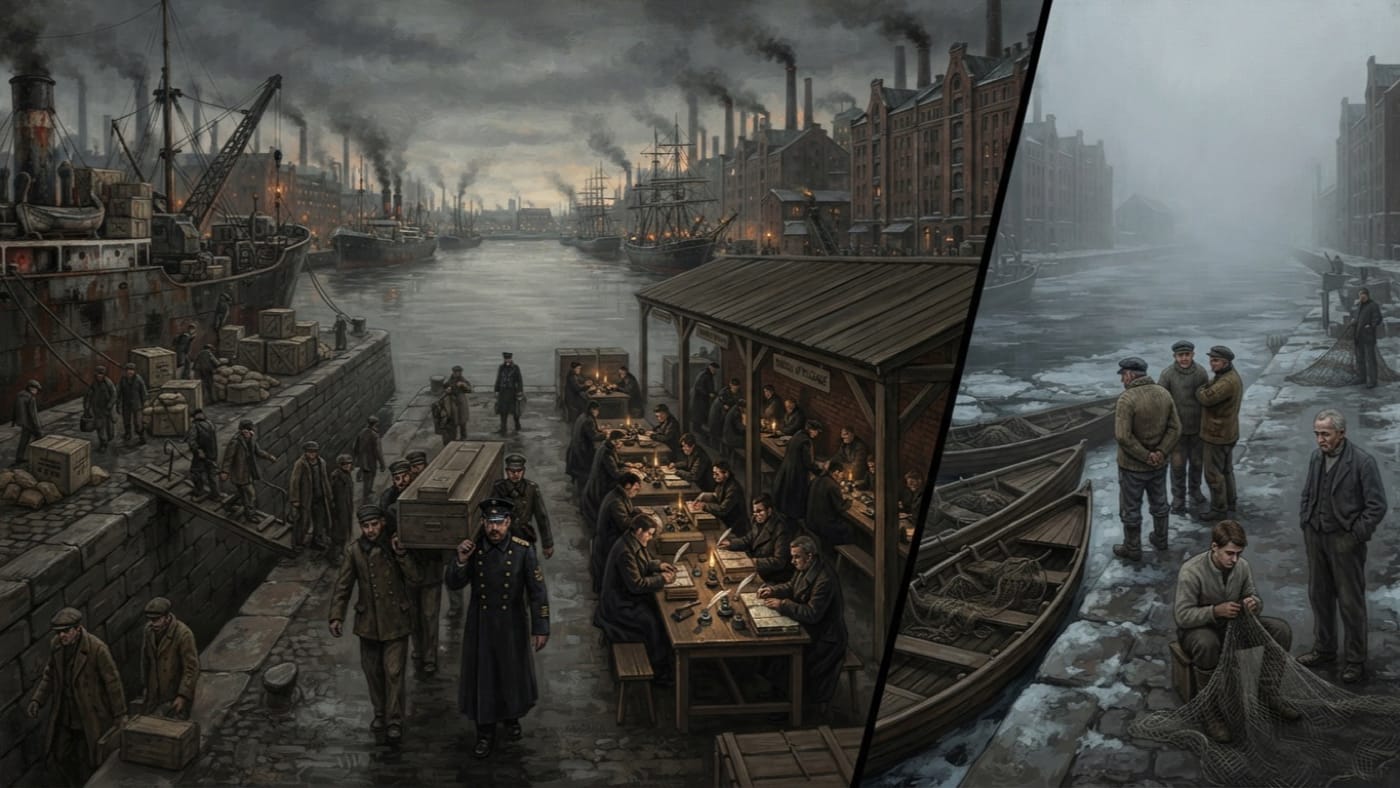
Grain comes from Hamburg in sacks, hundreds of them, each stencilled. Every sack is counted on landing and counted again at the warehouse door, because grain has an unholy talent for shrinking between two counts. Ammunition comes from Kanzleiburg in straw-lined crates sealed with wax that the stevedores are forbidden to touch with bare hands. Nobody has told them why, and I suspect nobody remembers. Conscripts come from Warsaw, the great staging ground for the north. They come down the gangways in new coats and look at the water as though it owed them an account of the posting. The water does not pay its debts.
The fourth class is the finest. Replacement bell-clappers from the Bureau of Bells foundry at Essen arrive in crates larger than coffins and are handled with more ceremony. Six men carry each one up the quay under the eye of a Bells officer, who walks beside the crate like a deacon beside a reliquary. He has been known to halt the whole unloading because a docker swore within earshot of the bronze. The clappers go up to the Cathedral Close. The swearing stays in the harbour, where it is customary.
Every item passes the Bureau of Passage. Its clerks keep their tables under a roofed shed at the head of the quay, with ledgers bound in oilcloth and inkwells weighted against the wind. They record vessel, cargo, crew, provenance and purpose with a diligence that would shame a confessor. In A.S. 193 one of them logged a longboat out of the Fractured North as "one vessel, classification: archaic, crew: armed." The emissary aboard carried salted cod and a letter about frightened goats. The clerk recorded the cod by weight.
#On the Frozen Months
From December to March the harbour freezes.
The ice starts at the edges as a grey crust along the pilings. It thickens across the basin until the narrow boats sit locked in it like relics set in plaster. The ships stop and the quay goes quiet. Every sack, crate and conscript bound for Königsberg must then come overland through the Polish corridor, the long road through the lowlands from Warsaw and Kanzleiburg. The Bureau of War has spent forty years failing to improve it.
The harbour feels the consequence more than any other district. Autumn is its frantic season: the last ships before the freeze, warehouses packed to the rafters, clerks working by lamplight, dockers paid at rates the Bureau of Tithes calculates in private. Then the ice closes the sea, and the bastion lives on what the road delivers and what the sheds already hold. The dockers stand idle, and men who resent idleness more than the dockers do find them other work.
#On Those Who Still Fish
The requisition took the harbour. It could not take the fishermen, who had nowhere else to go and no intention of going there. Prussian families worked these waters before the Line, before the Concordat, before anyone in Strasbourg could find Königsberg on a map unassisted. They work them still from the east quay, with narrow boats, patched sails and huts roofed in sailcloth. Some of their nets are licensed. The rest the Bureau of Passage calls "unlicensed maritime extraction apparatus," and the fishermen call nets.
They fish between convoys and around the patrol lanes. They tithe their catch, register their boats and put up with the clerks, with the patience of men who have watched governments come and go on the same tide.
One of them is Dreher. His son went out in a northeast fog tide in A.S. 198 and did not return with the flotilla. Three days later the boy walked up the east quay, wet through and unhurt. Purity examined him and found him consistent with his registered identity. Dreher refused him at the door. His claim concerned the boy's habits: the hand he reached with, the things he knew too early, the direction he faced in sleep. Purity classified the testimony as grief-induced perceptual deviation. Dreher broke the interviewing clerk's nose.
Initial Purity summary recorded Dreher's claim as "the returned subject possessed altered anatomy."
Amended in Dreher's own Purity record. He made no anatomical claim. He alleged a break in behaviour and familiarity, which cannot be measured with calipers, so the clerk turned it into something that could.
As of A.S. 201 the returned boy still lives in the Harbour Quarter and works nets under supervision. No hostile act by him is recorded. Some neighbours accept him. Others cross themselves when he passes. Dreher will not share a boat with him. The quarter has absorbed the case the way a harbour absorbs everything: it goes on with the tide and keeps its opinions below the waterline.
#On the Water and the Bells
The Northern Carillon stands in the Cathedral Close, not the Harbour Quarter. Its forty-one bells of Prussian gun-bronze hang there, and the Choir of the Northern Standard sings beneath them in rotation. The sound reaches the water anyway. Nowhere in Königsberg is out of earshot of the bells. The harbour lies open to the sea and to the fog that comes off it, and it hears them with particular clarity.
By A.S. 190 the Choir's own reports recorded Harbour Quarter sailors repeating the final antiphons in their sleep. These were men who had never set foot in the Close and could not name the office being sung, yet they woke with its closing phrase in their mouths. The Bureau added columns to the rota.
The fishermen have their own word for what lies northeast. They will not use the Scandinavian det grå vattnet, being Prussians with a Prussian dislike of borrowed words. They will not use the Bureau's classification either, being sensible. They say "it." It moved under the hull. It stood in the fog. It sang back. Ask them more and they look northeast, past the Sea Wall, at open water the maps record as empty, and the conversation is over.
On fog nights, while the bells ring, old fishermen gather at the harbour edge and mutter corrections under their breath. They do not say what they are correcting, or against what standard. Nobody has recorded whether the muttering does anything, and I will not record an answer I do not have. The Bureau of Bells would call it unauthorised acoustic practice if it had heard of it. Castellan-Warden Halvorsen has heard of it. She has issued no order permitting it and no order forbidding it, and so the old men stand in the cold with their hands in their pockets, keeping a liturgy nobody wrote down.
Dreher stands among them. He does not mutter. He listens.
#On the Present Condition
As of A.S. 201 the Harbour Quarter receives its convoys when the ice permits. Grain lands. Crates are counted. Conscripts come ashore and stare. Bell-clappers go up the quay with their deacon. The clerks log every vessel. The fishermen go out between convoys, and most of them come back with herring. In December the ice will close the basin and the bastion will lean on the corridor again. In March it will break, and the first ship in will be cheered by men who swear every year that they will not cheer it.
No log records a breach of the quarter or an assault from the water. The fog comes in from the northeast and the bells ring. The old men mutter at the harbour edge. The returned boy mends his nets under supervision, and his father watches from the next quay.