
#On the Office That Owns the Interval
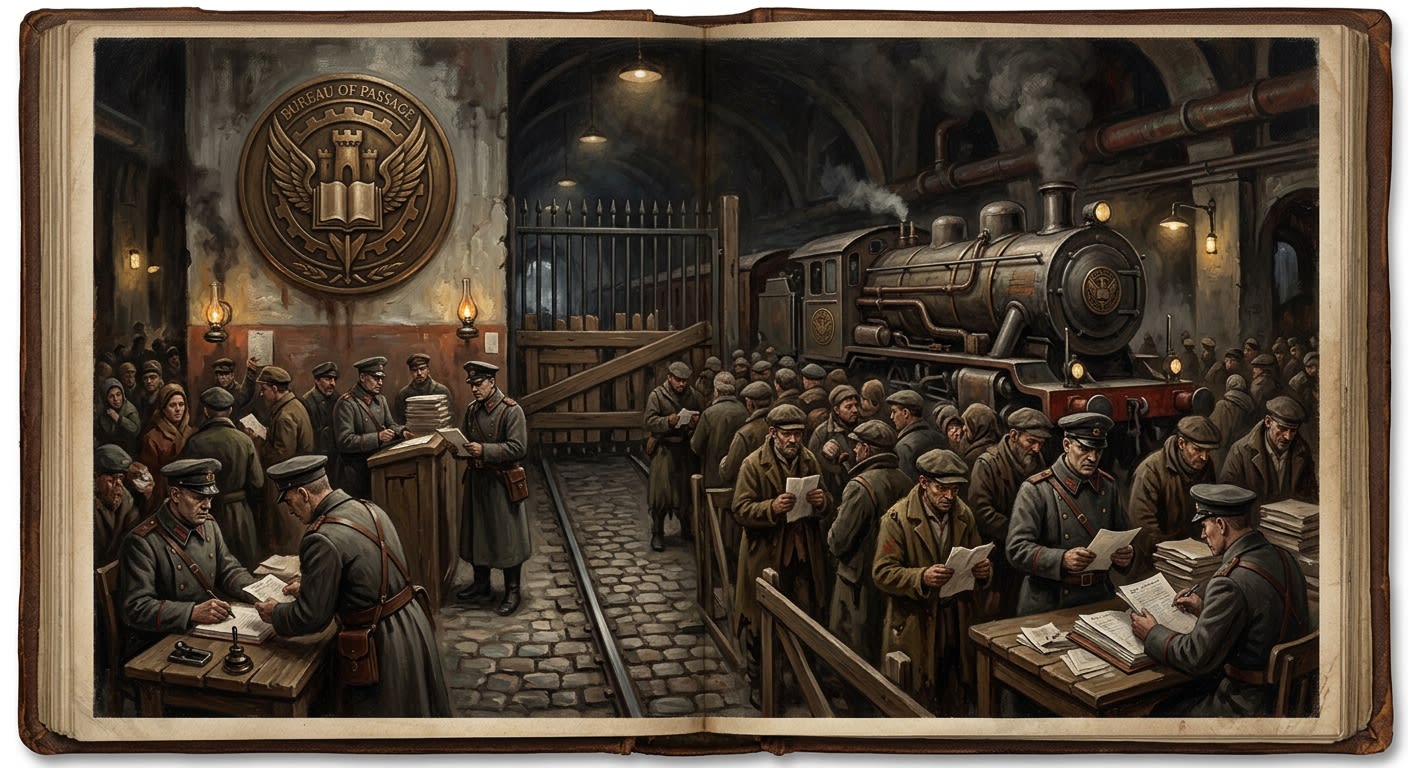
The Bureau of Passage exists because the Synod discovered, after the Sundering, that movement is never innocent. A cart may carry grain, fever, relic-bone, deserters under sacks, forged confession receipts, a widow's children, a demon's mutter folded into a hymn book, or a perfectly legal shipment of boots accompanied by illegal thoughts. The road does not distinguish. The gate must.
The Bureau's emblem is an iron key over a ruled line. Its clerks say the line represents lawful transit. Its enemies say the line represents the queue. Both statements please me; accuracy is improved by malice.
It is called a Bureau by habit and necessity, though its origins are uglier than charter language admits. Passage began as men with clubs at gates, then men with lists beside the men with clubs, then men with seals over the men with lists, then an office in Strasbourg explaining that the club had always been subordinate to doctrine. This is how civilisation dresses after committing assault.
#On Origin and Charter
During the Great Retreat of A.S. 48–65, movement killed almost as efficiently as the enemy. Refugees overwhelmed gates. Convoys clogged bridge approaches. Deserters vanished through market lanes. Plague rode west in carts whose manifests listed flour. Relic shipments were lost, stolen, traded, misblessed, and in one appalling case used as ballast by a barge captain whose descendants now enjoy the mercy of having no descendants.
By the Concordat settlement of A.S. 90, passage control had become too profitable, too dangerous, and too politically useful to remain a local nuisance. Records wanted the names. Tithes wanted the tolls. War wanted the convoys. Purity wanted the heretics before they crossed out of reach. Mercy wanted quarantine authority and immediately regretted receiving it. The resulting compromise gave Passage its shape: a Bureau whose jurisdiction begins wherever a body wishes to move and ends only when another Bureau shouts loudly enough.
Early instructional catechisms state that the Bureau of Passage was founded “to protect the faithful traveller.”
Corrected. Protection is an incidental benefit. The Bureau was founded to make movement legible, taxable, interruptible, and reversible. The faithful traveller may be protected if the queue is behaving.
The Transit Licensing Decrees (Unregistered) that later governed Gatewarden-Notaries did not create Passage authority. They domesticated it. A club at a gate is violence. A seal at a gate is policy. Policy is violence with witnesses and a better coat.
#On the Instruments of Passage
The Bureau works through paper, wax, voice, rope, chalk, bell, and delay. Paper names the traveller. Wax certifies the name. Voice confirms the password. Rope forms the lane. Chalk marks the wagon, forehead, crate, hoof, or coffin. Bells open and close the legal hour. Delay performs the remaining labour.
The crossing writ is the Bureau's common sacrament. Without it, a person is not a person in transit but a moving irregularity. A current tithe receipt proves that the traveller's fiscal soul has not curdled. A confession certificate proves that the mouth has been recently inspected for lies. A convoy clearance tells War that a road segment has consented to be used. Quarantine tags tell Mercy whom it may touch. Red tags mean halt. Blue tags mean do not approach. Black tags mean the traveller is already a file and should be treated with the politeness due to paper.
At major nodes such as Bratislava, Passage operates checkpoints in stone houses swollen by annexes: inspection counters, holding pens, quarantine sheds, brine-wash rooms, rope yards, seal vaults, and small chapels where the unverified may pray for patience without implying the Bureau lacks mercy. At Warsaw, its ferry regulation fights Praga's hunger and the Vistula's contempt. At Bastion-Königsberg, Passage clerks prevent people from leaving the Warrens with the same diligence other offices reserve for preventing entry. Direction is a local preference. Control is universal.
#On the Servants of the Gate
The Bureau employs Gatewarden-Notaries, Checkpoint Queue-Marshals, seal examiners, lane criers, quarantine counters, ferry auditors, chain-watchers, escort registrars, brine clerks, and the pale species of junior functionary who can say “next window” while looking at a mother holding a feverish child. The hierarchy is simple to describe and miserable to endure. The higher ranks own seals. The lower ranks own voices. The queue owns everyone.
The Gatewarden-Notary is the Bureau's minor sovereign: ink-stained, key-ringed, able to halt four thousand men by asking for documentation. The Checkpoint Queue-Marshal is the Bureau's visible muscle: a human valve stationed where roads pinch into gates and hunger begins doing arithmetic with fists. Between them stands the traveller, clutching paper as if paper were mercy. Sometimes it is. Usually it is paper.
A Records primer describes Passage personnel as “facilitators of lawful movement.”
The corrected phrase is “licensed interrupters of unlawful movement.” Lawful movement is what remains after interruption fails to find a reason.
There is corruption, naturally. A passage office without corruption would be a theological anomaly and should be burned for safety. Fast wax, duplicate seal heads, lane demotions softened by coin, bribe bundles itemised as chapel donations, escort tokens borrowed from dead men, password cards copied by candlelight: these are not deviations from the system. They are the grease that prevents the machine from shrieking itself deaf. Passage denounces them quarterly and relies upon them hourly.
#On Quarantine, Refusal, and Mercy's Complaint
Passage loves quarantine because quarantine is refusal dressed as concern. A coughing child can halt a lane. A damp confession certificate can hold a family three days. A wagon from a district with recent bell irregularities can be brined, smoked, blessed, unloaded, reloaded, unloaded again because the first unloading was performed under the wrong peal, and then released after its cargo has spoiled into proof of caution.
Mercy protests. Mercy always protests. Mercy protests in forms, memoranda, bedside prayers, and the exhausted handwriting of ward-superiors who know that a quarantine pen is a hospital designed by someone who hates beds. Passage replies that one infected caravan may kill a city. Mercy replies that three weeks in a holding yard may kill a caravan. Both are right. The Bureau of Doctrine finds such conflicts edifying, which is our word for insoluble.
PASSAGE-MERCY JOINT REVIEW — FIRST QUARANTINE WINTER APPENDIX Camp sealed under Neral precedent. Population: ██████. Admitted after clearance: ███. Bodies burned: ██████. Primary dispute: whether refusal constituted medical containment or administrative abandonment. Final classification: sanctified discretion.
Saint Neral of the Narrow Door (Unregistered) remains patron of gate discretion. He sealed a caravan camp outside a forward settlement because their confession receipts bore an irregular watermark. The camp died. The settlement lived. Later examination attributed the watermark to damp storage. Neral knew. The canonisation stands. A saint need not be kind; kindness has no seal authority.
#On Present Application
As of A.S. 201, the Bureau of Passage is everywhere and never where blame requires it. It is at Danube bridges, bastion gates, ferry chains, pilgrim route locks, harbour mouths, Vistula crossings, quarantine yards, convoy stacks, rail chokepoints, and the narrow municipal door where a clerk asks why your papers smell of smoke. It is powerful because the war requires movement and because every movement gives power to whoever can interrupt it.
Its conflicts with other offices continue with healthy venom. War curses delayed convoys and begs for stricter deserter screens. Tithes wants tolls collected before Mercy touches anyone. Records wants every traveller named even when naming takes longer than survival. Purity wants lanes designed so fear reveals itself. Settlement wants refugees moved west until west becomes a queue. Passage stands amid the petitions and raises one hand.
The hand is ink-stained. The line stops.