
#On the Long Flat Throat
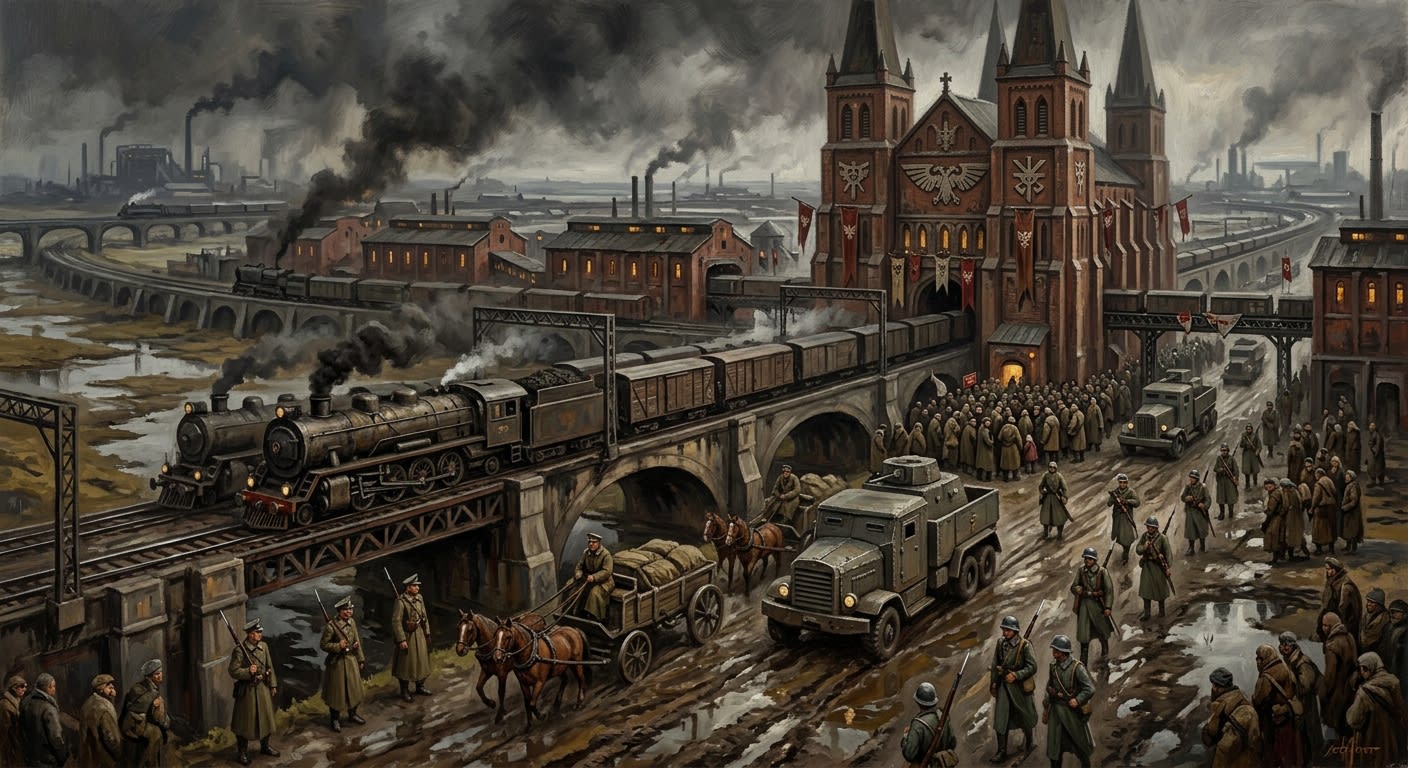
The Polish Corridor is not a province, not a road, not a railway, not a front, though every mapmaker with insufficient sleep and too much red ink has attempted to make it one of these things for the comfort of committees. It is the long flat throat by which Warsaw feeds the northern Line: grain, coal, cartridges, coffin planks, bell-clappers, replacement men, rejected men, corrected men, horses who have not yet learned the sound of eastward guns, and clerks dispatched with satchels full of forms that will be obsolete before they arrive.
It runs across the low country between the Vistula staging city and the exposed bastions of Brest and Königsberg, through ground so level that a wicked child could draw a horizon with a ruler and call it geography. The Bureau of War loves it. Flat ground favours rail, convoy, survey, telegraph, artillery, timetable, and every other instrument by which men in offices convince themselves that distance has been beaten into obedience. The soldiers hate it, which proves the soldiers have retained the better theology.
From Warsaw’s eastern yards the corridor forks: one iron artery toward Brest and the Bug crossing, one northern artery through Białystok and the lakeward approaches toward Königsberg. Between these lines lie sidings, cattle platforms, ration sheds, signal towers, prayer huts, rail-confessor booths, ditch graves, repair depots, night telegraph cabins, and those innumerable small Polish villages that the Bureau of Records alternately counts, merges, renames, evacuates, repopulates, and misplaces depending on which quarterly table has priority over mercy.
#On How the Corridor Was Made Holy by Use
The corridor existed before the Synod named it. Merchants crossed it, armies crossed it, priests crossed it, refugees crossed it with relics tied in blankets and children tied to carts so the carts would not lose the children in mud. After the Sundering in A.S. 45 and the Great Retreat that followed, the same lowlands became the funnel through which eastern loss poured westward. The first roads were not roads. They were lines of flight repeated until grass gave up.
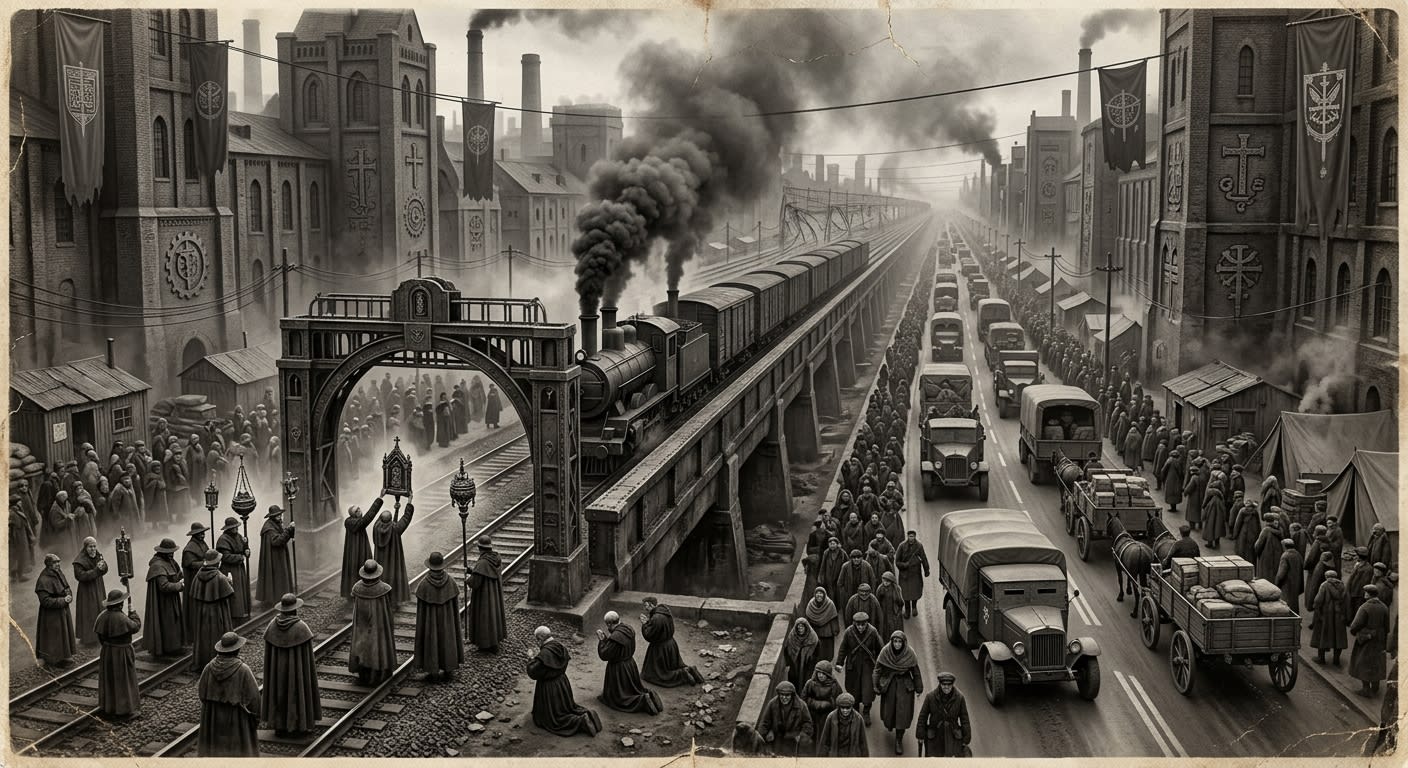
The Line hardened in A.S. 65. Bastions rose where geography had teeth: Baltic coast, Bug crossing, Carpathian gate, mountain wall, Danube gorge, Shipka pass, Bosphorus lock. The Polish lowland had fewer teeth and more appetite. Brest became the lock on the Bug. Königsberg became the Far Nail against the Baltic. Warsaw, lying one hundred and sixty kilometres behind the nearest front and pretending that numbers protect people from sound, became the city that made both positions possible.
By A.S. 95 the Bureau of War had requisitioned the old route system into a military corridor. The same year Warsaw received its evacuation order, Standing Order 14-W/3, which has remained suspended, revised, reviewed, and usefully unenforced for longer than several saints’ cults have survived. The corridor gained rail priority, signal law, bridge guard regulations, and the first formal departure blessings for trains leaving the city. Men pray differently when the track ahead is straight. They can see too far.
Early Northern Logistics summaries describe the Polish Corridor as “secure rearward access.”
Corrected. The corridor is rearward only by comparison with the trench. It is secure only by comparison with open hell. Any clerk using the phrase now is to be seated on an eastbound ammunition wagon in February and invited to revise his adjective before Brest.
The A.S. 112 Broth Riots revealed the corridor’s true anatomy. Winter grain shortages at Brest, Königsberg, and Przemyśl were treated as local mercy failures until stalled trains in Warsaw showed the more humiliating fact: hunger at the front begins as arithmetic in transit. A delayed siding becomes a half-ration. A broken bridge becomes a riot. A misfiled wagon becomes a widow with a ladle in her hand and a theology of soup fierce enough to frighten Purity.
#On Rail, Road, and the Bureau’s Favourite Illusion
The rail is the corridor’s spine and its vanity. Two principal spurs leave Warsaw eastward. The Brest spur runs fast and exposed across terrain with no tunnels, few cuts, and almost no places where a train may hide from weather, eyes, or the Creator. The Königsberg spur bends north by stages, carrying grain, ammunition, replacement personnel, and bronze instruments whose labels contain more holiness than many sermons. When the harbour at Königsberg freezes from December to March, this overland route stops being one supply method among several and becomes the whole northern breath.
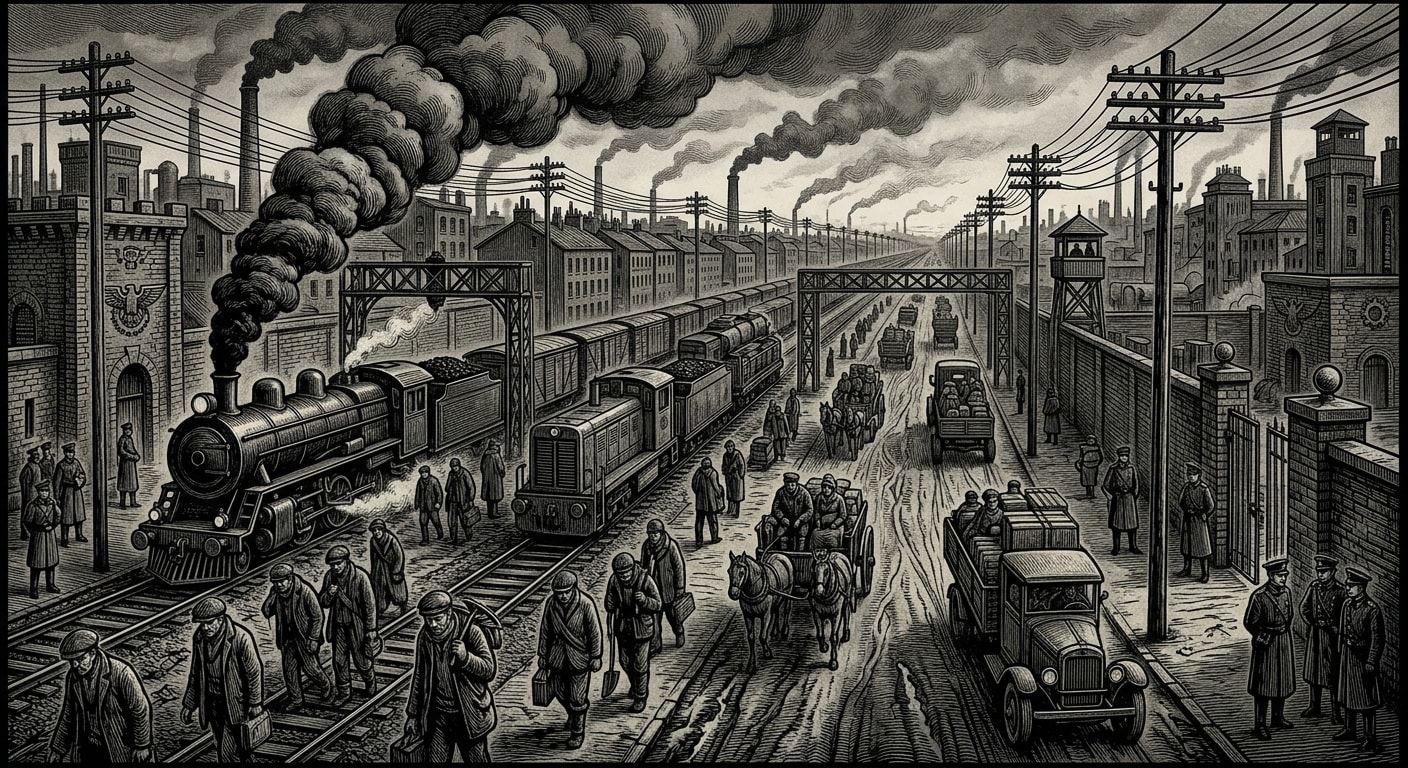
The Bureau of War calls the line efficient. It is. It is also fragile in the precise manner efficient things become fragile when men begin trusting them. One derailed locomotive outside Warsaw can choke the Brest line for days. One ice-split rail north of Białystok can leave Königsberg waiting for bell-clappers while the Northern Carillon rings with patched throats. One refugee crowd on a siding can delay an ammunition train while four offices debate whether starving citizens constitute obstruction, appeal, settlement overflow, or bad weather with faces.
Road convoys carry what trains cannot: irregular freight, wounded men moved quietly, relic crates too nervous for public platforms, officers whose importance exceeds their patience, and the little black carts of the Bureau of Purity that travel with curtains drawn and no lantern after dusk. The roads are corduroyed where mud repeats itself, ditched where water gathers, and guarded where villages have learned that a passing wagon may contain more food than the parish has seen in a week.
Signal towers stand every few miles along the main route. Their crews speak in lamp, flag, bell, telegraph, flare, and blasphemy, the last being unofficial but often fastest. Each tower keeps a route chapel no larger than a toll booth, a water cistern, a cartridge locker, and a locked folio of emergency names. If a train fails to arrive, the nearest tower records the absence before it records fear. That is civilisation.
Corridor transit rule — Northern Route Table: no eastbound train departs Warsaw without clearance, blessing, axle witness, cargo seal, and War priority notation; no westbound refugee convoy enters Warsaw without Passage count, Mercy triage mark, and Records provisional name slip; no signal tower may go unlit after dusk except under direct artillery, direct fog, or direct order.
#On the People Who Live in a Passage
The Bureau prefers to imagine the Polish Corridor as infrastructure. Infrastructure does not ask for bread. Infrastructure does not hide sons from levy officers. Infrastructure does not build bakeries under evacuation orders, birth children beside rail sidings, marry into villages that have been officially temporary for one hundred years, or curse eastbound trains because the wheels wake infants. The corridor is inhabited, and that is its administrative sin.
Railway families live in signal hamlets: switchmen, lamp girls, coal measurers, brake boys, axle inspectors, telegraph sisters, confession-scribes, and the women who keep platform soup hot enough to disguise its poverty. Their houses stand too near the tracks because distance costs timber and heat. Children learn train schedules before catechism. They know the difference between a grain train, a troop train, a coffin train, and a train that carries something no one should ask about. The last moves slower and has priests at both ends.
Refugees live along the corridor in layers. Some came after A.S. 45 and never completed the walk west. Some came after village reclassifications pushed Zone Four habits into Zone Three fields. Some came from the Bug settlements, some from the Masurian edges, some from hamlets that Records has folded into “No-Man’s-Land adjacency” as if a stamp could make a well forget its bucket. Warsaw absorbs many. The corridor keeps the rest, like cloth catching burrs.
The Rail-Confessor Corps belongs to this world more than to any chapel. Its grey-cassocked priests stand on platforms and give eleven-second blessings to engines already hissing with impatience. They confess locomotive crews who have killed men on tracks, soldiers who vomit before boarding, porters who stole ration flour, engineers who signed off on cracked wheels because the timetable screamed louder than conscience. The confession is too short, the absolution too quick, the soot too thick. Grace, in the corridor, has learned to run beside moving trains.
A Bureau of Rites instructional sheet once described the Rail-Confessor’s task as “pastoral accompaniment of transit personnel.”
Amended after three chaplains objected. The task is spiritual triage conducted at steam pressure among men who may be dead before a full prayer can finish. “Accompaniment” is what one offers a dowager crossing a courtyard.
#On Warsaw’s Hunger and the Eastern Sound
Warsaw is the corridor’s stomach, throat, and conscience, which is unfair to Warsaw and convenient for everyone else. Its eastern yards receive the west’s abundance and convert it into counted departure. Its Praga district hears the front on clear nights. The residents call the low percussion the Breathing, and the Bureau of Doctrine forbids the name because ordinary people naming military acoustics is how fear becomes grammar.
The corridor carries that sound backward. On winter nights the flatness becomes an acoustic document: Brest’s bell-cannon muttering through frozen air, distant rail couplings answering like rosary beads, tower lamps ticking in wind, dogs waking before men, mothers pausing with bread knives held above loaves. It is possible to stand far enough west to be told one is safe and still hear the east disagree.
BUREAU OF WAR ACOUSTIC NOTE — NORTHERN CORRIDOR, A.S. 196 Observation: impact sounds from Brest sector carried beyond expected range under hard frost. Recorded civilian term: “Breathing.” Recommended action: discourage nomenclature; avoid publication of range table. Suppressed addendum: one tower crew heard reply-pulse from north-northeast after Brest guns ceased ███████████████████
Warsaw’s refusal to empty gives the corridor its daily contradiction. Every eastbound train passes a city under evacuation order. Every westbound refugee convoy enters a city that has been instructed, in law, to have ceased receiving them. Bureau of Settlement reports call this “review status.” Bakers call it business. Children call it home. The Ledger, being less sentimental than children and more honest than Settlement, calls it population variable.
The corridor’s ration politics are savage because everyone can see the wagons. Hunger hidden in warehouses breeds suspicion. Hunger beside moving grain breeds riot. Praga learned this in A.S. 195 when civilians blocked the eastern rail spur for eleven hours and demonstrated, with bodies alone, that a district of “limited administrative interest” could halt the northern supply line. Since then the Bureau watches bread queues with the care other cities reserve for artillery.
#On Brest, Königsberg, and the Two Kinds of Fear
Brest fear is horizontal. The ground east of it lies flat, exposed, and brutally legible. The Polish Corridor approaches Brest through the same military nightmare: no cover, no mercy of contour, no wall of mountain or forest to interrupt the eye. Trains run fast because speed is the line’s only armour. Convoys move at night and discover that night on flat ground is merely daylight without permission.
Königsberg fear is northern. The overland route reaches the Far Nail when the Baltic harbour freezes, bringing the bastion grain, coal, men, gun parts, and bell metal through territory that grows colder and less talkative with every mile. The Masurian Lakes defend the bastion and complicate every approach to it. Lake villages send Watchers, guides, rumours, fish, and the kind of local knowledge that makes Bureau maps look like devotional art made by children.
The Grey haunts the northern imagination even when no fog is present. Dreher’s case travelled down the corridor faster than any authorized report: a lost son returned from northeast fog, a father refusing the archive, a household split between flesh and recognition. Railway men repeated the story in coal sheds, then denied having heard it. Signal crews began marking north-facing windows with chalk crosses. One trainmaster in A.S. 199 ordered all sleeping berths on the Königsberg spur turned westward. He was reprimanded for unsanctioned furniture doctrine. His crews obeyed him anyway.
Königsberg’s need makes the corridor vulnerable to every superstition the Bureau would prefer to burn. When the harbour freezes, trains must arrive. If they do not, the garrison eats paper by the fourth week and doctrine by the fifth. The Northern Carillon requires parts. The Sea Wall requires rotations. The Frost Yards require whatever chemistry permits oil not to congeal and corpses not to behave. The corridor delivers. It also carries back stories, which are harder to seal than crates.
#On Sabotage, Weather, and Other Honest Enemies
The corridor’s enemies are not all demonic, which the Bureau finds disappointing because mundane failure lacks liturgical grandeur. Rails buckle. Bridges ice. Coal spoils. Telegraph lines snap. Porters steal. Horses die. Clerks transpose wagon numbers. Engineers sign estimates with the optimism of drunk prophets. A troop train can be delayed by Hell, frost, axle heat, human stupidity, or a cow too stupid to move and too sacred to shoot in view of villagers.
Sabotage exists. Some of it belongs to enemy agents, some to black-market freight crews, some to village resentments, some to desperate parents cutting signal wire to delay levy trains. The Bureau of Purity calls all four treason when tired. The Bureau of War prefers categories because categories can be punished at different rates. A man paid by Hell to loosen bolts is a traitor. A mother who hides a switching lamp so her son misses a draft train is, technically, also a traitor. Doctrine may see the distinction. War rarely has time.
Weather is the more reliable saboteur. Spring mud pulls cart wheels down to the hub and produces language unsuitable for confession. Summer dust enters rifles, lungs, inkpots, and saints’ reliquaries with democratic enthusiasm. Autumn rain makes every siding smell like wet wool and old cabbage. Winter becomes a second command structure: ice decides bridge speed, frost decides coupling time, snow decides visibility, and the wind decides whether Warsaw hears the guns.
The corridor survives through repair gangs. Track Kneelers, Bridge Saints, coal haulers, spike boys, signal sisters, ditch crews, and nameless Polish farmers with shovels keep the route alive after storms and strikes. They do not appear in grand reports except as labour totals. Their absence appears immediately. This is the nearest thing the Bureau grants to sainthood without relic revenue.
#On Present Condition
As of A.S. 201, the Polish Corridor functions. This is the highest praise logistics can receive and the ugliest. It functions while Warsaw remains unevacuated, Brest remains hungry, Königsberg remains cold, the Grey remains unnamed, the Breathing remains forbidden as a word, and rail crews continue to bless engines already moving east. It functions because too many lives depend on it for anyone to ask whether its operation is sane.
External inspection has recommended widening the northern sidings, doubling winter coal reserve, relocating several refugee hamlets, building two fortified bridgeheads, suppressing corridor rumours, standardising Rail-Confessor timing, and reviewing Standing Order 14-W/3. These recommendations will produce files. Files will produce objections. Objections will produce subcommittees. The trains will depart while the subcommittees are choosing chairs.
The corridor’s truth is visible from any signal tower at dusk: rails shining east, smoke flattening under low cloud, a prayer hut lamp blinking beside a ditch, a village woman counting wagons by ear, a soldier asleep on a crate, a child waving at a train that carries men who will never wave back. The Synod calls this supply. The Line calls it survival. The Polish Corridor, being wiser than both, says nothing and lets the wheels pass.