
#On the Cold Bowl
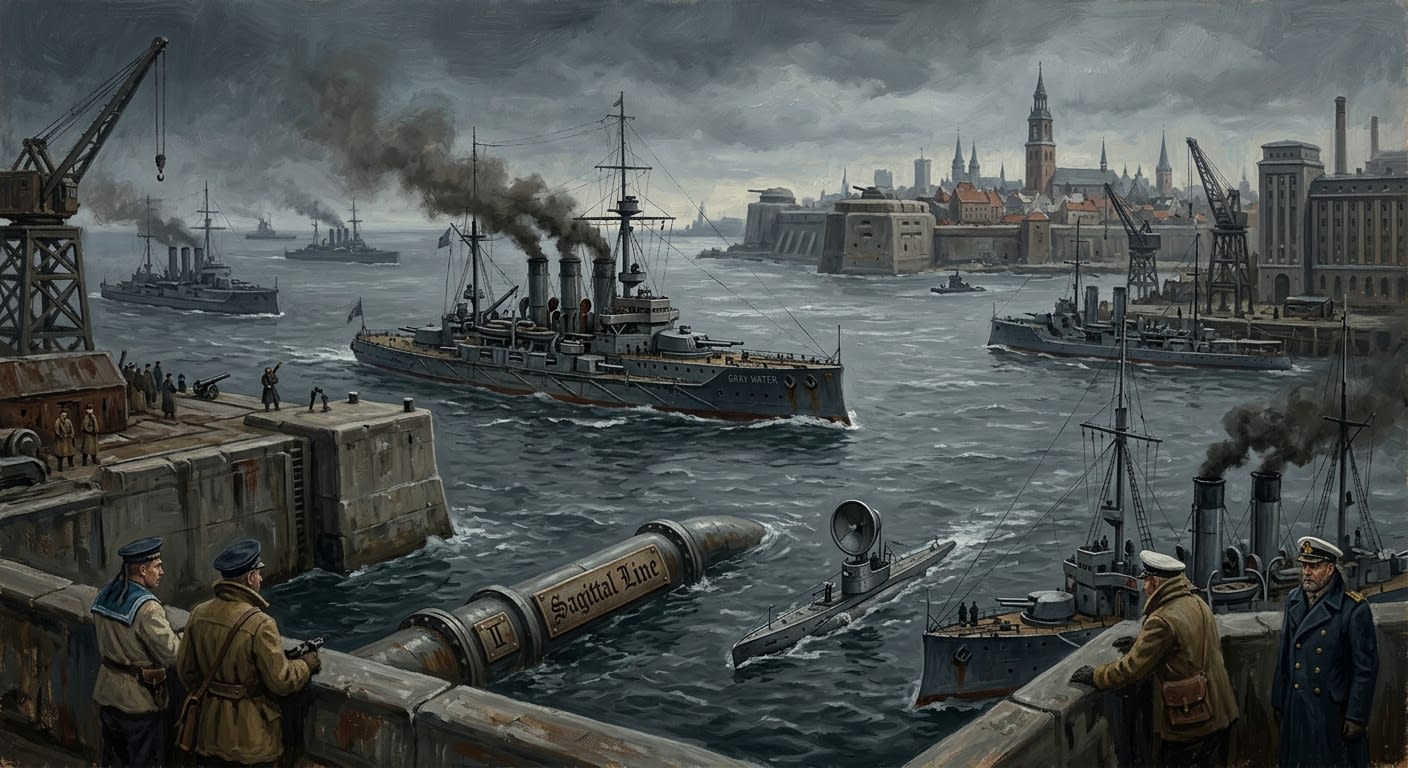
The Baltic Sea is the northern bowl into which Europe pours its fear when the land has no remaining ditch to offer. It lies beyond Bastion-Königsberg, under the eyes of the Sea Wall (Unregistered), across the disputed approaches of the Fractured North, beside Danzig's grain mouths, beneath fog that refuses the courtesy of being weather. Maps colour it blue. This is a painter's lie and a clerk's cowardice. The true colour of the Baltic Sea is the grey of pending classification.
A sea should perform four tasks: drown fools, carry ships, freeze when instructed by winter, and feed coastal men who smell permanently of fish and old grievances. The Baltic does all four, when watched. When unwatched, it listens.
The sea matters because the Sagittal Line ends at it. Two thousand miles of trench, bastion, wire, ration, gun-platform, bell-tower, latrine ditch, burial road, prayer schedule, and administrative vanity run north until Königsberg's brick meets salt water and can go no farther. The Line may descend toward Constantinople in the south, but in the north it terminates in a maritime shrug: here is the wall, here is the water, here is the thing beyond water that looks back.
Before the Sundering, the Baltic Sea was a merchant's argument: Prussian ports, Danish pilots, Swedish timber, Polish grain, Hanseatic ledgers, Lutheran ghosts, Catholic holdouts, smuggling families, university men at Königsberg writing philosophy while fishermen quietly knew more useful things. The Rationalists admired it for distance. Strasbourg was far. Rome was farther in memory than in mileage. A customs house could be renamed, a toll secularised, a bishop corrected by decree, and the gulls would continue screaming without respect for metaphysics.
Then the East cracked in A.S. 45, and northern confidence received the slowest, most humiliating form of correction. The horror came first by rumour, then by cargo, then by refugee, then by requisition. The Baltic cities had time to misunderstand. Danzig believed grain would buy insulation from catastrophe. Königsberg believed Prussian order could systematise any frontier. Scandinavian elders believed the southern ruin might teach the mainland modesty. Two errors and one joke at Strasbourg's expense. The elders were nearest truth.
#On the Line Meeting Water
By A.S. 65, when the first refusals hardened into the Line, the Baltic Sea had become the northern limit of retreat. The West had walked backward until there was nowhere sensible left to walk. Southward, the Line found mountains, rivers, gorges, passes, and the Bosphorus. Northward, it found Königsberg, the Masurian Lakes, and sea.
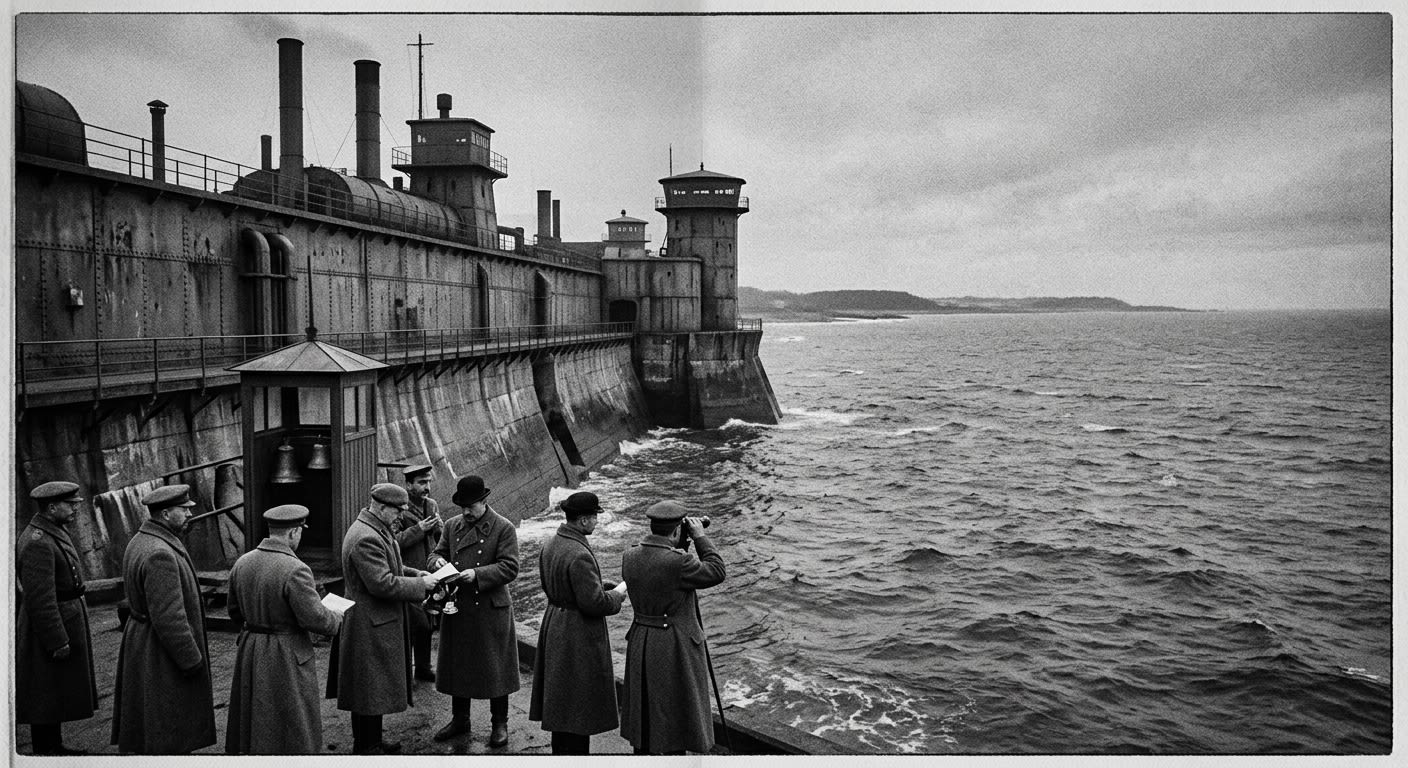
This should have comforted the Bureau of War. Seas are old friends of military laziness. They seem to remove directions from which enemies may arrive. They flatter commanders into speaking of secure flanks, maritime barriers, naval watch, and other phrases that sound excellent indoors. Older northern primers described the Baltic as Königsberg's safe flank. The primer authors were neither drowned nor shot for this, which shows our ancestors' softness.
Earlier northern primers described the Baltic Sea as Bastion-Königsberg's safe flank.
Corrected. A flank cannot be safe merely because an infantry column cannot march across it. The sea does not need to march. The fog does not need to march. Certain primer authors have been transferred to educational labour, where their errors may injure fewer garrisons.
Königsberg was requisitioned around A.S. 67 and converted, in the Synod's customary improvement of all living things, into a fortress that resembles a tomb with payroll discipline. The Sea Wall faces the Baltic. The Northern Carillon rings forty-one bells toward the water. The harbour freezes, opens, freezes, breaks, refuses, and takes supply schedules as personal insults. The old Pregel mouth serves War, Tithes, Passage, Records, Bells, Orison, and those fishermen whose families worked the water before Bureaus developed the charming theory that fish should carry permits.
The Masurian Lakes guard the landward maze. The sea guards nothing. It receives everything: fog, ice, wreckage, bells, ships, bodies, returned sons, old Scandinavian warnings, and the careful lies of port officials. At the Sea Wall, sentries learn the difference between looking outward and being observed. The first is duty. The second is the beginning of a sealed interview.
#On the Grey Water
The garrison at Königsberg calls the phenomenon the Grey. The Scandinavians call it det grå vattnet, the grey water. The Bureau of Doctrine calls it Unknown Forces, Extradoctrinal Classification Pending, which is how an institution screams into a handkerchief.
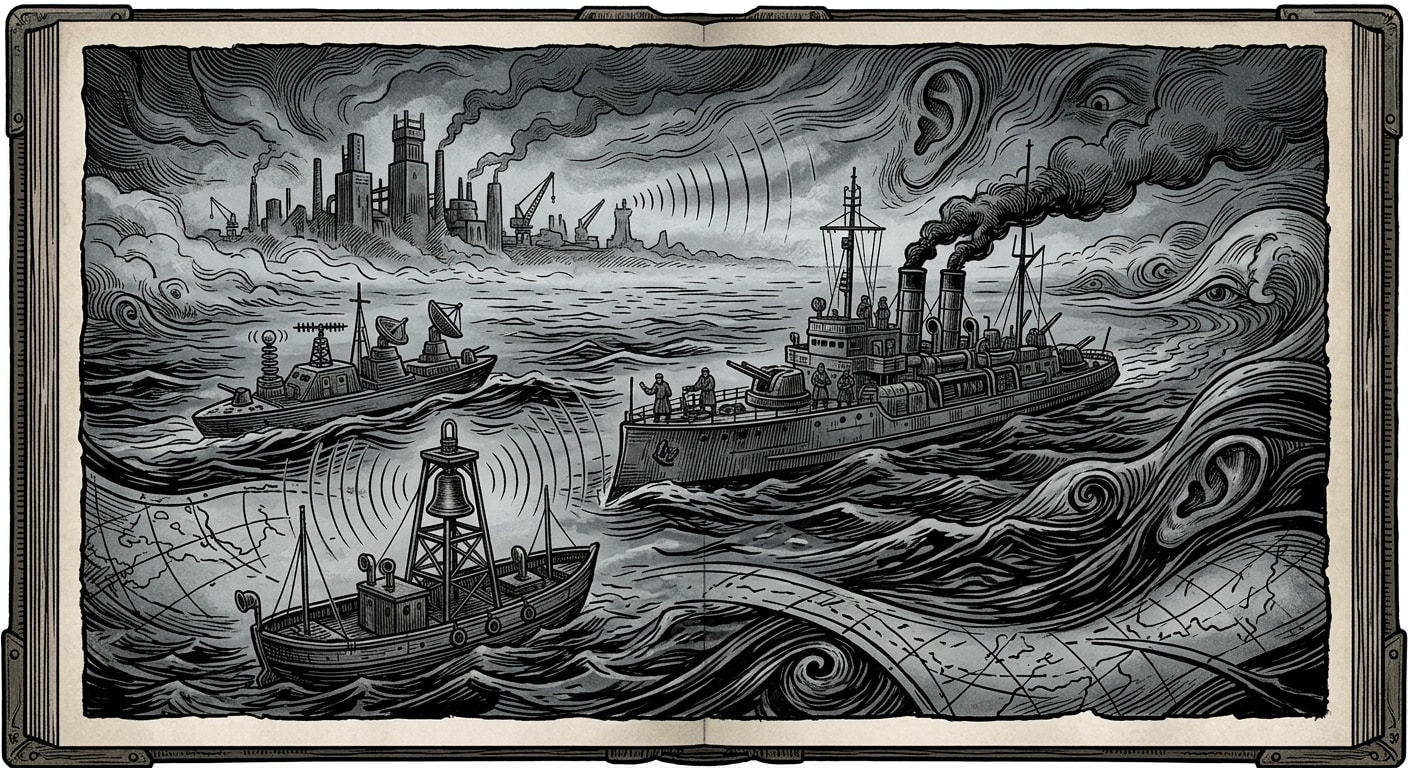
It comes from the northeast, from the Baltic Sea, from open water that maps describe as shoals, patrol lanes, wreckage, ice hazard, disputed approaches, and nothing. Nothing is the word that haunts Castellan-Warden Ingrid Halvorsen, who has looked at those maps long enough to distrust every blank space with a cartographer's seal upon it. Sergeant Halder's corpses turned northeast. Sea Wall sentries salute northeast. Fog crosses from northeast. Old northern bell warnings point northeast. The map says nothing lies there. Excellent. The map has named the suspect.
The Grey is no kin to Syrion's fog, though lazy mouths love kinship because kinship saves thinking. Syrion's fog stills time, sweetens rest, and steals the will to rise. The Baltic Grey arrives with faces. Ordinary faces. Almost-known faces. Faces that make soldiers lift hands in salute before the mind has found a reason. The Bureau calls these events involuntary motor response to atmospheric anomaly. The soldiers call them salutes. Soldiers, unlike committees, know what their own hands have done.
Hymns do not repel it. Relics receive no satisfying recoil. Bells ring and the Grey remains. Worse, the Grey answers. The Choir of the Northern Standard has heard its own hymn returned in its own voices, note for note, word for word, sometimes before the sung line has reached the singers' mouths. The Bureau of Bells installed harmonic-isolation screens in A.S. 197. The screens reduced the return. They did not silence it. One must admire the economy of the insult.
The Fractured North treats the Grey Water with the calm irritation of a village living beside a murderer whose habits are known. Its fjord-bells are tuned in older intervals, pre-Concordat, non-standard, legally offensive, and useful. The Bureau of Bells requested the old tunings three times. The North refused three times. The third refusal included a demonstration at sea (Unregistered) in A.S. 193. No fourth request followed. This restraint from Bells is so unlike Bells that the demonstration must have been magnificent or educationally cruel. Ideally both.
BUREAU OF SHADOWS — NORTHERN SEA DEMONSTRATION, A.S. 193 Bell sequence: non-standard; transcription forbidden. Water condition: flat under wind. Fog condition: halted at distance █████. Returned vessel: previously logged lost A.S. ███. Crew: █████████████████████████. Instruction: no whistling by observers; no replication by Bells; no missionary interpretation.
#On Ports, Grain, and Honest Crime
The Baltic Sea feeds the northern war through mouths that have lied for centuries and improved with practice. Danzig moves grain, timber, rope, salt fish, wax, gossip, pilotage, false invoices, and occasional truth disguised as dockside drunkenness. Hamburg feeds the wider northern import throat. Lübeck teaches what happens when the Bureau of Shadows decides a prosperous harbour has remembered too much. Königsberg consumes all of it with the bleak appetite of a bastion that cannot afford elegance.
Grain is the Baltic's cleanest sin. A sack from Danzig may feed a Königsberg gun crew, a Warsaw rail yard, a Brest confession scribe, a Mercy ward, a condemned labour gang, or a sealed convoy whose manifest has been rendered pious by omission. The Bureau of Tithes weighs it. The Bureau of Records follows it. The Bureau of War requisitions it. The dissolved Bureau of Agriculture still haunts the margins with soil notes nobody official reads until famine makes them prophetic.
Smuggling is less a criminal industry than a form of Baltic weather. It moves because ice moves, fog hides, islands multiply jurisdiction, and overtaxed men develop theology in their pockets. Northward go paper, medicine, sacramental wine, iron fittings, bell-metal scraps, forbidden hymn sheets, unofficial catechisms, and small luxuries packed under fish. Southward come seal-oil, pine tar, amber, old bell notes, pilots without papers, carved icons, cured fish, and testimony the Synod prefers to receive through unofficial channels so it may officially deny having learned anything useful.
The Trial of the False Bishop of Danzig (Unregistered) remains the approved morality play: local episcopal deviation, northern pride, correction by authority, obedience restored. The fuller file smells of herring and sense. The condemned chapter adjusted fasts around grain arrivals, blessed ice roads without central approval, recognised fjord-bell testimony in a minor maritime hearing, and permitted fishermen to swear by saint-names whose ratification had been pending since the assigned clerk became bones. Danzig learned the lesson. Public obedience keeps Purity indoors. Private competence keeps ships from vanishing.
Grey contact has made honest crime stranger. Fish arrive pre-salted when no salt was loaded. Amber washes ashore holding tiny bubbles arranged like liturgical notation. Seal-oil burns grey at the wick after certain voyages. Warm-papers appear from northern settlements that deny issuing them. One Königsberg customs officer opened a barrel marked cod and found it full of dry chapel sand, three brass buttons, and a ledger page in his own handwriting dated the following winter. He paid the duty. Good man.
#On Bells Under Ice
Winter makes the Baltic Sea appear obedient. It skins the harbours, locks small boats in place, narrows channels, and gives War the illusion that a frozen surface is a controlled surface. The illusion lasts until second watch, when men hear bells beneath the ice (Unregistered).
These are neither the Northern Carillon nor buoy bells, fog signals, cathedral misfires, or drunken dockhands making sport with bronze. They are small bells, domestic bells, chapel bells fit for a village no larger than guilt. They rise through the ice under the quays, under fishing lanes, near moored patrol craft, sometimes beneath the Sea Wall itself. They stop when a priest kneels. If a clerk kneels, they continue. Records has found this distinction offensive and filed offence as uncertainty.
The Harbour Quarter keeps an unofficial list of winter bell-hearers. Fishermen, ropehands, widows, bell apprentices, passage clerks, a naval gunner, two children, one Purity examiner who signed the list twice and denied it thrice. Unofficial lists are often superior to official ones because they are written by people who need to remain alive rather than promoted. Three hearers later returned from sea with grey at the temples. One returned with pockets full of river stones though his vessel had not entered a river. Each stone bore a tiny stamped mark resembling no authorised seal.
Bureau of Bells memorandum A.S. 186 classified under-ice bell reports as “acoustic carry from registered harbour instruments.”
Clarified after A.S. 199 review. Registered harbour instruments cannot ring from beneath sealed ice, cannot answer kneeling by vocation, and cannot stamp river stones inside sailors' pockets. The memorandum survives as evidence that confidence freezes later than water.
The old northern bells answer differently. Across the water, in Hrafnvik and other shrinefjords, bell frames stand on cliffs where wind scrapes piety down to bone. Their tones are older than Concordat tables, older than the Strasbourg standard, older than the Bureau's assumption that correct sound requires central permission. When those bells ring, the Grey Water halts, or listens, or accepts courtesy. Pick the verb according to your courage. I use all three in sealed copy and none in school editions.
#On Doctrine's Wet Failure
The Baltic Sea is a theological injury with waves. The South gives Doctrine usable enemies: Maldrake burns, Syrion stills, Kargath devours, Velkara sweetens, Velmora buys, Morwen envies, Atheron crowns himself. Seven sins, seven generals, seven panels, seven categories, seven sermons for dull children and duller officers. The Baltic offers water that predates the argument, bells that work outside permission, and an enemy or neighbour or older witness that does not kneel to the Sin-ledger.
If the Grey Water predates the Sundering, the war is larger than its official folders. If old bells restrain it where sanctioned bells fail, the Bell Codex is incomplete. If fishermen know what clerks cannot classify, the Bureau's hierarchy of knowledge has been inverted by men who gut cod before breakfast. Doctrine finds each possibility intolerable. Doctrine has chosen pending.
Pending is a wonderful word. It preserves salary, avoids martyrdom, postpones apology, and keeps truth outside the room without denying its appointment. The Grey has been pending since A.S. 190. The sea has not waited.
As of A.S. 201, the Baltic Sea remains claimed, unowned, frozen, open, watched, smuggled, sung across, lied about, and listened to. Königsberg holds the northern nail. Danzig moves grain and practices public obedience. The Fractured North rings what it will not teach. Halvorsen watches northeast. Dreher of the Harbour Quarter bars his returned son from the door and receives pastoral correction for his grief. Somewhere under grey water, a bell waits for a hand that may not be human and may not be hostile, which is worse.