
#On the Phrase in the Register
"The masonry is older than the wording."
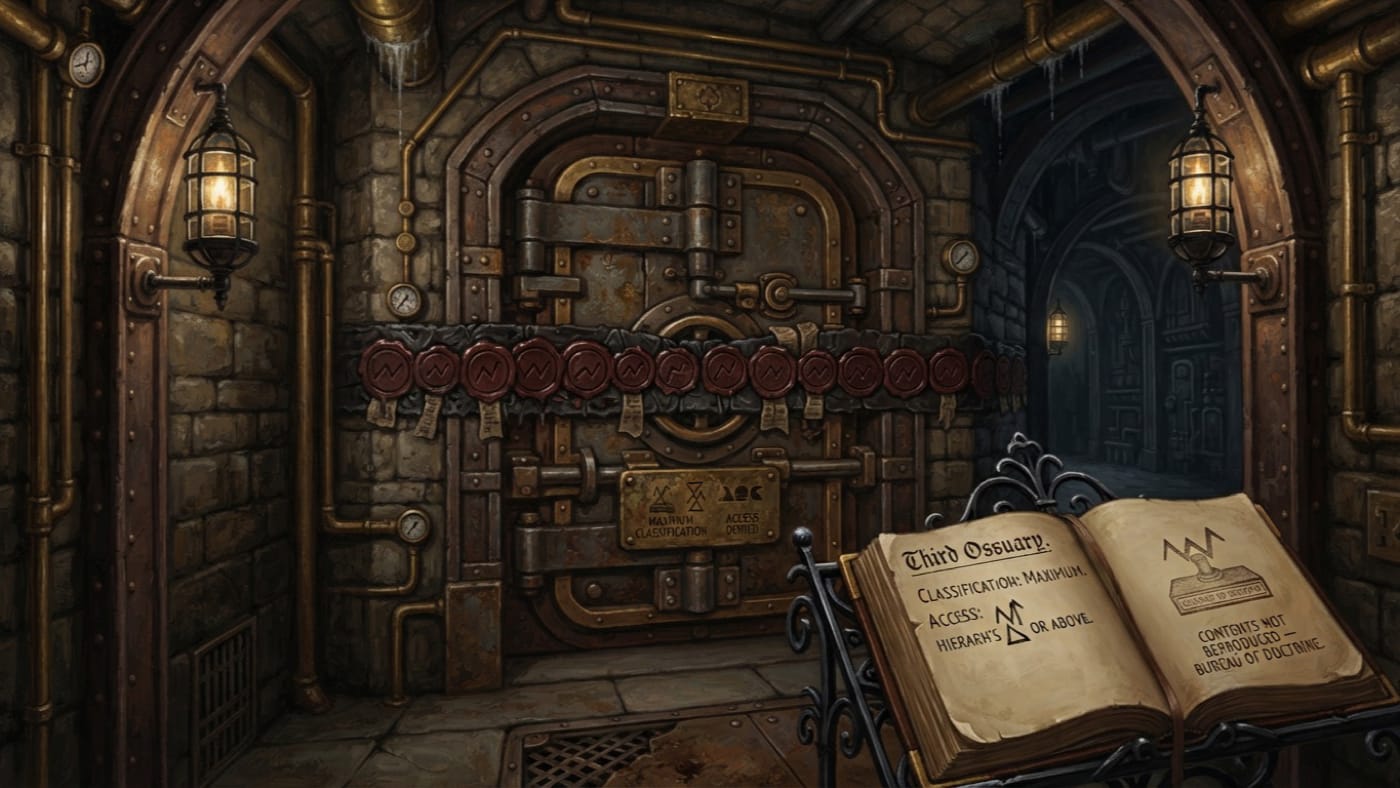
The phrase Hierarch's Seal appears twice in the files of Bastion-Constantinople, and each time it appears where the file stops. The inventory of the Third Ossuary reads Classification: Maximum, Access: Hierarch's Seal or Above. The record of the incident aboard the Vigil Ark Saint Barachiel states that the content of the broadcast is classified at the Hierarch's Seal level. Those two lines are the whole of its documented use. I looked for a third with some diligence, and with the zeal of a man who suspects his own Bureau of hiding the spectacles he is wearing. I found none.
What the phrase does is plain enough. It draws a line in a register. A reader below the line may know that a thing exists, where it lies and who sweeps the floor outside it. Only a reader at or above the line may know what the thing is. The name ties that threshold to the Hierarchs themselves, and I accept the connection, as any sober reader of the Synod's grammar must. The instrument that created the designation has not crossed my desk, and I cannot certify who issues it, by what form or in what year it was first written. I have asked Records, in the tone I reserve for Records, and been told the question has been received.
#On the Authority at Strasbourg
The Hierarchs sit in the Inner Circle of Strasbourg, in white and crimson, styled Vicarii Orbis, the Vicars of the World. Each claims stewardship over one of the Seven Seals of Faith: Doctrine, Discipline, Martyrdom, Concord, Purity, Vigilance and War. Their decrees bind. They also overlap, so that a ruling under one Seal can be contradicted by a ruling under another. Both remain binding, and clerks such as I am left to reconcile them into one folio with one number. The Hierarchs speak in finalities. We file in ambiguities. The arrangement has kept me employed since boyhood.
That college sits under the constitution settled at the Concordat of Strasbourg in A.S. 90 (1800 CE). The Church was older than the Concordat. It kept itself hidden until the Sundering of 1 November A.S. 45 (1755 CE) dragged it into public view. Around A.S. 50 a provisional council governed in practice, with whatever offices the war required that season. When this Codex applies later titles to that earlier work, it does so in hindsight, and the reader should hear the hindsight.
None of that dates the Hierarch's Seal. The constitution explains where the authority behind the name resides. It does not tell me when someone first wrote the name on a register.
The reader must also keep three senses of "seal" apart, because the clerks do not. The Seven Seals of Faith are domains of authority. The Hierarch's Seal is a threshold of access. Then there is the seal of wax, a lump of red pressed into soft material, on a deed or on mortar. The three may touch, and in the Third Ossuary they very nearly do. No document in my keeping makes them interchangeable. Nor does any document I have seen give the Hierarch's Seal a die, a ring, a colour or a device of its own. I have heard junior clerks describe it as a ring, and as a black wax. They described two different objects with equal conviction, which settles the question of their sources.
#On What May Be Kept and What May Be Read
The Synod has never had trouble keeping things. The trouble has always been in deciding who may read them.
The Bureau of Records keeps: the register, the duplicate, the audit and the certified copy, in ink that outlasts everyone who used it. The Bureau of Doctrine decides what may be understood. Its Index Claritatis lists the words in which Creation may be described, and a meaning left off the list does not officially exist. The Bureau of Purity enforces what Doctrine defines. It holds the Index Damnatus and treats ignorance as guilt. A designation like the Hierarch's Seal sits where all three offices meet. Records keeps the matter, Doctrine forbids its interpretation, and Purity attends anyone who interprets it regardless.
Three separate things must be held apart here, as the clerks hold them apart in practice. Custody is the hand on the key, or on the ledger. Knowledge of existence is the entry in the index. Leave to disclose is the permission to say what the entry concerns. A keeper may hold the first without the second. An archivist may hold the second without the third. I hold a great deal of the second. I have never claimed the third under this designation, and the reader will note that I say so in a public Codex, where such claims can be checked.
#On the Third Ossuary
Beneath the Ossuary Rings of Bastion-Constantinople there is an older structure. When the retreating levies came to the Bosphorus in A.S. 47 (1757 CE), two years after the Sundering, it was already sealed. They sealed it again, with fresh mortar and with wax. The fortress was ratified two decades later, in A.S. 68 (1778 CE), and the formal Synod was settled twenty-two years after that. I set these dates side by side for a reason. The masons of A.S. 47 mortared a doorway. They did not, and could not, write Access: Hierarch's Seal or Above under a constitution that had not yet been drafted. Somebody added the classification later. The register does not record when, and I will not pretend that it does.
The inventory classifies the chamber as Maximum. Officially, by the Bastion's own explanation, it contains relics too holy for common access. I repeat that explanation exactly and attribute it to the Bastion. I do not certify it, because nobody has opened the chamber to certify anything.
Mother-Cryptor Sabine administers the Rings around it. She knows the surrounding catalogue to the urn and can recite it in sequence from memory. That is custody of the Rings, and only of the Rings. Nothing in her office grants entry to the chamber at their centre, and I have never seen her claim otherwise. She keeps the corridor. The classification keeps the room.
Then there are the words or Above. They govern the whole inventory line, and they trouble me more than the bolts do. They mean the Hierarch's Seal is a threshold, which the inventory never calls a summit. Something stands beyond it, and the clerk who wrote the line knew so, or wished the reader to think so. Either way, I cannot call the Hierarch's Seal the highest classification in the Synod. The phrase forbids me, and I obey phrases.
An earlier edition of this Codex's entry on Bastion-Constantinople stated that the Third Ossuary "presents no operational hazard and has been thoroughly catalogued."
The Third Ossuary has not been catalogued. The Third Ossuary has not been opened. A chamber cannot be catalogued without being opened, and it cannot be opened below the threshold its inventory names. The clerk who filed the earlier passage has been transferred to Bastion-Danzig. The Bureau of Records considers the matter closed. So, for once, does the chamber.
#On the Record of the Saint Barachiel
The Vigil Ark Saint Barachiel is a dirigible-warship, commissioned by the Bureau of War in A.S. 168 (1878 CE). It patrols above the strait, broadcasts sermons through horn-amplifiers the size of organ pipes, and drops sanctified incendiaries on anything below that moves without authorization. It has an excellent service record.
On the 3rd of Argent, A.S. 199 (1909 CE), the Ark broadcast a voice that belonged to none of its crew. Several listeners described what they heard as an apology. The signals log gives the duration as eleven minutes and forty-three seconds. The Bastion's entry gives eleven minutes, which is the same figure after a clerk has tidied it. The content is classified at the Hierarch's Seal level. The third crew was replaced. The vessel stayed in service. It flies today, with its fourth crew.
The incident is public. Pilgrims know the date, harbour men know the sound, and it has an entry in this very Codex. The substance is not public. Four listeners who tried to describe it publicly were offered a period of theological rest in the Swiss cantons, at Bureau expense. I record the offer as it was made to those four. I do not inflate it into a statute. No one has shown me a general penalty, and I will not write one so that the reader can be frightened more efficiently. Four is enough.
I will not paraphrase the broadcast, summarize it, guess at whose voice it was or name the person the apology was meant for. The designation exists precisely to forbid all of that. A clerk who writes "the voice seemed to say" has already said too much, and has said it in the passive voice.
#On the Present Application
The Hierarch's Seal is in force on both matters at this writing. The chamber beneath the Rings remains closed, and the transcript of the broadcast remains sealed. In each case the Synod has kept the record and restricted the reading. The bolts, the wax, the replaced crew and the four men in the Swiss cantons are what the restriction looks like from outside.
What this entry can establish, it has established. The designation exists, it is written twice, and it governs one place and one sound. It ties a threshold of access to the authority of the Inner Circle, and the words "or Above" admit something past it. Its origin has no date, its form has no description, and its holders have no names in this Codex. I leave those three blanks as I found them. A forged entry would fill them faster, and a forged entry is how the clerk at Danzig earned his transfer.