
#On the Station of the Seven
"Seven chairs and one head of state. Arithmetic is a secular discipline."
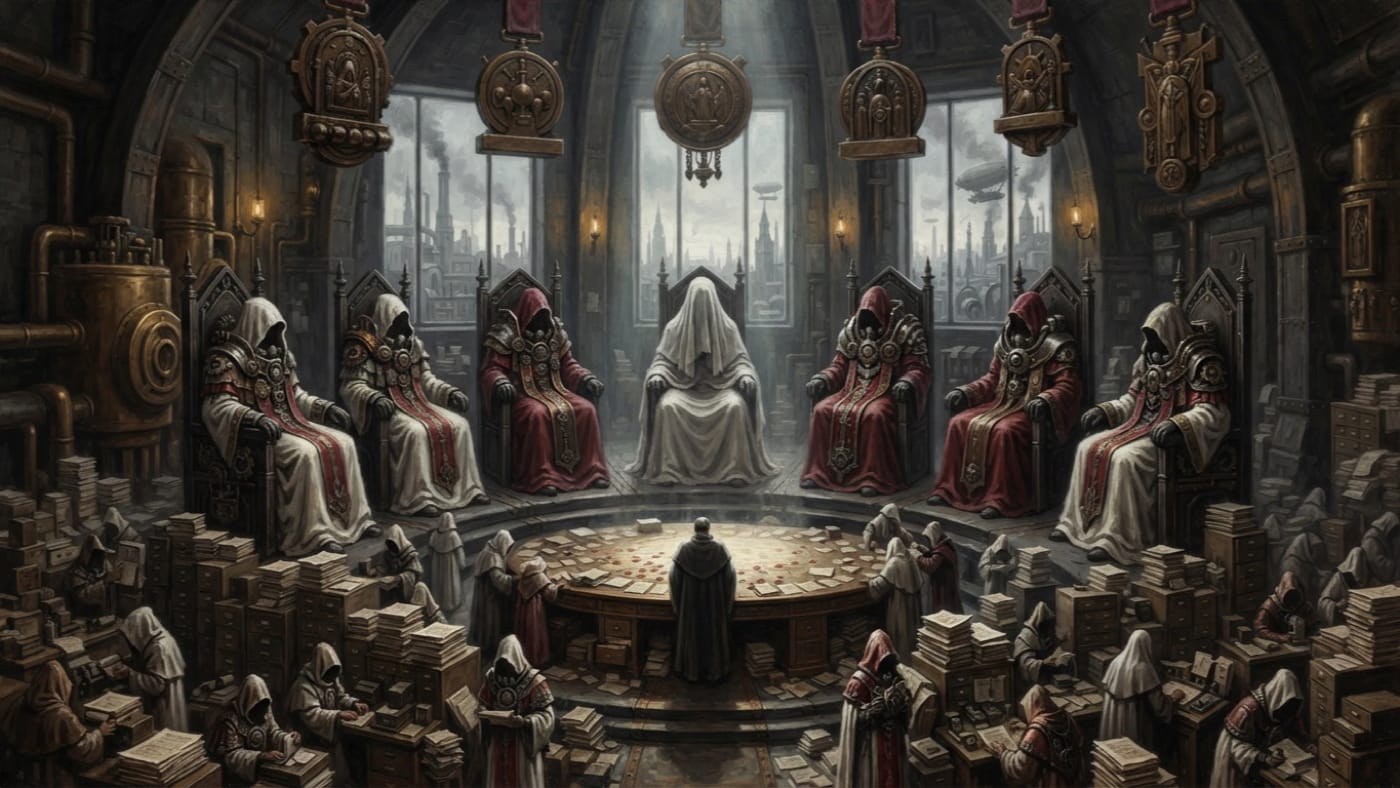
The Synod has one head, and that head has seven faces. The Seven Hierarchs together hold the office the Bureaucratic Synod calls its head of state. None of them holds it alone, and each of them has at some session or other forgotten this. Their collective style is Vicarii Orbis, the Vicars of the World. The Bureau of Records must engross that title in full on every instrument issued under their authority, which accounts for much of the Bureau's vellum bill. They sit in the Inner Circle of Strasbourg, and they wear white and crimson. Doctrine has never told me what the colours mean. I have learned not to ask questions whose answers come with an escort.
I am Hieromnemon of Strasbourg and archivist of the Bureau of Doctrine. I have never sat at their table. For most of my life I have sat at the table where their decrees land, so I can tell you exactly what a Hierarch's word weighs. I am the one who has to lift it, read it, reconcile it with the six other words that arrived that morning, and file all seven under a single number.
#On the Authority Inherited
The Hierarchs are styled successors to Augustinus. That is a claim to a legacy, and like most such claims it is better documented by the heirs than by the dead man. Augustinus never sat among the Seven. He could not have, because he was dead before the January of A.S. 88 and the college sits under a constitution that did not exist until the Concordat of Strasbourg in A.S. 90 (1800 CE).
The order of events matters. The Church kept itself hidden until the Sundering of 1 November A.S. 45 forced it into public view. Around A.S. 50 a provisional council governed in practice, surrounded by whatever offices the war required that season. The Common Allegiance of A.S. 55 was issued under Augustinus's authority, though he composed it with Cardinal Kratz and Sabine. The Council of Worms ratified the work in A.S. 87. A year later both architects were in the ground. The Concordat was sealed by the living, using materials the dead had left behind. The Seven inherited the materials. The signatures on the settlement belong to other hands.
When a Hierarch invokes the Binder of Wounds, the clerk enters the invocation as precedent. The clerk does not enter it as a co-signature. I have corrected that distinction in petitions more often than I can count, and I have been thanked for it twice.
Earlier editions of this Codex listed the Council of Worms, A.S. 189, among the proofs of the Hierarchy's continuity.
The Council of Worms sat in A.S. 87 (1797 CE), three years before the Concordat and about a century earlier than the previous compiler preferred. The compiler responsible for "189" has been reassigned to the counting of years, under supervision.
#On the Seven Seals
Each Hierarch claims stewardship over one of the Seven Seals of Faith: Doctrine, Discipline, Martyrdom, Concord, Purity, Vigilance and War. I list them in the order this Codex has always used. That order is a habit of the scriptorium. I will not certify it as a constitutional ranking, an order of precedence at table or a numbering of chairs. Certain drafts circulating among the junior Records clerks do certify it, and their authors may expect correspondence.
The names announce the ground each Seal claims. Doctrine keeps what may be believed, and Discipline decides how believers are corrected. Martyrdom concerns what the faithful may be asked to surrender. Concord keeps the Church's members in agreement, so it is the Seal whose instrument most often needs repair. Purity governs what must be shut out, and Vigilance what must be watched. War governs what must be fought, which along the Line covers nearly everything.
According to the Codex's own summit chapter, every one of these authorities is absolute. The administrative consequence is easy to show. Take a single sermon preached in a border parish. Its content falls under Doctrine and its phrasing under Purity. The punishment of the preacher belongs to Discipline, and the informant who reported the sermon belongs to Vigilance. If the preacher dies well, Martyrdom has a claim. If the parish riots, Concord does, and since the parish lies within sight of the Line, so does War. That makes seven absolute jurisdictions over one homily that lasted under twenty minutes. I have the folio. It is thicker than the homily.
Anyone who tries to match the Seven Seals to the Holy Bureaus should count again. There are twelve Bureaus. The five left over have never been troubled by this.
#On Decrees and Their Execution
The decrees of the Seven require no justification. Doctrine teaches that they carry the breath of the Sundering, and I teach Doctrine. That is the theology of the matter. The practice is in the post-bags.
I once wrote that the Seven speak in finalities and write in ambiguities, so that clerks like me must turn their paradoxes into ledger form. Doctrine adopted the phrase. A decree arrives. It says one thing absolutely. By the second bell another decree arrives under another Seal and says the opposite, just as absolutely. Neither may be refused. The clerk's task is to find the reading under which both are obeyed. If no such reading exists, the clerk constructs one, seals it and dates it.
This Codex's entry on the Synod already records the usual case. The Bureau of Doctrine proclaims a teaching, and the Bureau of Purity brands it suspect. The Bureau of Records keeps both rulings in triplicate under contradictory seals, and the Bureau of War enforces whichever version can raise the most battalions. A Hierarch's word arrives complete. Reconciling it is the Bureaus' business. Which version is executed is decided by whoever holds the rifles that week. The Seven remain supreme at every step, because no step has ever required them to be consulted again.
Older scriptorium folios record that quorum was once kept by bell, and that a Hierarch who failed to answer the Summons of the Ninth was counted as voting anyway, "by faith," with a red check beside the name. I record the usage. I will not build a voting code out of it. Nobody has shown me a voting code, and I have asked under seal.
A decree reaches the provinces through the Bishops-Praetorial. Collectively they are the Custodes Animae, and each is a Custos Animae, a Keeper of Souls, who must balance the tithe quota against the quota of faith. They sit in the Assembly of Thrones and debate how to apply what the Inner Circle has already settled. A Bishop who raises the tithe but neglects the fasts is praised. A Bishop who keeps the fasts but misses the coin is burned. Below the Bishops come the Wardens, whose hands are the last instrument the decree passes through. A farmer outside Metz will never see white and crimson. He knows the Seven by the hand on his shoulder at curfew.
#On Supremacy and Its Limits
Hierarch Odo of Trier is recorded as declaring, "When we speak, the stones of Strasbourg listen." The stones have not confirmed this. The Bureau of Records filed their silence as assent, and I endorsed the filing. I do not know which Seal Odo held, and nothing under my hand settles it.
In rank, the Seven have no superior on earth. In practice they depend on everyone beneath them. A Hierarch who wants a regiment needs the muster rolls of War. A Hierarch who wants a heretic examined needs the Inquisition, and the Inquisition's account of whom it obeys exists in two editions. Doctrine says the Inquisition answers only to the High Censor. A redacted Records ledger once suggested that it answers to no one. Elsewhere in this Codex an earlier hand wrote that when an inquisitor annuls an absolution because the candle dripped crooked, no bishop or Warden dares contest the judgment, and neither do the Hierarchs themselves. I report the claim and its source. No constitutional settlement of the question has crossed my desk.
The Seven do not answer this by contradicting the Inquisition. They answer it with silence. A decree that is never issued cannot be defied, and a supremacy that is never tested cannot be found wanting. I have read a hundred and eleven years of minutes, and I have learned to file the gaps as carefully as the entries. This is a professional observation, not a criticism. The Bureau of Purity is available to anyone who reads it otherwise.
#On the Present Register
It is A.S. 201, a hundred and eleven years since the Concordat. The Great Deceiver presses on the Line, the twelve Bureaus keep multiplying their forms, and the Seven still govern from the Inner Circle in the same white and crimson.
The corridor rumours are already recorded in the Synod's own entry, and I repeat them only so that they are filed under the correct heading. One says the Hierarchs no longer speak to one another except through intermediaries. Another says the higher circles are corrupt. I have no ledger that proves either. I also have no ledger that disproves either, and anyone who offers me one will be asked where they got it.
The publicly documented facts are few. The Hierarch of the Seventh Seal has not appeared in public session since A.S. 107. The chair in the Inner Circle is draped in white cloth. The Bureau of Records lists the holder as "presently engaged in contemplative duties," and the Bureau of Shadows has no comment. That makes ninety-four years of contemplation. I have known penitents to finish faster. I record no cause, name the holder in no folio and give no date of death, because no instrument under my seal supplies any of them.
Holder of the chair: ████. Instrument establishing the contemplative status: ████. Office presently countersigning under that Seal, if any office does: ████. Records supplied these blanks in place of answers. Doctrine has not supplied the answers either.
The other six chairs remain occupied, and their decrees keep arriving at my table, absolute, contradictory and sealed. I reconcile them before Vespers.