
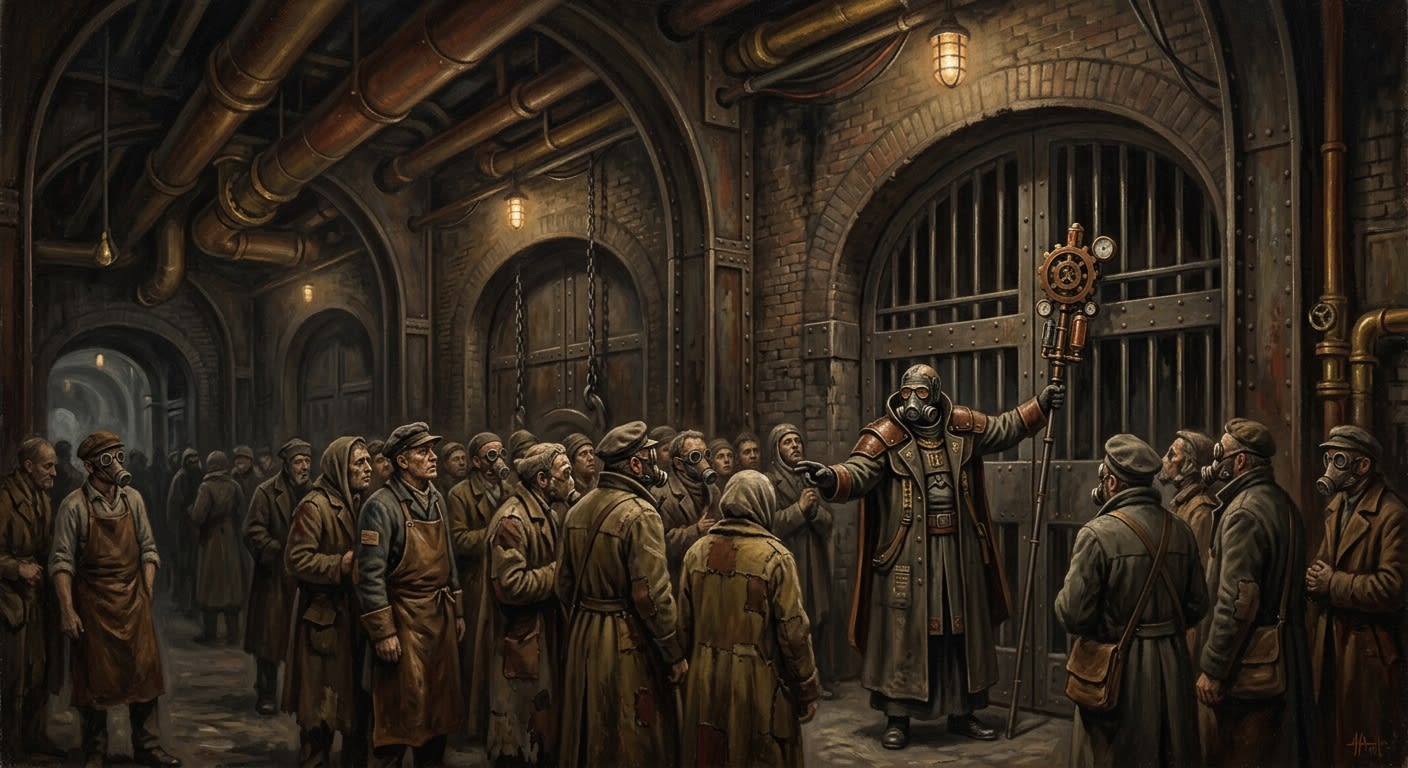
#On the District Under Grey
The Hollow Fast of Saint Calistus occurred in Lyon during the Year Without Dawn, A.S. 32, when the sun withdrew from Europe for forty canonical days and the Rationalist Republic, with its usual courage before evidence, announced that the heavens had suffered a temporary administrative inconvenience. Crops died. Fish arrived already rotten. Sheep walked in circles until wool pressed against wool and the whole obedient heap became one warm, breathing emblem of Reason's final lecture.
In the district later named for Saint Calistus, the reliquaries dimmed. Candles burned with short, mean flames. The Rhône carried a smell like wet bandage and opened cellar. A plague advanced westward from the river quarter at the speed of a seal drying on paper: slow enough to be witnessed, fast enough to become law.
Calistus was Cellar-Prior of the district, though no surname survives. This absence has troubled biographers and delighted the Bureau of Doctrine, which prefers saints without relatives. Relatives ask questions. Calistus kept a chapel beneath a shuttered bakehouse, administered forbidden sacraments from flour bins, and preserved two finger bones of an unnamed martyr in a copper spice tin. Such was the Church in those days: illegal, hungry, fragrant with yeast and fear.
#On the Sealing of the Halls
Calistus determined, by prayer or desperation or the arithmetic that appears when both have been sufficiently starved, that the plague could be halted by withholding bread from the living. The district possessed four ration-halls: Saint Odran's Store, the West Flour Office, the Hall of Civic Distribution, and the municipal refectory under the Rationalist sign FOOD IS A PUBLIC MECHANISM. The sign was left in place. Providence enjoys jokes.
The faithful entered. Men, women, children, old dockhands, laundresses, apprentice coopers, three midwives, two bakers, a blind notary, and a Rationalist clerk who had arrived to confiscate the chapel registers and was locked inside by mistake. The Bureau later describes the fast as voluntary. Some entered singing. Some were carried. Some were pushed by neighbours who believed, correctly or otherwise, that the district had no other tithe worth paying.
Earlier festival leaflets stated that “all fasters entered freely, crowned with joy.”
Corrected. The Bureau of Doctrine permits “entered under communal vow.” The distinction preserves both sanctity and the fact that three door-bars were nailed from the outside.
For forty nights the doors remained sealed. No bread. No broth. Water, once daily, passed through narrow wall-slits in clay cups marked with chalk crosses. The guards outside heard prayer during the first week, quarrelling during the second, weeping during the third, and during the fourth a sound the Bureau of Mercy's later surgeons identify as “oral self-injury under ecstatic compulsion.” A bureaucrat wrote that phrase. May his inkpot boil.
The plague stopped at the district boundary on the thirty-ninth night. It struck the line like a beast against iron and went no farther. A chalk line drawn outside the West Flour Office remained clean while the stones beyond it sweated black fluid. Three houses on the eastern side emptied by dawn. Three houses on the western side slept, hungry and alive. The miracle had accepted payment.
#On the Forty-First Morning
The doors opened on the forty-first morning, because the canonical fast was forty nights and because no one outside had the courage to open them earlier. The fasters were alive. This was the first horror. The second was silence.
Every tongue had been bitten through at the root and swallowed. The wounds were clean. Deliberate. Repeated where the first bite failed. Children showed the same marks as adults. The blind notary had used his own broken teeth so methodically that the surgeon's report pauses, in the middle of its clinical cowardice, to note “unusual determination.” The Rationalist clerk survived and attempted to write a denunciation. He could not stop drawing small loaves in the margin.
MERCY SURGEON'S ANNEX — SAINT-CALISTUS RATION-HALLS Subject group: 612 recovered living bodies; 0 functional tongues. Common wound: complete lingual severance and ingestion. Anomaly: no septic progression despite forty-night confinement. Witness note: several children attempted hymn response through pursed lips; tone described as █████████████████. Annex sealed after junior surgeon began whistling the same tone in sleep.
Lyon still sings in whistles. The descendants of the district possess narrowed voice-boxes, high breathy registers, and a hereditary inability to form certain consonants without pain. The Bureau of Festivals licenses their hymnody for feast days. Tourists weep. Merchants sell silver whistles. Pilgrims ask whether the sound is beautiful. It is. So is a knife, properly polished.
#On Calistus and the Accounting
Calistus survived the opening by seven days. He could no longer speak. His final instruction was written on a board in flour paste: COUNT THEM. The phrase later became the motto of the local Mercy register and, in A.S. 92, a minor doctrinal formula for emergency communal tithes. The Bureau canonised him retroactively, omitting surname, hesitation, and the testimony of the baker's widow who struck him with a ladle when the doors opened. Her blow is not recorded in the hagiography. It should be. Saints require percussion.
The Bureau of Doctrine classifies the Hollow Fast as a miracle. The Bureau of Records classifies it as acceptable spiritual investment. The Bureau of Mercy keeps the surgeon's reports in a locked press lined with linen. The Bureau of Tithes has, twice, attempted to derive a per-capita formula from the event for later ration emergencies. Both attempts were withdrawn after Lyon threatened to send a choir to Strasbourg and stand beneath the Tithes windows until apology arrived.
A.S. 137 instructional tables listed the Hollow Fast as “low-cost communal mortification.”
Withdrawn after review. The corrected table reads “high-cost communal preservation, locally survivable, generationally persistent.” The clerk who wrote “low-cost” was transferred to the Paper Mines of Ulm, where bread is available by form.
The event remains paired in doctrinal instruction with the Bell of Saint Isidore and the Last Stand of Kalnik Ridge: miracles that saved bodies by billing bodies, works of grace that left receipts in bone, breath, lifespan, and speech. Sorcery scars the world. Miracle scars the obedient. This is not mercy. It is preference.