
#On the Bell and Its Improper Name
The Bell of Saint Isidore is not the Reliquary of Saint Isidore, though pilgrims confuse them with a persistence that would be touching if it did not generate so many corrective pamphlets. The Reliquary is the gold-and-iron casket raised by Brother Tomislav at Kalnik Ridge in A.S. 48. The Bell is the cracked bronze instrument later cast around a shard of ridge-glass, three filings from the empty reliquary hinge, and a pinch of white ash that the Bureau of Relics refuses to call Tomislav's while charging visitors as though it were.

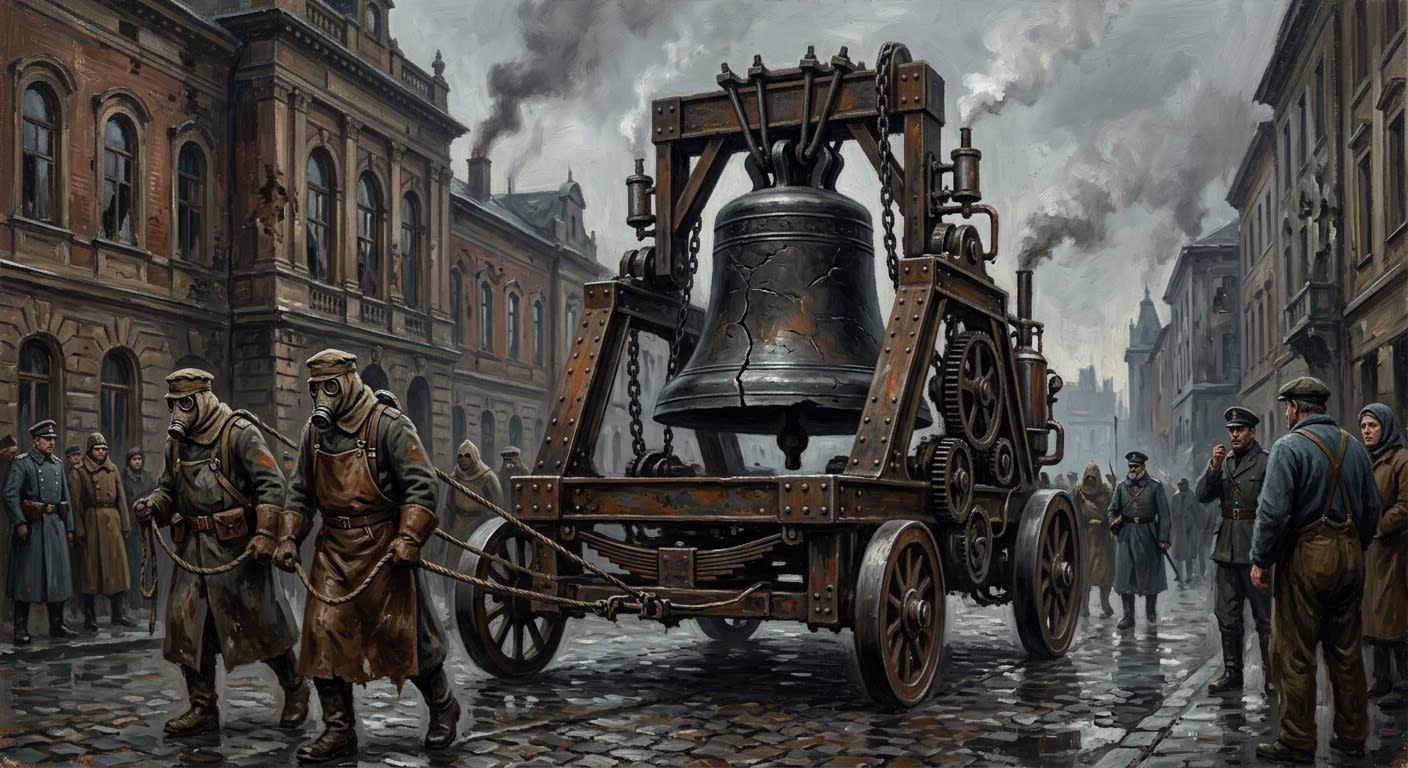
It hangs nowhere. This is important. Ordinary bells hang in towers, because ordinary bells belong to parishes, fortresses, ships, prisons, and other honest cages. The Bell of Saint Isidore is mounted on a gun-carriage draped in black silk and rolled only under armed writ. It is a bell that travels like artillery. The distinction comforts the Bureau of Bells, which likes bells to stay where their tables say they belong, and terrifies the Bureau of War, which knows what mobile sanctity can do to a map.
Its sound is wrong. Bureau acousticians describe the tone as fractured: a high clean strike followed by a lower answering break, as if bronze and bone disagree about which one has been wounded. The faithful call it beautiful. Soldiers call it useful. Debrecen calls it expensive.
#On Kalnik Ridge
The Bell's authority derives from the first blaze at Kalnik Ridge, when Maldrake's vanguard climbed the Croatian highlands and discovered, to its considerable inconvenience, that faith had resumed its old habit of killing things. Tomislav raised the Reliquary. Seventeen relics ignited. Maldrake's Wrathforged recoiled. The Sin-General flinched, and mankind has been making theology from that flinch ever since.
The Bell was cast after the surviving forty-three were counted, after the ash had been collected, after the fused glass of the ridge had cooled enough for men to cut shards from it without leaving their fingers behind. The official casting date is A.S. 49. The Bureau of Records gives three foundries and rejects all three in footnotes. One account places the casting in a ruined shrine cave under Kalnik itself, where the bronze arrived cold and molten at the same time, a phrasing I dislike because it sounds like a poet escaped supervision. Another places it in Strasbourg, which is tidy and probably false. The third claims the Bell was never cast at all, merely found beneath Tomislav's cairn already cracked, already warm, already bearing Saint Isidore's name in raised bronze.
Earlier catalogues listed the Bell's origin as “Strasbourg Foundry, A.S. 49, conventional casting under relic supervision.”
Clarified. Conventional casting has not been demonstrated. Strasbourg Foundry (Unregistered) records for the relevant week show no bronze requisition, no fuel expenditure, and three workers absent after hearing “a hill ring underground.” The Bureau of Relics accepts custody without endorsing metallurgy.
The largest ridge-glass shard lies at the Bell's crown, cloudy with the image of kneeling men. The image does not align with any known survivor list. Tilt the shard and the kneeling figures do not move. Strike the Bell and one figure raises its head. The Bureau of Pilgrimage denies this during ordinary tours and charges double for the Feast viewing. Commerce is doctrine with cleaner shoes.
#On Debrecen's Payment
The Bell rang at Kalnik Ridge in A.S. 48 during the aftermath of the Last Stand, when the retreating faithful needed more than victory; they needed proof that victory could be repeated. Debrecen paid for that proof.
The formula is preserved under Relics seal and Tithes copy, which is how one knows the cost was real. Twenty aggregate years were shaved from the surviving population of Debrecen. Not twenty years from one man, which would have been simple, almost merciful. Twenty years spread through households, bloodlines, apprenticeships, wombs, sickbeds, and kitchens. A month here. Seven winters there. A child's fiftieth year removed before she had finished learning to walk. An old cooper granted one extra day, then charged three years from a grandson not yet named. The Bureau calls this distribution. Debrecen calls it inheritance.
DEBRECEN LIFESPAN LEDGER — A.S. 48, PARTIAL EXTRACT Household A-17: debit nine months; applied across maternal line; third daughter later collapsed at loom, age thirty-one. Household C-04: debit three years; recipient unborn; birth cry recorded as “elderly.” Household F-22: debit refused by parish priest; priest died before signing refusal; debit reassigned to parish choir. Marginal note in unknown hand: ███████████████████████████████████
The miracle worked. The peal sealed morale along the retreat roads. Men who had fled from the Sundering began carrying relics forward instead of hiding them in carts. Officers who had mocked chapel discipline requested bell-hour chits. The Cellar Saints became proof-bearing ancestors of the later relic bureaucracy. Faith became logistical.
Debrecen's young still die badly. They collapse mid-task with ledgers open, bread half-cut, boots unlaced, prayers unfinished. Birthdays are recorded with funeral contingencies. Marriage contracts include mortality clauses specific to the Isidoran debit. The Bureau of Records calls the pattern “a manageable civic rhythm,” a phrase so bloodless it could survive only in a building with excellent heating.
#On the Feast of the Cracked Bell
Every Feast of the Cracked Bell, the instrument is paraded on its black-silk gun-carriage. The route varies, because the Bureau of Festivals enjoys theatrical authority and the Bureau of Bells enjoys protesting it. In some years the Bell passes through Strasbourg under sealed balconies. In others it is dragged through Constantinople's processional streets, where soldiers spit into their palms and touch the carriage wheels for luck. The Bureau of Medicine objects to this practice. The soldiers continue. Medicine does not hold the Line.
Broken bells are meant to symbolize mankind: flawed, faithful, still capable of tolling. This is the Festival Bureau's approved explanation, and one sees why it is popular. It makes damage sound like character. The Bell of Saint Isidore complicates that pleasant little sermon by being broken and effective, wounded and weaponized, cracked in the exact place where its power gathers. The Bureau of Bells hates it with a professional purity I respect.
The Bell is struck once in public. Never twice. The single peal leaves a taste of iron and old snow. Candles bend toward it. Children in Debrecen wake crying for reasons their parents do not record. At Kalnik Ridge, pilgrims report that the kneeling shadows in the fused glass darken for the length of the tone. In Strasbourg, clerks in the Relics Archive pause their pens until the sound has gone, because ink laid during the peal has been known to form names absent from any registry.
#On Custody and Refusal
The Bell belongs to the Bureau of Relics. The Bureau of Bells maintains it. The Bureau of Festivals displays it. The Bureau of Tithes audits donations collected in its presence. The Bureau of Doctrine explains why this arrangement is harmonious. It has become old enough to have acquired hymns.
Relics wants the Bell silent except when silence would waste devotion. Bells wants it recast, retuned, rehung, or preferably replaced with an object that obeys arithmetic. Festivals wants it visible, tearful, and surrounded by licensed vendors. Tithes wants the crowd counted before, during, and after the peal. Doctrine wants the whole dispute preserved because quarrelling Bureaus prove the Synod's vitality, much as fleas prove a dog has blood.
A Bureau of Bells memorandum described the crack as “repairable with controlled recasting and doctrinally supervised cooling.”
Withdrawn after the test sample, a shaving no larger than a fingernail, rang by itself for nine minutes in a sealed crucible and caused two technicians to remember dying at Kalnik Ridge. Neither technician had been born.
As of A.S. 201, the Bell remains active, cracked, mobile, and offensively useful. No one admits wishing to hear it in battle again. Everyone has written procedures for that event.