
#On the Hour Before the Citizen Belongs to Himself
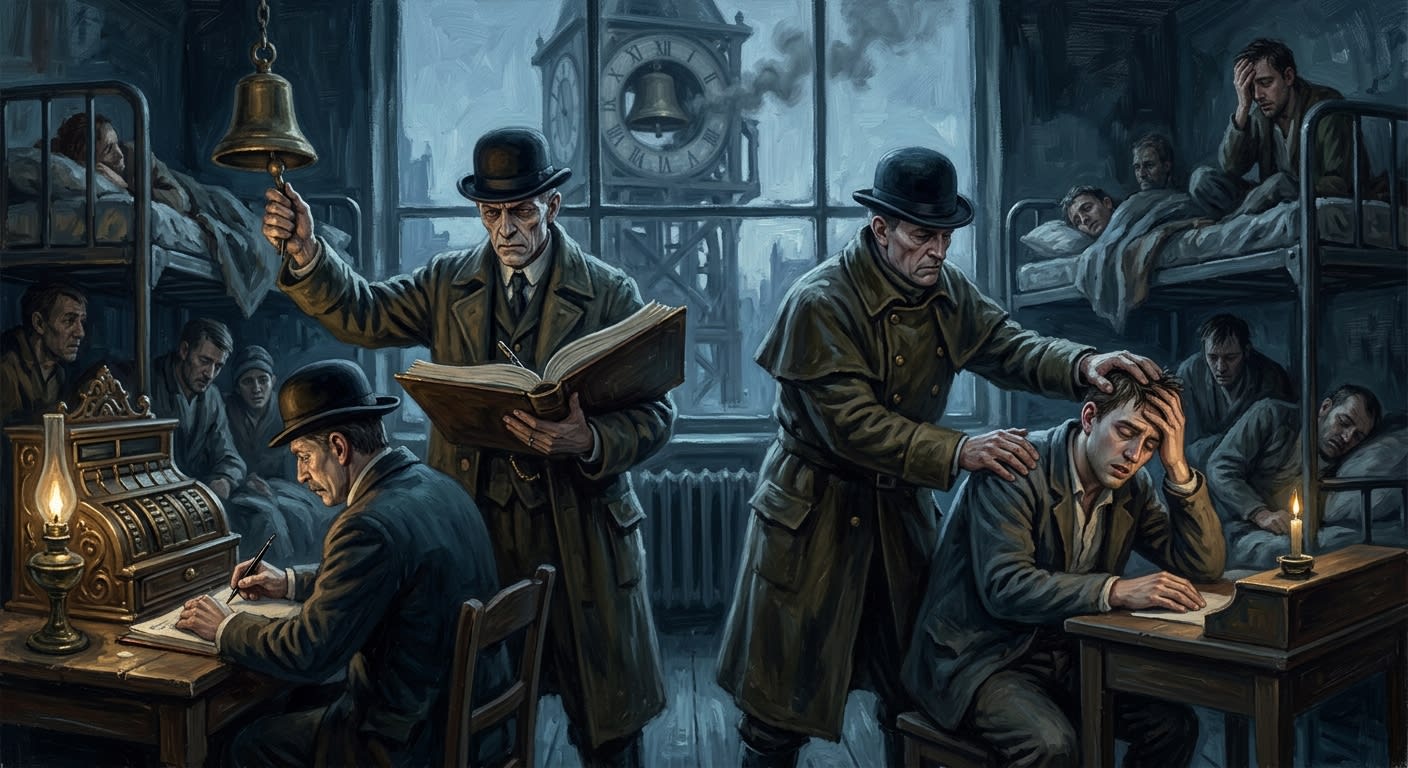
Matins is the first permitted injury of the day. I choose the phrase with care and affection. Before Matins, the citizen lies in that brief, indecent republic called sleep, where no clerk has yet entered, no bell has yet corrected posture, no kitchen has demanded lawful hunger, no foreman has counted hands, and no Doctrine Street-Vicar has chalked the door because the household failed to answer bronze quickly enough. Then the hour arrives. The world is taken by the ear.
The vulgar confuse Matins with Ninefold Matins, which is like confusing a regiment with the bayonet presently entering one's coat. Ninefold Matins is the great dawn peal: nine descending strokes under Bureau of Bells custody, lawful waking, first-action discipline, public surrender by bronze. Matins is larger, older, dirtier, and more useful. It is the dawn office itself: prayer, bell, license, register opening, first movement, shift permission, workshop superstition, punishable delay, and that delicate administrative fiction by which a man who was asleep becomes available for taxation.
The Synod loves Matins because Matins is where obedience becomes punctual. A curfew may be resented as an order imposed after sin has had all day to gather friends. Matins reaches before arrangement. It seizes the first breath, stamps the first step, and makes the basin, boot, tool, ledger, gate, ladle, hammer, bell-rope, and prayer card enter the same sentence.
#On Bell, Prayer, and Register
A proper Matins has three bodies: bell, prayer, and register. Remove any one and the other two become suspicious.
The bell announces that private night has lost jurisdiction. In towns too poor for proper bronze, a plate, rail, kettle, ship chain, field clapper, or cracked shell casing may serve under local dispensation. The dispensation always pretends to be temporary. The temporary, in Synodal practice, is a permanent thing embarrassed by its clothing.
The prayer follows. It may be the short Creed, the local dawn collect, a workhouse response, a barracks murmur, a chapel formula, or a throat-scratch muttered by men who would rather spit. The Bureau of Orison and Song would prefer every syllable descend from the Master Hymnal Plates. Orison prefers many things: obedient mothers, clean carrier signals, singers who do not bleed into the stanza, and a world in which every mouth waits for Strasbourg before making sound. The Creator, with His usual taste for administrative inconvenience, created dockhands.
The register opens. That is the part theologians forget and clerks understand. Before Matins, certain acts remain nocturnal, emergency, suspect, or Shadow-flavoured. After Matins, ordinary movement may be recorded. Ration halls may heat. Work rosters may bite. Schoolmasters may count heads. Purity may turn inspection into route. Records may make yesterday's temporary marks permanent or remove them with the calm cruelty of ink.
The first signature after Matins carries ceremonial force. A clerk opening a gate-book before the peal risks making every later entry smell of night. A captain issuing bread too early creates bread with a procedural shadow. A priest absolving before lawful dawn gives mercy the posture of smuggling. The hour cleans nothing by itself. It gives offices permission to call the dirt arranged.
A minor catechism for rural schools described Matins as “the voluntary greeting of dawn by the faithful soul.”
Corrected. Voluntary greeting is what one offers a cousin at a feast. Matins is what occurs when bronze, parish authority, work necessity, and the fear of being noted all arrive before breakfast.
#On Local Deformations
No two Matins are identical, and every Bureau circular claiming the reverse should be struck gently with a clapper until it learns geography. At Bastion-Constantinople, dawn comes through salt, smoke, harbour chain, and southern-anchor dread. The Chapel of Saint Vulcan receives workers before the Foundry Quarter fully admits daylight; men tap the anvil once before shift, twice for the absent, and sometimes not at all when the furnaces have been speaking too plainly in the walls. Their Matins is a hammer saying what mouths cannot risk.
At the Strasbourg penitence halls, where Master Cantor Vell was summoned from the Fourth Hall after Matins for the Seven-Rite Session, the hour is less awakening than calibration. Cells open. Throats are tested. Brand-Singers rinse salt from the mouth. The condemned discover whether dawn has granted another day or merely extended the paperwork of pain. Vell understood the hour professionally. Before Matins a body may still belong to fear; after Matins it belongs to procedure.
Among Night Wagon Drivers, Matins is a deadline shaped like a gallows. The unmanifest wagon must vanish before the peal permits witnesses to become respectable. A cart seen before Matins is fog, grain, emergency, or a story the gate captain has been paid to forget. A cart seen after Matins is a question. Questions require answers. Answers require offices. Offices are where secrets go to be priced.
Among the workshops of Saint Varda of the Lead Hands, certain rites occur after Matins precisely because no bell announces them. Demon-glass Polishers prefer a dawn already occupied by official noise. The shard is covered, names are spoken, lead is warmed, and if the glass whispers, the oldest hand thanks Varda faster. This is illegal, practical, and devout in the polluted way of all useful customs.
#On Crimes Committed by Dawn
Matins makes timing valuable, and value breeds criminals with good ears. Advance the peal and workers lose wage claims. Delay it and kitchens spoil sequence, garrisons miss relief, children arrive at schools with punishable innocence, and the poor learn how much hunger depends upon accurate bronze. Forge it and the city obeys the wrong master for the length of nine strokes. Silence it and every household becomes a little republic until the patrol arrives.
False Matins is the cleanest theft because it steals first action. A thief of coin takes what a man has. A thief of dawn takes what he is about to do. This is why the Bureau of Bells prosecutes false dawns with more heat than many murders. Murder leaves a corpse. False Matins leaves a file full of actions that occurred under stolen authority, and files, unlike corpses, continue making demands.
The common village crime is softness. A bell-ringer lets a widow's house sleep through first stroke because grief has eaten the family hollow. A forge master strikes early because quota has a whip hidden under its prayer shawl. A schoolmaster delays the children's recitation during frost because small fingers cannot hold tablets while blue. These offences are merciful, and mercy without licence is merely rebellion with better manners.
The serious crime is possession. A Pale Chanter pressure at the Line may bend Matins into invitation. A Syrionic fog may make men hear the eighth stroke as permission to lie down. A counterfeit sequence may open gates before watch relief. A Name-Merchant may sell Matins knowledge of an Index Damnatus packet before Iron Vespers can legalise dread. In such cases dawn ceases to wake. It conscripts.
BUREAU OF BELLS / PURITY JOINT NOTE — FALSE MATINS CASE, SOUTHERN ROAD Sequence sounded four minutes before civil dawn. Witnesses rose correctly. Gate opened correctly. Convoy departed correctly. Road beyond third marker was not the licensed road. Recovered wheel iron rang the ninth stroke when placed on the examiner's table. Disposition of convoy: ███████████████████████.
#On the Poor, the Deaf, and the Private Matins
Matins is administered as if all citizens possessed equal ears, equal roofs, equal blankets, and equal reasons to rise. This is charming nonsense, the sort that survives because it is printed on good paper. The poor wake before the bell because hunger is an older Bureau. The very rich wake after it because servants can absorb the first injury of obedience on behalf of the household. The sick may not rise. The imprisoned may already be awake. The soldier has been half awake for hours. The clerk pretends he rose voluntarily and spoils the lie by arriving with ink on his sleeve.
Deaf citizens receive Visual Matins boards, lamp pulses, wrist cords, floor taps, and reduced liability for first-stroke failure. They also receive enhanced suspicion for everything else, because no Bureau relinquishes cruelty merely because one door has closed. A child runs fingers down nine carved ridges at dawn and stands on the final groove. Mercy calls this inclusion. Records calls it compliance under alternate witness. Children call it the washboard. Their description has the merit of lacking a budget request.
Private Matins thrives in houses where official dawn has failed to carry enough grief. Mothers touch children's brows at the third stroke. Widows hold breath through the fifth because the dead once rose there for work. Workers spit after the eighth so the ninth will not find their mouths dry. Bellwardens tap ribs before tower ladders. Demon-glass apprentices draw Varda's closed-eye mark under benches after the peal has covered the sound of chalk.
Doctrine permits most of these little devotions because suppression would require dawn inspections in every room, and even I, whose appetite for orderly terror is famous and deserved, hesitate before the staffing chart. The Synod governs first action. It cannot govern every first thought. Not yet.
#On the Present Hour
As of A.S. 201, Matins remains universal in law and contested in sound. The Bell Codex holds the form. The Bureau of Bells guards the strike. Orison watches the prayer. Records loves the opening register with a passion bordering on indecency. Purity listens for households late enough to be interesting. War treats Matins as muster, which is what War does to every gentler noun it can seize.
The Enemy has learned the interval. The poor have learned the loopholes. Merchants have learned the tariff. Mothers have learned which strokes can hide tears. Drivers have learned how far a wagon must be before bronze makes sight lawful. Polishers have learned that some shards are safest after the official noise begins. Brand-Singers have learned to test the throat before the first scream of the day's work.
Earlier Bell commentaries state: “Matins belongs wholly to the Bureau of Bells.”
Clarified. Bells owns the stroke. Orison owns much of the prayer. Records owns the first lawful line. Purity owns the delay. War owns the muster. The citizen owns the curse muttered before his feet touch the floor, pending future review.
At Matins the bell does not say good morning. It says: begin being useful.