
#On the Writ's Office
A warrant names what the Bureau intends to do. An Indiction tells you it has already started.
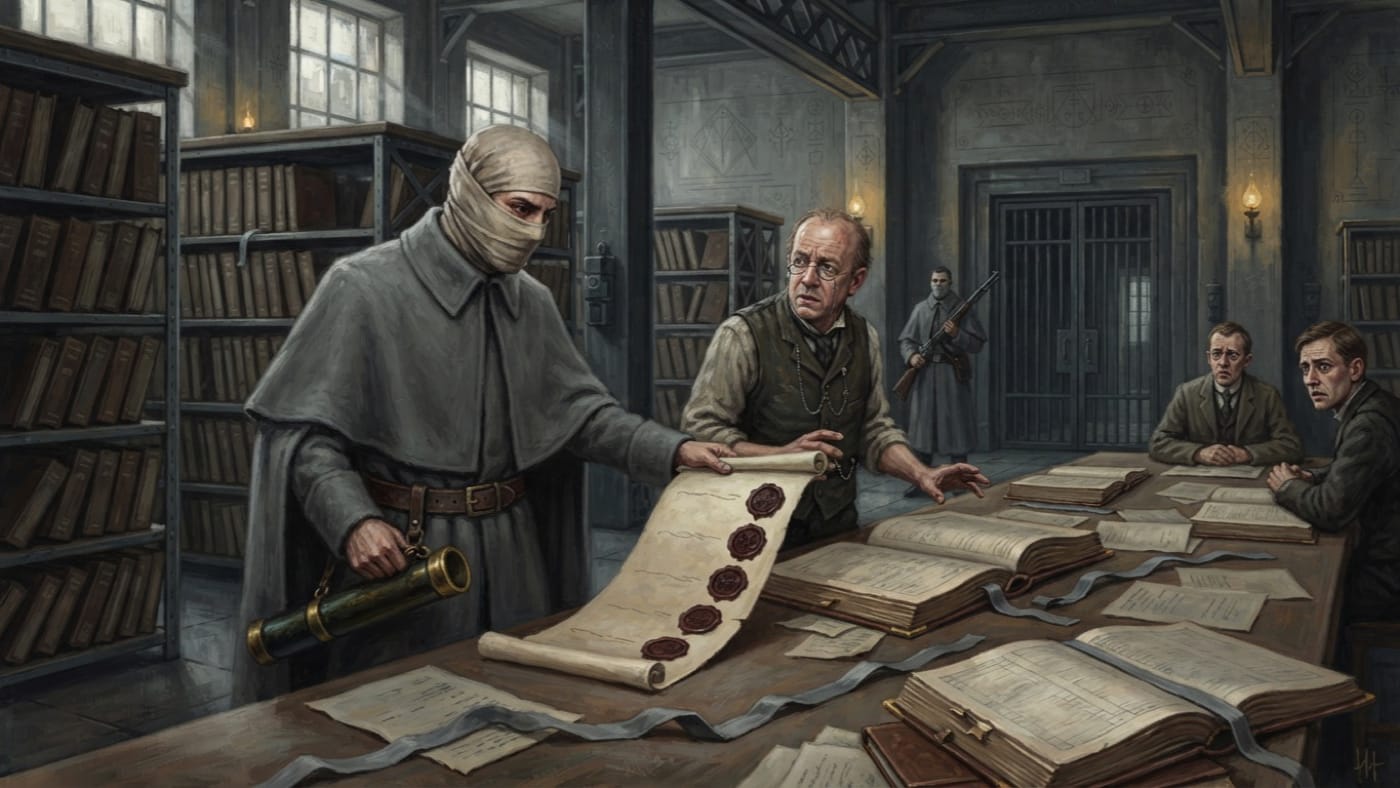
The paper arrives folded. A grey-cloaked figure in a stiffened linen mask, mouth covered and eyes left bare, draws it from a writ-tube at the hip and opens it once across the registry table. The room sees the five seals before anyone reads a word. The guard at the door salutes. The parish clerk hands over his keys, the whole ring, as carefully as a man passing his own spine across a counter. The bells are held, the doors barred from inside, and the inventories begin. Nobody has yet been accused of anything.
This is the Indiction writ, the instrument carried by the Indiction Shadows of the Bureau of Records. Records calls it a writ of announcement. It comes before a warrant and stands beside a charge, and it is already enough to freeze a room. By freeze I mean what the procedure requires: ledgers collected, witnesses kept in place, nobody speaking unless summoned. Records treasures the difference between announcing and accusing. The people standing at the table cannot see it. The writ never says you are guilty. It says the Bureau has noticed, and in the Synod the second sentence tends to run longer.
#On Its Origin and Authority
The writ came out of the hungry harmonisation years after the Concordat of Strasbourg in A.S. 90, when the newly formal Synod found that conquering a continent was easier than counting it. Records had been reshaped from older Church offices twelve years before, in A.S. 78. It took over their shelves, their quarrels and their errors, and found the errors had bred. Villages changed their names between censuses. Parish books burned. Families kept dead cousins on the ration rolls out of piety and arithmetic. Guilds kept two ledgers, then three. Census-scribes sent to correct them came home with apologies, bribes and bruises.
The answer is credited to Archon Benedict Veyrault, patron of the cruellest sentence in the archive: no record exists. The first bearers were senior notaries with armed escorts. Three years later the escorts stood behind them. Seven years later the escorts waited outside. By fifteen years the notaries no longer needed them, because the paper had learned to walk by itself.
The authority comes in a fixed order, and I will state it once. The writ cites the Great Ledger Harmonisation Mandate. The Mandate supplies the authority. The writ carries that authority into one particular room, on one particular morning, against one particular set of books. Audit Silence covers the person holding it, under the Article 9 that leaves the bearer unnamed. I will not recite the other articles here. Some readers would be bored by them. Others would get ideas.
Older glossaries, including a line still in the Lore Book, describe the bearers of the Indiction writ as Covenant elite stealth cadres.
Clarified. The writ is carried by Bureau of Records audit-operatives. Readers who see something military in them are seeing a resemblance the Bureau regrets, finds useful, and denies.
#On the Standard Form and Its Five Powers
That is the whole instrument: six lines, five seals, one silence clause, all folded small enough for a tube at the hip. The bearer also carries a travelling ink-case, because the writ does not finish its work in the room where it is shown. Visitors often treat the five seals as five signatures, or as one wax mouth for each power. The record supports neither reading, and I refuse to make one up to calm the curious. Five seals are five seals. Their job is to be seen.
Seizure comes first and goes quickest. The keys are surrendered, the presses opened, the books carried to the table. Nobody signs a receipt, since a receipt would be a record, and in this room records belong to the Bureau.
Comparison is where the real work happens. The bearer lays out the parish book, the tithe roll, the death book, the birth book, the marriage annex, the confession index, the military levy copy and the local corrections sheet, and reads them against each other the way a confessor reads a penitent against his neighbours. Grey ribbons mark where they disagree. One ribbon marks a missing birth. Two mark a duplicated death. Three mark a baptism without a sponsor. Four close the room. Five summon Purity. Six bring a second Indiction Shadow, and everyone present then learns that the first visit was the gentle one. The ribbons belong to audit practice. They are not further clauses of the writ, and anyone who counts them alongside the seals should be given a ribbon of his own.
Provisional suspension sounds the mildest of the five and does the most harm. The Bureau suspends a name from an entry while the entry is being reconciled. Every Records Scribe knows what hangs from an entry: rations, residence, passage, inheritance, administrative standing, the right to be paid and the right to be buried. The writ does not list those consequences. It has no need to. A name lifted from the ledger leaves everything that hung from it with nothing to hold on to.
Witness enclosure keeps the room as it was found. Witnesses stay. Witnesses are silent until called. Children cry once, and the Bureau notes it.
Archive entry lets the bearer pass any shelf the matter touches. The bearer leaves with the file. Records may wreck a man's standing completely, but it never loses his paperwork.
#On Reconciliation and Standing
Duration: until reconciliation. The form sets no deadline, and I have found none anywhere else. Appeal: after reconciliation. No court of appeal is named, and I know of no successful appeal to cite. The two lines meet at a hinge that the Bureau keeps well oiled. A citizen may appeal once the books agree. If the books agree that the citizen has no standing, his appeal arrives from someone who, on the record, cannot file one. Records calls this procedural hygiene. I call it elegant barbarism, which is praise in my profession and an indictment in every other.
The textbook demonstration is from Mainz, A.S. 136, 1846 by the old reckoning. An Indiction pair entered the Bridge Toll Annex and found fourteen years of duplicate widow exemptions paid out for men whose wives were plainly still alive. The tollmaster's name was suspended from the payroll first, then from baptism, then from burial. He lived nine more days in the state Records calls pending personhood. No physician would treat him. No tavern would sell him beer. His wife, who stayed legally his widow the whole time, inherited his chair before he had finished sitting in it. The file is very clean.
I note for younger clerks that the Mainz sequence was what the Mainz books called for. It is not a liturgy that every Indiction performs. Each suspension follows the discrepancy it is chasing, and a different set of books will cut differently.
The writ suspends. It does not nullify. Sanctioned nullification belongs to the Erasure Notary, who works under other instruments, and I will not have the two confused while I am in the room. Records has always kept that distinction clear. The tollmaster at Mainz might have found it hard to say which of the two he was dying of.
#On the Writ in the Field
At Budapest in A.S. 159, the South Granary accounts showed more flour leaving than arriving, a miracle with no approved saint. A writ was presented and the granary sealed. Comparison failed, and the Bureau weighed every sack itself. The weights showed a second floor, between the first and third, that appeared on no plan. On it were six clerks, three merchants, forty-two forged seals and a chapel to Saint Expedience, an unauthorised patron popular with smugglers. The writ reached the granary and stopped there, as it should. Records corrected the granary. Purity corrected the chapel. The Bureau of Tithes corrected the merchants until money fell out of them.
That division of labour is the point of the instrument. Purity wants the guilty body on display. The Bureau of Shadows takes people away into absence. Records wants the entry right, and keeps the file even when the person attached to it has stopped being recognised.
The writ also has limits, and Records files them as carefully as its successes.
INDICTION REPORT — BASTION-BREST, A.S. 188 Subject: suspected Peripheral Erasure penetration of ration ledgers. Finding: entries altered before ink dried; hand matched clerk ████████, dead three weeks; ash-tracks ended at a locked file wall; one bearer returned with glyph script on the mask, marked from inside. Disposition: file retained; bearer retired; room bricked; ration deficit declared "anticipated."
The Brest file stays shut. I record only that a writ can seize, compare, suspend, enclose and enter, and that this list does not include knowing who was writing.
#On Present Application
As of A.S. 201, 1911 by the old reckoning, the writ goes wherever Records suspects the world of improvising. It is presented in parishes and bastion ration offices, in tithe courts and refugee registries, over cathedral orphan rolls, death wagons, canal ledgers and the private books of guilds who thought their books were private. The wording has not changed. The five powers have not grown. The tube on the hip is still smaller than a man's forearm, and it still clears the room as fast as it did in the hungry years.
The Great Ledger has to agree with itself. The writ is how the Bureau makes it agree, one room and one ribbon at a time. Speed is not the Bureau's concern, and neither is the comfort of the people at the table.