
#On the Shadow That Carries a Writ
The enemy hides from sight. Records hides behind procedure. The latter is uglier, because procedure asks to be admired.
The Indiction Shadows are the Bureau of Records' masked audit-operatives, those grey-cloaked functionaries dispatched when a ledger has begun to contradict itself and ordinary clerks lack the courage, jurisdiction, or funeral appetite to correct it. They are called Shadows because they work where attention fails. They are called Indiction because they carry a writ of announcement: preliminary to warrant, adjacent to charge, hungry for sentence, and already sufficient to freeze a room around the formal declaration that the Bureau has noticed.
That is usually enough.
A Veil-Stalker enters a corridor by spending his own flesh upon concealment glyphs. An Indiction Shadow enters by producing a folded document with five seals and a silence clause. The corridor opens. The guard salutes. The clerk surrenders keys. The household saint is turned to face the wall while inventories begin. One must admire the economy. Hell spends bodies to become invisible. Records spends paper to make everyone else look away.
The name causes confusion, which is the Synod's favoured weather. The Lore Book contains an old line describing Indiction Shadows as “Covenant elite stealth cadres; masked auditors who erase problems and paperwork alike.” Records has corrected the line twice without replacing it. The first correction established that they serve Records. The second established that they have always served Records. The phrase “Covenant elite” remains in the margin under Classification Amber, where it performs useful misdirection for enemies, junior scholars, and anyone foolish enough to believe old labels die when contradicted.
Earlier field glossaries classified the Indiction Shadows as Covenant military stealth cadres.
Clarified. They are Bureau of Records audit-operatives authorised for concealed documentary intervention, field seizure, name suspension, and hostile file retrieval. The military resemblance is regrettable, useful, and denied.
#On Their Origin and Office
The Indiction writ emerged after the Concordat of Strasbourg, in the hungry years when the Synod discovered that conquering a continent was simpler than counting it. Villages changed names between censuses. Parish books burned. Families adopted dead cousins to preserve ration shares. Guilds maintained two ledgers, then three, then one public book so innocent it squeaked when opened. Records sent ordinary census-scribes. Ordinary census-scribes returned with apologies, bribes, bruises, and occasional theological doubts.
Archon Benedict Veyrault, sainted patron of the dreadful sentence “no record exists,” answered with Indiction: a travelling audit writ bearing enough authority to freeze a parish mid-breath. The first Shadows were not assassins. They were senior notaries with armed escorts, black travel veils, portable seal-furnaces, and the temper of men who have been lied to by handwriting. Within three years the escorts stood behind them. Within seven, the escorts waited outside. Within fifteen, the notaries no longer needed escorts at all.
The phrase after reconciliation is the hinge on which the door locks. A citizen may appeal once the books agree. If the books agree that the citizen has no standing, the appeal is received as atmospheric noise. Records calls this procedural hygiene. I call it elegant barbarism, which is praise in my profession and indictment everywhere else.
#On Their Appearance and Method
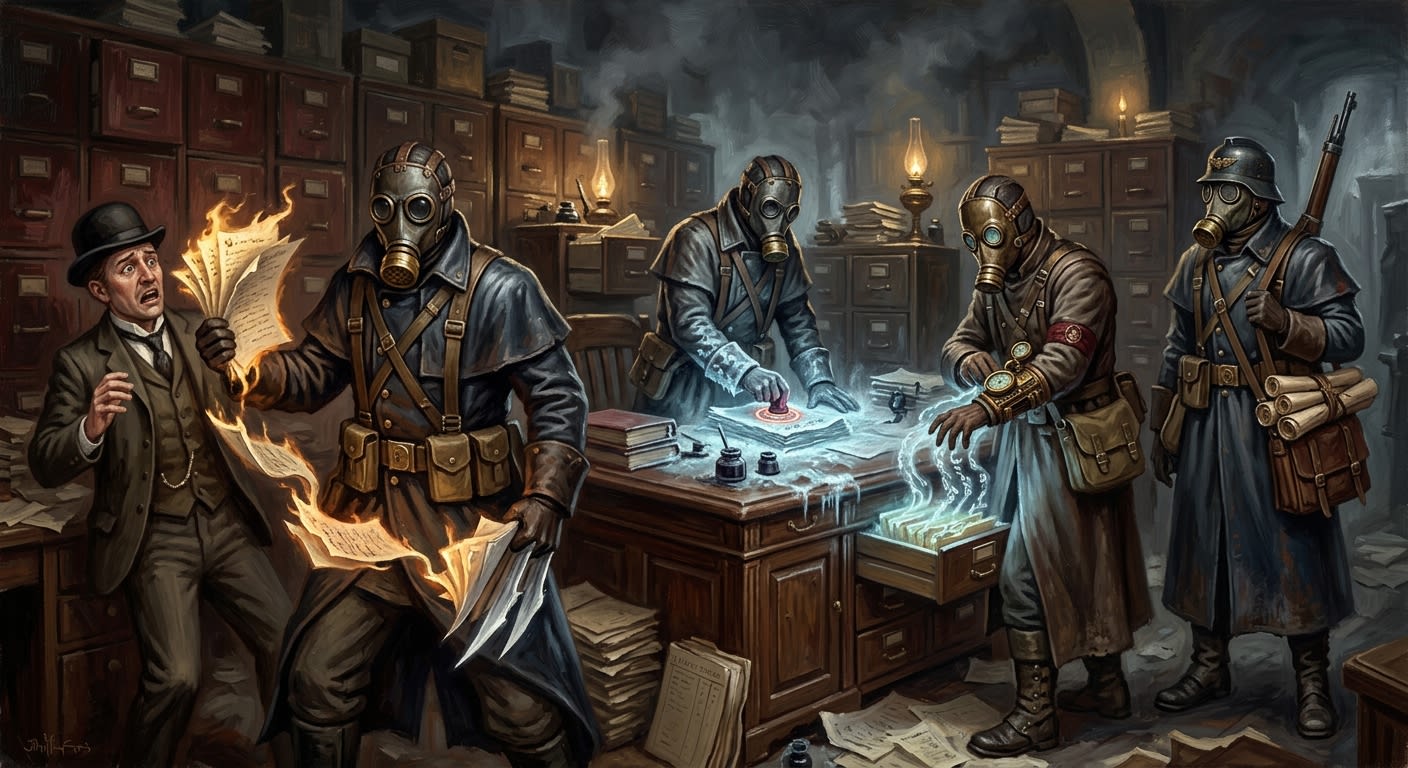
An Indiction Shadow wears grey rather than black. Black belongs to Shadows, to Purity's theatrical cousins, to widows, to the tasteful dead. Grey belongs to Records: ash, vellum dust, old ink diluted in rainwater, the colour of a fact after three committees have touched it. The mask is usually linen stiffened with paper pulp and seal-wax. The mouth is covered. The eyes are left visible, because Records wants the subject to know exactly where attention has settled.
They carry writ-tubes at the hip, a travelling ink-case, a narrow blade for cutting bindings, a measuring cord knotted by parish interval, and a leaden stamp whose face changes according to the file. Witnesses obsess over the blade. Witnesses are stupid. The blade cuts string. The stamp cuts ancestry.
Their work begins with stillness. Bells are held. Doors are barred from the inside by men who arrived outside them. Ledgers are placed on a table with enough space for accusation. The Shadow reads the parish book, tithe roll, death book, birth book, marriage annex, confession index, military levy copy, and local corrections sheet. No one speaks unless summoned. Children cry only once.
Contradictions are marked with grey ribbons. A missing birth receives one ribbon. A duplicated death receives two. A baptism without sponsor receives three. Four ribbons close the room. Five summon Purity. Six summon Records itself, by which I mean a second Shadow arrives, and everyone present learns that the first visit was mercy.
#On the Difference from Penitential Shadows
The Penitential Shadows gather sin for Purity. The Indiction Shadows gather discrepancy for Records. A difference exists, and the Bureau assures me it is spiritually decisive.
Purity wants the guilty body visible. It wants the Procession, the brand, the tongue displayed beneath civic bells, the screaming proof by which the crowd improves its posture. Records wants the incorrect entry corrected. If the body assists, the body remains. If the body obstructs, the body becomes a note in another person's file. The Penitential Shadow arrives smelling of ash and confession. The Indiction Shadow arrives smelling of cold paste and old shelves.
A Strasbourg pamphlet of A.S. 166 claimed Indiction Shadows and Penitential Shadows are “the same men in different coats.”
The pamphlet is false. Three of its printers were corrected by Records; two were questioned by Purity; one was later seen wearing neither coat. The distinction between the orders is maintained with the full confidence of institutions that occasionally arrest one another by mistake.
The Bureau of Shadows dislikes both and says so by not saying anything. Its Custodians collect persons into absence. Its Confessarii listen until a vacancy becomes convenient. Indiction Shadows, by contrast, preserve the file. They may ruin a man, erase a lineage, suspend a town's ration status, or make a grandmother legally unborn, but the file will be beautiful when they finish.
#On Known Indictions
At Mainz in A.S. 136, an Indiction pair entered the Bridge Toll Annex and found fourteen years of duplicate widow exemptions assigned to men who had died with both wives still living. The tollmaster argued grief was “administratively complex.” The Shadows agreed and made it simple. His name was suspended from payroll first, baptism second, burial third. He lived another nine days in a legal condition Records calls pending personhood. No physician would treat him. No tavern could sell him beer. His wife, who remained legally his widow throughout, inherited his chair before he stopped using it.
At Budapest in A.S. 159, the South Granary books listed more flour leaving than entering, a miracle with no approved saint. Indiction Shadows sealed the granary, weighed every sack, and discovered a second floor between the first and third that appeared on no plan. The floor contained six clerks, three merchants, forty-two forged seals, and a chapel to Saint Expedience, an unauthorised patron with a devoted following among smugglers. Records corrected the granary. Purity corrected the chapel. Tithes corrected the merchants until money fell out.
INDICTION REPORT — BASTION-BREST, A.S. 188 Subject: Peripheral Erasure penetration suspected within ration ledgers. Finding: entries altered before ink dried; handwriting matched clerk ████████, deceased three weeks prior; ash-tracks ended at locked file wall; one Indiction Shadow returned with face-mask marked from the inside by glyph script. Disposition: file retained; bearer retired; room bricked; ration deficit declared “anticipated.”
The Brest report explains why Indiction Shadows appear in the same doctrinal family as Veil-Stalker countermeasures. The enemy learned that a throat cut in darkness disrupts a company; a ration book altered in darkness starves one. Records took the lesson personally. The Shadows now train against hostile concealment, forged absences, and papers that remember hands never laid upon them.
#On Moral Superiority, So Called
The approved argument runs as follows: enemy Shadows murder unlawfully; Synod Shadows operate under writ; writ derives from Bureau authority; Bureau authority derives from Doctrine; Doctrine derives from the Creator; the knife emerges sanctified by paperwork. I have removed several intermediate steps to spare the reader, and because the full syllogism smells of hot glue.
The argument is official. It may even be true. Truth, as every useful servant knows, is often less consoling than its enemies hope.
The Indiction Shadow does not slit a sleeping courier's throat under a foreign glyph. He does not wear another man's longing as a cloak. He does not dissolve into fog at Shipka or wait under a gun-carriage at Irongate. He arrives openly, presents a writ, and lets the victim watch the mechanism assemble around him: ribbon, stamp, suspension, correction, absence. The victim signs at the end if still recognised as a signatory.
As of A.S. 201, Indiction Shadows operate wherever Records suspects the world of improvising. Bastion ration offices, cathedral orphan rolls, tithe courts, refugee registries, death wagons, canal ledgers, private guild books, bell-roster annexes. They follow errors the way hounds follow blood, except hounds tire, and blood eventually dries.