

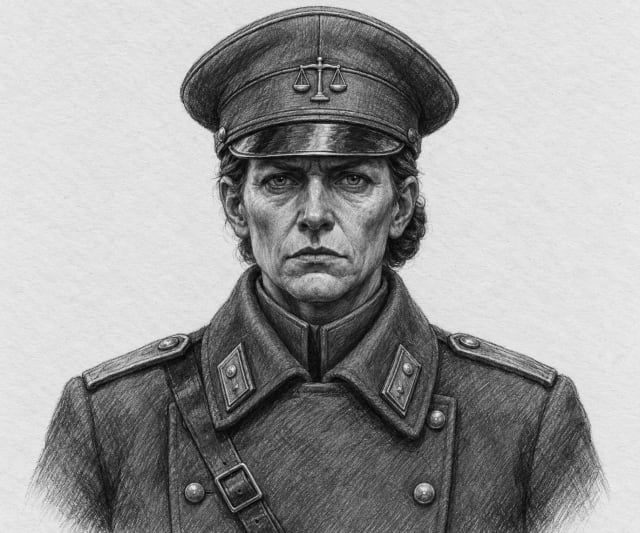
#On Her Station
Vanna Rook is Provost-Marshal of Bastion-Przemyśl. It is the third bastion of the Sagittal Line counted north to south, set where the western Carpathian passes narrow to one rail spur and one wagon causeway. The Bureau of Records calls such a place a transit choke. Everything that passes west or east through Przemyśl is stopped there and searched: men, freight, permits, rumor.
Three persons govern the bastion in fact, whatever the Synod Chapterhouse prints on its letterhead. Archivist-Prelate Odran Kelle holds the confession vault beneath the Chapel of Counting. Sealwright-Master Joryn Malk holds the wax blanks and the stamp dies. Rook holds the soldiers.
There are roughly two thousand four hundred of them, provost troops and auxiliaries, quartered in Barrack-Ash in ash-gray wool with iron collar tabs. They check tags at the permit gate. They walk the curfew corridors after the bells put out the lamps. They eat first. That is policy, and the policy is hers to enforce.
East of the wire, on the black ridges of the Ebon Heights, sits Atheron, Sin-General of Pride. Facing him, the Provost-Marshal is a wall-officer whose nerve has been proven under a falling shadow. Facing everyone on the western side of the wire, she is the officer who sends out the harvest. This assessment records both, as the Bureau requires. Preferring one would be a different job.
#On the Dawn Harvest
"Dawn is a knife with paperwork." — Proverb of the Orchard
Before the first bell, the Provost-Marshal dispatches the harvest.
The patrols go out through the Orchard Ring into the three miles of electrified barb the garrison calls the Wire Orchard. At first light they return with carts and strings. The carts hold bodies. The strings hold identity tags, ration tags and transit chits, cut from the dead or worked free of the barbs where they snagged when their owners did not stop.
The bodies go to the ditchpits. The exception is the dead who can establish burial entitlement by tag and filed claim. Each of these receives a wax seal on the tongue, by Przemyśl custom, and a grave with edges. The ditchpit has no edges.
The tags go to the morning ledger, where they are counted against the morning's projected intake. When the figures agree, the ledger is balanced and the bastion proceeds to the ration blessing. When they do not agree, the Logistics-Penance Tribunal adjusts. Rook's office does not adjust. Her office delivers. The Bureau of Records insists on this jurisdictional distinction as firmly as a chandler insisting he sold only the rope.
Her patrols keep to the hour with an exactness I have seen commended by the Bureau of Rites in choirs that were less punctual.
A ration tag in Przemyśl is food, roof and name in one square of stamped card. Its bearer exists in the Great Ledger between its date of issue and its date of expiry. A man who loses his tag to the wire, to a thief or to a harvest string joins the Erased. The Erased eat nothing, sleep nowhere, and are fair game for anyone with a hook. Each string brought in at dawn is a sum of persons removed from the column of the living, entered and reconciled before breakfast.
Then there are the harvest boards. These are public lists posted in Taghouse Row, and they change overnight. A name read out at curfew may be gone at dawn. The Bureau of Records calls this "clerical optimization." The soldiers say the Provost. I record both attributions without ruling between them. Disappearances are a matter for the Tribunal, and the Tribunal is currently of great interest to the Provost.
The dawn harvest recovers deserters and no other persons.
Withdrawn. Deserter recovery is the harvest's official function and remains its only stated one. But the wire also catches refugees, smugglers and the uncounted, and the strings come back from all of them alike. The street puts it more simply: "They take whoever balances the week." The Bureau does not print what the street says. I have printed it once, here, under correction, where it can do no harm.
At the ditch edge and in the Underwire galleries works a heretic mutual-aid cell called the Gleaners. They shelter the Erased, swap tags between the living and the recently dead, and corrupt the harvest lists. Every name they keep alive is a name the morning ledger must account for some other way. The Bureau of Purity has been hunting them since A.S. 183. They show no sign of having noticed.
#On the Current at the Wire
In the autumn of A.S. 195 / 1905 CE, Atheron's Spire-Crusher came out of the saddle below the Ebon Heights. At first sighting it stood three hundred and forty feet tall. When it reached the outer wire it stood nine hundred. Major Cestian Rell's batteries had been firing on it for six hours, and it had grown under every salvo. At the Orchard it bent the pylons outward before it touched them, as though the wire were bowing to it.
Provost-Marshal Rook ordered the eastern Orchard current doubled.
The wire burned blue. The ration tags hanging on the barbs caught fire one after another, a line of small paper authorities curling to ash across the salient. The forward pier of the tower entered the charged field and stopped.
It stood there for twelve minutes, while every heavy gun on the eastern salient kept firing at a target that was, for once, holding still.
Then the Spire-Crusher grew again. It lengthened the pier over the wire instead of pushing through it. The base rose clear of the charged strands, the shadow crossed the ditch, and the inner wall fell under it. Atheron's engine did not argue with the current. It climbed over it.
The current did not destroy the tower. Major Rell ordered every battery onto a single mark, the narrowing of the forward pier below the lowest gallery. Sister-Adjunct Hilde Marek calculated the firing angle on a requisition form, because every range slate in the battery had cracked. At the ninth hour the pier broke. The Bureau of War's corrected bulletin lists wire current among the causes of the destruction, between bell discipline and ash smoke. That is where it belongs. The full count of shells, and the forty feet of rubble, are recorded in the engine's own entry.
The after-action summary does not say whose tags burned. Nobody at Przemyśl has asked. The wire had been holding them, and the wire spent them.
#On the Tribunal
"Never argue with a stamp." — Proverb of the Orchard
In A.S. 200 / 1910 CE, a stamp die was reported missing.
A die is the instrument that makes seal-blanks. Whoever holds a true die can print true tags, true transit seals and true lives, and the Ledger will receive them as its own children. The Bureau of Records sent investigators. Their preliminary report notes that the die's serial number appears in the records of two bastions at once. The Bureau has classified this as an administrative artifact of no strategic significance, which in the Bureau's usage is a formal statement of alarm.
The die is Malk's province, and its loss is his exposure. The confessions that might name a thief lie in Kelle's vault, indexed three levels below the chapel floor. Rook has neither the die nor the vault. She has the men who walk the wire, and she has an argument.
The argument runs as follows. The harvest is security, not supply management. When forged tags may be circulating, every unexplained tag is a threat, every ledger out of balance is a breach, and a breach calls for a soldier. Clerks will not do. On this reasoning the Logistics-Penance Tribunal, which balances the ledgers, ought to answer to the officer who fills them. Her aim is to bring the Tribunal under Provost command through an audit emergency: a clean coup, on paper, with every form completed.
It has not happened. In A.S. 201 the Tribunal remains its own office in Taghouse Row, its clerks in ink-black aprons, its adjustments in its own hand. Kelle watches from the Chapel of Counting. Malk watches from the Candleworks Quarter. No settlement among the three has been sealed, and I will not invent one so that the chapter ends neatly.
The danger of her proposal lies in its logic. The provost who stopped a siege tower for twelve minutes may fairly say that she knows what security costs. The ledger she would take over has never yet balanced unless some column of persons was cut to fit it. Combine the hand that fills the ledger with the hand that corrects it, and no one is left in Przemyśl to ask where the difference went.
#On Her Present Authority
It is A.S. 201 / 1911 CE. The die has not been recovered, and no culprit has been named. The serial number remains in two bastions at once.
Every morning before the first bell the patrols still go out, and at first light they come back with carts and strings. The ditchpits take what the ledger cannot use. The wax seals go onto the tongues of the entitled. The boards in Taghouse Row change overnight, and the soldiers still say the Provost, and the Bureau still says optimization.
If the die stays lost and forged tags multiply, Przemyśl's own forecast is tag inflation, then ration riots, then mass erasures. That forecast is conditional, filed and unproven. The Provost-Marshal presents it as the reason for her harvest. The Gleaners would call it the harvest's natural result. Both readings rest on the same strings.
Across the wire, Atheron builds new foundations on the high eastern ridges and waits. He has never needed to cut a single strand of the Orchard. Inside Bastion-Przemyśl, the question of who will count the dead is still open, and three people are holding it.