
#On the Joined Sheet
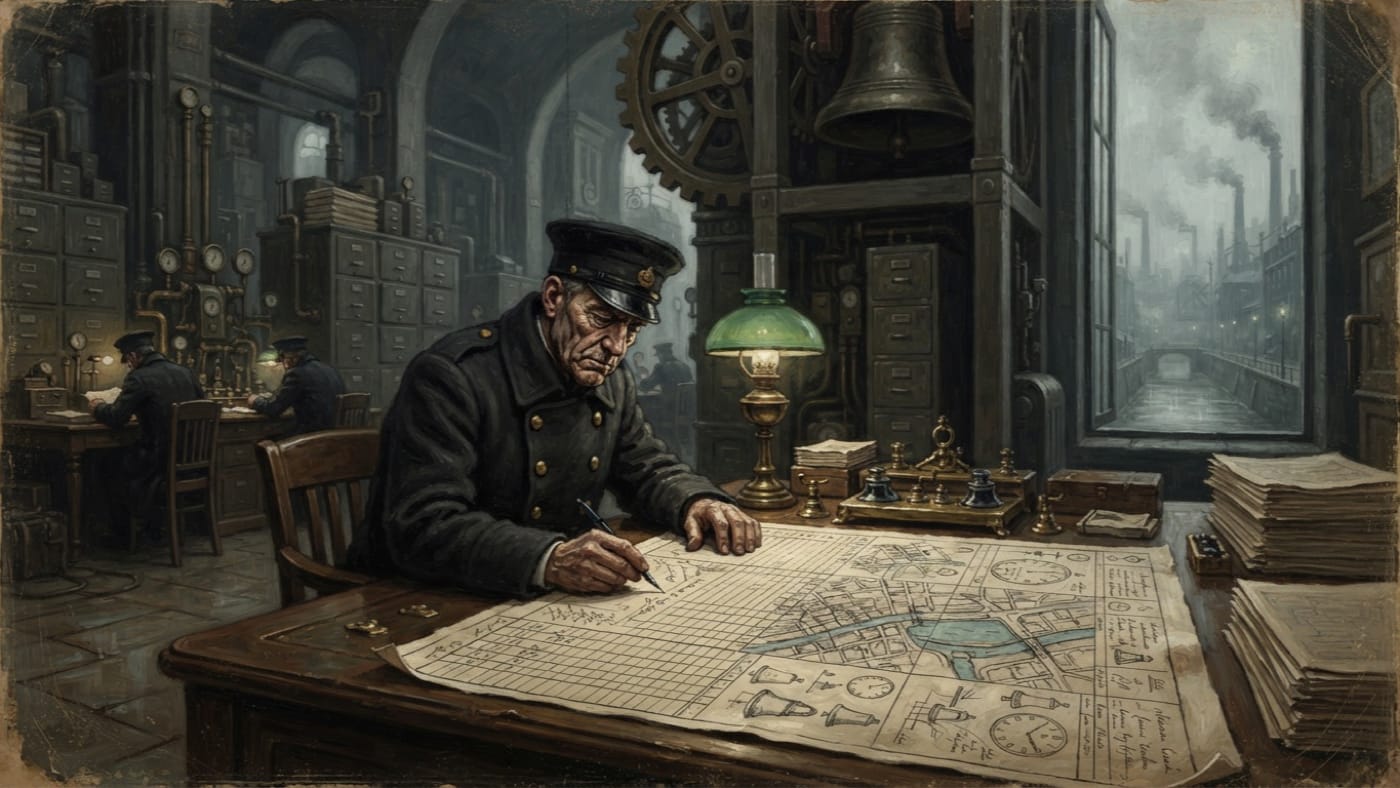
The Integrated Route and Bellway Table is one ruled sheet. A city must complete it before moving any serious crowd through a street that a bell can reach. It is the working instrument of the Route-Timing Concordat of A.S. 129. The Concordat is the law. The table is where the law acquires a street name, a head count and a person to hang it on.
It should not be confused with either of its parents. A route sheet tells a Marshal where feet will go. A bell-table tells a tower when bronze will speak. Before A.S. 129 each lived in its own office with its own clerk and its own patron saint of punctuality, and neither was required to know the other existed. The Concordat of Civic Cadence of A.S. 113 had already taught the Synod to march a crowd. It had not taught the Synod to ask which bell the crowd was marching to. The table puts both documents on one face of paper, so that the funeral column and the vespers peal meet in ink before they can meet in the street.
The first version was Form RT-1. Its successor, RT-1b, exists because RT-1 left out bridges. The Concordat's own account says nothing more than that, and I will not improve on it with invented amendments. The Bureau has enough fiction in its holdings without my adding to them.
#On the Canal Entry
The Night of Two Bells supplied the reason. In A.S. 129, in the cathedral quarter of Strasbourg, the funeral bell of Saint Erasmus and the vespers bell of the Cathedral of the Perpetual Writ struck together. Both were lawful. Both were entered on their own tables, entered correctly and rung correctly. Eight hundred mourners heard two commands and obeyed both, and a crowd can obey two commands only by splitting. It split into three obedient streams. One of them found a canal embankment whose rail had been removed and whose lamps had been put out under repair orders. Nineteen deaths were admitted.
No bell was rogue and no demon sat in the belfry. The bell-tables were in order. The repair order was in order. They were filed in different buildings. The bell-table knew nothing of the missing rail, and the repair order knew nothing of vespers. Every office involved had done its duty, and the water did the rest.
The table therefore records sound and stone together. The principle cost nineteen lives to prove at the canal lip: a crowd does not separate the two. It hears a bell and walks toward an edge. If the paper does not hold both, the paper lies.
#On the Required Fields
These eight are the mandatory spine. Clerks fill in more, and the Concordat expects them to: route class, expected head count, lead auditory authority, secondary bell restrictions, choke points, bridge mouths, canal lips, market intrusions, gas-line works, weather notes, relic interference, and the name of the Marshal in charge. I list them as the Concordat lists them. No complete original sheet sits on my desk for me to number its columns, and I will not number columns I have not seen.
The first fields establish identity: which route, which class of procession, how many bodies. Procession class matters most, because it decides whether two-bell clearance applies. Funerals, levy transfers, relic processions, ration releases, penitent marches and emergency evacuations all fall under the rule. Readers who take the name literally should note that the rule does not limit itself to two bells and does not prescribe two strikes. It is named after a night, not a count.
Next comes auditory command. A bellway is an acoustic jurisdiction, a corridor of authority marked out by what can be heard, and it is more than a road that runs past a tower. The table names the lead auditory authority for the passage and the bells that must hold their tongues. The harmonic exclusions field is where the rule gets particular. A bell within harmonic range of the route may not strike during the passage unless the lead Marshal certifies compatibility by whistle, by baton and by written mark. For funerals the clearance begins three turns ahead of the coffin and lasts until the last mourner passes the final chalk mark. I have heard junior clerks try to turn "three turns" into minutes. They have been corrected.
Then the stone. Choke points, bridge mouths, canal lips, gas-line works dug open across a lane, market stalls that creep into a thoroughfare on market days, weather, and relics whose presence pulls the pious off their line. Every one of these was absent from the bell-table of A.S. 129. Every one of them now sits beside the bell entries on the same face of paper.
The emergency cut lanes show where a Marshal may sever the column if it must be severed. The Synod would rather cut a crowd on purpose with a whistle than have a canal do it by accident.
Last comes the responsibility chain. Everything above it describes the street. This field describes who answers for it.
#On the Copies and the Living Name
One copy goes to the Bureau of Bells, so its towers know which of their voices are held. One goes to the Bureau of Rites, so the officiants know when their sacrament is permitted to move. One goes to the Cadence Corps, whose Marshals will walk the sheet with chalk pouch and baton-staff. The Bureau of Records keeps the master and resents every request to amend it, as Records resents all motion.
The custody follows the Bell-Hold Writ, the settlement Bells extracted while still protesting. Bells keeps its liturgical authority over tone, sequence and sanctioned silence. The Corps gains interruption rights during crowd movement, and inside a cleared route zone a Marshal's whistle can suspend a parish bell. Bells did not lose its authority. It lent part of it out on a written receipt, and the receipt is this table.
Then there is the signature. RT-1b requires the legible name of a living officer. Initials will not do, nor a seal, nor the inherited smudge of a predecessor long retired to his vineyard. The Night of Two Bells showed what happens to responsibility spread thin across separate offices: it goes off, and in time it becomes a corpse with no parent. The signature line is there so that every future corpse has one.
None of this stops the street from differing from the sheet. A rope frays. A hawker ignores his permit. A widow stops on the bridge mouth to cross herself. The table records what the officers expected. The passage records what happened. When the two disagree, Records holds the master and the name on it, and the procedure is complete.
#On Those Who Measure Obedience
The same Concordat created the Cadence Architects. They design the routes and the choke-point solutions that the table records, and they train the Marshals who carry it out. The Marshal holds immediate command of movement: the whistle-flute matched each morning to the day's bell, the sash knotted in the code of the office, the baton tapped three times before the first step. The Bellwarden, toll-key chained at the wrist, verifies peal authority, calibrates the bell and records every deviation. Each of the three reads a different part of the same sheet, and each suspects the other two of reading it badly.
The Architects' real discipline is the prediction of divided obedience. A panicking crowd is easy to read. An obedient crowd is dangerous, because it splits along lines of authority, and the table exists to make sure that only one authority is speaking at a time. How an Architect calculates the split is not for this page. Public doctrine says the calculation exists and that it is taught. It does not say what it contains.
Bells has never fully forgiven the harmonic exclusions column. A Bellwarden sees in it a list of bells that the Corps has told to be quiet, and Bellwardens do not like being told to be quiet. The Bellwarden's reply is the deviation log, kept to the standard of the Bell Codex, and it is very thorough.
An older Bureau compendium dates the ratification of the Bell Codex to A.S. 231.
Corrected: the Bell Codex was ratified in A.S. 115. The Office of Bells had been constituted in A.S. 52, and the A.S. 231 date describes a year that has not happened yet. The Bureau keeps excellent records. It does not keep records of the future.
#On Current Passage
As of A.S. 201, the table is in daily use wherever the Synod moves people within earshot of bronze. Strasbourg publishes clearance sheets every day before Prime, and the cathedral quarter that first needed them now reads them over breakfast. On the Bug River sector, Bastion-Brest runs its ration queues under grain-yard bell locks. Hunger is a procession class too, and the table records it as one. In the western Carpathian passes, Bastion-Przemyśl fits trench levy transfers in around its ridge alarms. A ridge alarm is a bell that cannot be held, so the levy column has to be timed around it. In the Danube gorge, Irongate times its bridge crossings by fog bell and boot strike, which is a fitting place to end, because RT-1b was written for bridges.
The terrain changes and the sheet does not. The same eight fields serve each of these places. In each place the same living name goes at the bottom, written large enough to read from the far bank of a canal.