
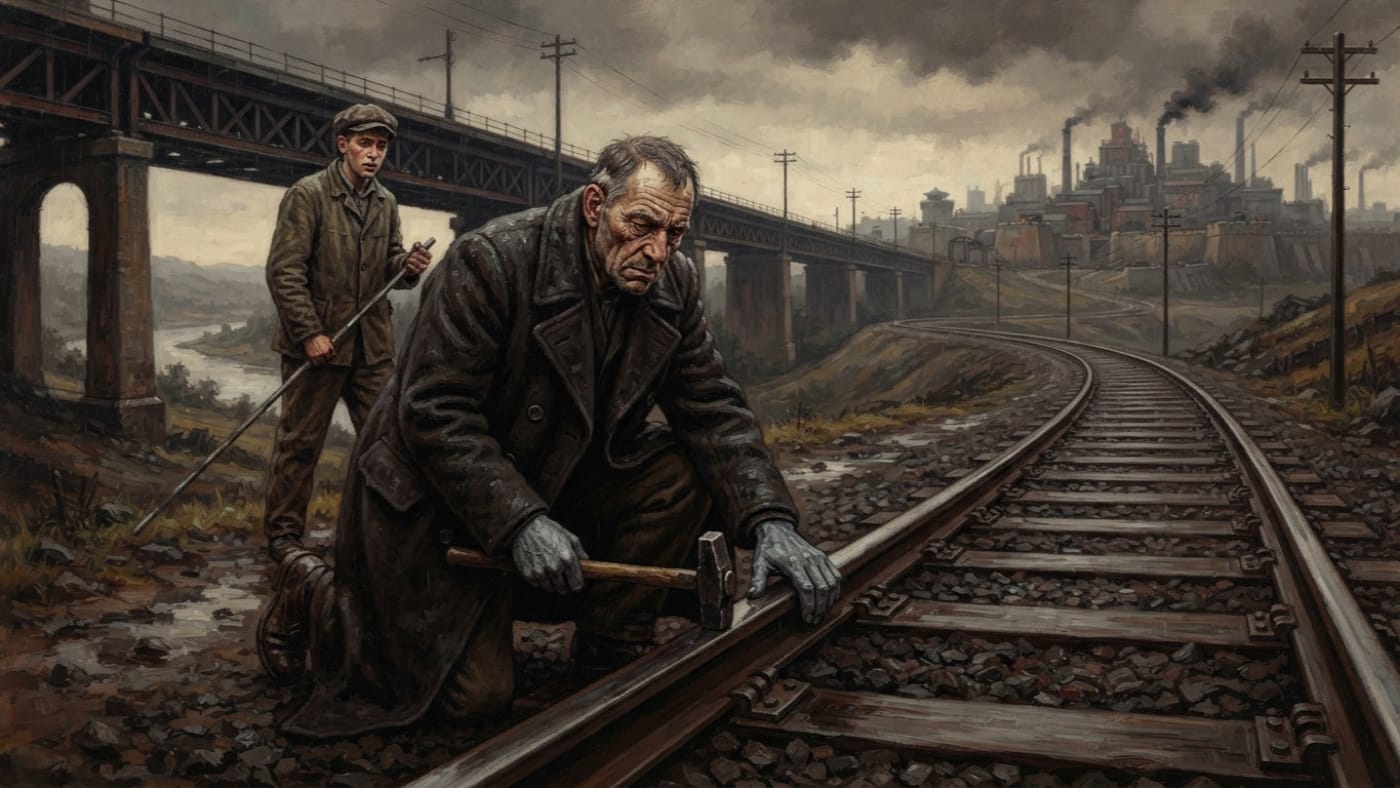
#On the Name and the Work
Or: what the yard-boys shout, and what the old Walkers will only mutter.
Iron-Blood has two meanings, and the Church's clerks mix them up at their own risk. The first is a street title for the whole trade: the Railway Track Engineer, the Gandy Dancer, the Rail-Priest. People shout it after anyone in an oilskin duster with a gauge rod on one shoulder. A yard-boy in Metz uses it the way he would use "sweep" or "tanner." It names a guild, a smell and a hammer. The second meaning is spoken more quietly and only inside section houses. It names a change that the crews say comes over a body that has walked the line too long.
I can certify the first meaning. The second I can only record.
A section crew of four to six keeps the gauge at 1,435 millimetres, the rails level, the sleepers sound, the ballast packed and the joints honest. They walk their section, check the gauge every twenty metres and tap the rail-head with a hammer to hear how it rings. A bright ring means solid steel. A dull one means a fracture or a void. Before the Guild of Rails issues a certificate, a candidate must name twelve categories of defect by ear alone. The trade costs fingers to frost, hearing to the hammer and spines to the tie tongs.
Whatever iron-blood may be, it grows in bodies that the work has already marked.
The Night Walkers, who patrol between dusk and dawn, are always men. The Guild has never explained that rule, and it governs that patrol alone. Men and women in the wider trade hold certificates side by side, and the crews give the name Iron-Blood to both, in both of its senses.
#On What the Crews Report
The claims go as follows, and they are repeated in every section house from Königsberg to Constantinople. Old Track Walkers say they can feel a fracture forming three days before the steel shows it. They say their teeth ache before a cold snap buckles the rail. They say the rail remembers every train that has crossed it, every load and every stress. A body that walks a section long enough comes to share that memory, in the way a confessor comes to carry a parish.
The crews blur two things that should be kept apart. A Walker who strikes a rail and hears it ring flat has found a defect that already exists. Any certified apprentice can do this. A Walker who says he felt the defect three days before it existed is claiming something of another order. No ledger I have read records such a forecast before the crack appeared. The Guild keeps no tally of right forecasts against wrong ones. The crews see no need for one.
They will not say how it happens either. Ask a foreman when it began in him and he will say he did not notice. Ask whether it can be stopped and he will look at you the way a bastion gunner looks at a man who asks whether the war can be stopped. The condition has no stages, no test and no first case. The old ones have it. The young ones expect to.
#On Grosz and the Dead Sound
In A.S. 186 the Bureau of Doctrine sent me down the line from Strasbourg toward Bastion-Przemyśl, on an inspection it describes as voluntary. The journey took three days. My guide was a Track Walker named Grosz, who smelled of lamp-oil and spoke in single syllables.
On the second night he stopped, struck the rail and listened.
"Dead sound."
The ring came back flat, the sound a coffin lid makes under a knuckle. He took my arm, pulled me off that stretch, and we went around it. To my eye the steel looked exactly like the kilometres behind us. The Guild examines its apprentices on precisely that note. The crews would say Grosz knew before he struck. All Grosz said was "dead sound," which settles nothing.
I made two observations that night and have never found a place to file them. The first is that his hands were grey. It was the blue-grey of rail-steel left out for fifty winters, and I can tell it from dirt because I have seen a great deal of dirt. The second is that when he pulled me from that section, his grip was stronger than I would credit in a man I took for seventy. Grosz called the colour callus. That is his statement, and I enter it here as his.
What I recorded does not amount to metal in the blood, bone turned to iron or strength beyond the human. It amounts to a grey hand, a hard grip and my continued existence.
Two winters earlier Grosz had lost his junior man. Fehr died in a crush incident in the Carpathian tunnel section in A.S. 184. Grosz filed no grievance, and he walked his section alone for nine months. When asked about it, he said: "The rail remembers Fehr. I walk where he walked. That is enough." The Guild holds that a crew is a single organism. I enter his words as a foreman's grammar of grief, spoken in the only idiom his trade supplies. Whether the boy is in the steel is a question for an office I do not hold.
#On the Six Investigations
The Bureau of Purity has examined iron-blood six times. I cannot tell you when, by whose hand or with what instruments. The record cites the conclusion and very little else. Every inquiry ended with the same sentence: "No evidence of supernatural contamination; recommend continued observation."
The crews read this as vindication. Six times the white cloaks came, and six times they found nothing to burn. I read it as a Bureau declining to open a file it cannot close. Purity's charge is contamination. It found none it could name and nothing it could call clean, so it recommended watching. Watching costs nothing and concludes nothing.
The jurisdictions fit badly together. Doctrine has authority over what a thing may be said to mean, and it has said nothing at all about iron-blood. Purity holds the question of taint, and six times it has declined to find any. The Bureau of Engineering holds the rails, the gauge and the certificates, and it cares only whether the man with the hammer hears the flat note. None of the three has written a statute on the subject or classified the condition. The Track Walker stands under three seals, and none of them describes him.
Rail-demons cloud the reading further. Doctrine maintains that the word is a folk term for patterns of mechanical failure. Purity says it has received no referral. The crews chalk the junctions anyway. No Bureau has tied iron-blood to whatever lives in the junction, and nothing I saw on Grosz's section ties it for them.
#On the Guild's Inheritance
The section house keeps the belief the way a chapter house keeps a rule. The crew eats and sleeps in one room between bastions and speaks in taps and gestures that outsiders cannot read. The old ones are listened to, and the young ones listen. "The rail remembers." "Steel doesn't lie; stone doesn't forget." "Walk the line, know the line, be the line." The Bureau of Doctrine would prefer that the crews stopped saying the third.
Saint Vandrail hangs above the coal stove with a hammer in his hand and rails for fingers. The Guild venerates him, and the Church tolerates him without canonising him. His hagiography has him driving spikes with his bare fists and walking from the Baltic to the Bosphorus in a single night. The rail-fingers belong to the icon. No crew I have met claims its old men are turning into him. The Bureau of Rites records the oil and chalk left at his feet as "guild observances, tolerated."
The Guild has plainer roots. Its charter, the Codex Ferrum, dates from A.S. 94. Its first members came from Prussian military rail battalions and civilian navvy gangs. Its reverence for old bodies goes back to the Gauge War, forty years of incompatible track, and to the relaying that followed the 1,435-millimetre decree of A.S. 136. The crews worked double shifts through that relaying, and some four thousand of them died. The survivors of the Years of the Hammer were treated with something close to worship. Ever since, a grey-handed veteran has been a figure of awe in the trade, whatever the grey may mean.
The published entry on the Railway Track Engineer captions its relaying image "The Years of the Hammer, A.S. 96–136."
The years A.S. 96–136 are the span of the Gauge War, forty years in all. The Years of the Hammer are the three years of double-shift relaying that the Guild commemorates under that name. The Bureau of Records holds no confirmed first or last year for them, and this entry supplies none.
#On Certification and Continued Observation
This is the practical problem the Bureaus have arranged not to see. The Guild needs its old Walkers because they hear what apprentices miss. What they hear is exactly what draws the white cloaks. The longer a Walker serves, the better the ear and the stranger the hands. Purity watches, Engineering certifies, and nobody retires the man.
Then the Bureau of War needs the train to run. A Track Walker asks for the right to refuse certification on a section he judges unsound. That right is contested, because a closed section starves a trenchline. The crews seconded to the Military Track Corps work under that pressure on every rotation, close enough to the front that a good ear is the only margin they have.
Section 22-North, A.S. 199. A stress fracture was noted in the maintenance ledger, and a military order deferred its repair. A derailment followed. Thirty-seven died, and no fault was assigned. The ledger does not say who heard the fracture or how, and I will not supply a grey hand for the occasion. The fracture was written down. The ink was correct. The order outranked it.
The Bureau of Records holds no entry for iron-blood's cause, onset, course or cure. Grosz's ledger entries were countersigned and filed. His hands were never entered.
Recommend continued observation.