
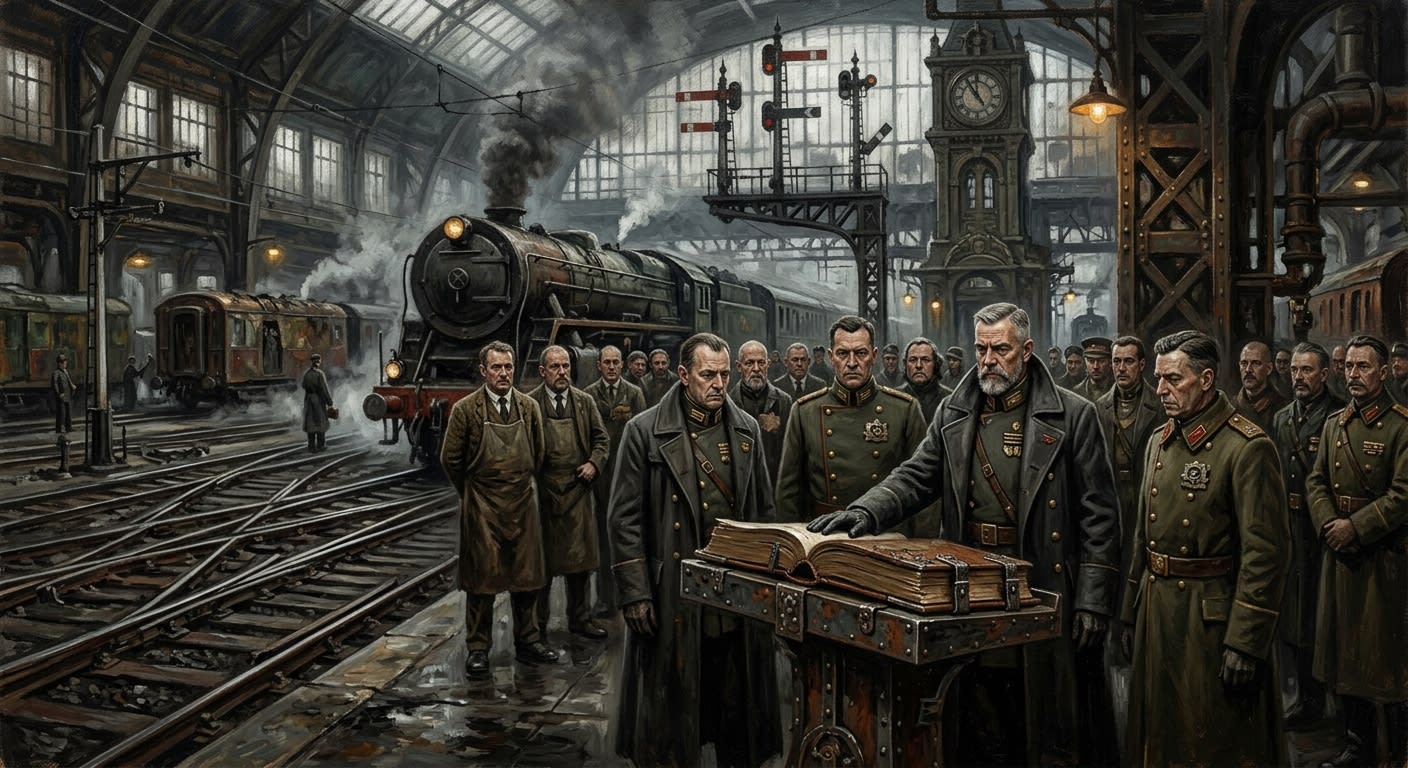
#On the Iron Book
The Codex Ferrum is the A.S. 94 charter by which the Guild of Rails received legal body, iron appetite, and the dangerous right to tell bishops that a train will not move because the rail says no. It is called a codex because Strasbourg dislikes admitting that some of its most consequential scripture was drafted by engineers with dirty cuffs. It is called Ferrum because iron, unlike most officials, does not soften when praised.
The document chartered the Guild from Prussian military rail battalions, civilian navvy gangs, requisitioned surveyors, heartland labour bosses, Synod engineers, and the first Stationmasters (Unregistered), those grim little kings of yard, switch, schedule, and excuse. It gave them a mandate over track, gauge, junction, ballast, bridge, and corridor maintenance. It gave Engineering a licensed body to blame. It gave War an iron throat to seize during emergency. It gave Records enough ledgers to breed a small paper famine.
It did not create the railway. It created the authority to argue with the railway in public and be paid for the attempt. This distinction, like the distance between two rails, looks small until men begin dying over it.
#On the First Lie in the Charter
The first lie appears before the first seal has finished drying. The Codex Ferrum speaks of harmonised rail service under loyal technical consensus. At the time of filing, the northern lines used old Prussian military measure, southern spurs obeyed harbour contractors, mountain tracks followed emergency widths laid on ledges by men whose survey stakes had frozen into prayer, and several city yards maintained private gauges with the smugness of minor princes guarding mistresses.
Consensus was not present. Loyalty was present in the same way smoke is present during a fire: everywhere, useless, and cited by officials who would rather not discuss flame.
The charter's framers knew the contradiction. One marginal note, preserved in the damaged Strasbourg copy and scraped badly enough to attract more attention than concealment, reads: One empire. One Creed. Seven corridors. Nine gauges. The Ledger blushed. Records identifies the hand as unknown. I identify it as honest, which explains why no owner was later found.
The same page bears three grease marks, two nail-scores, and a brown crescent that Chemical Standards identified as old tea because Chemical Standards, like all laboratories, prefers cowardice when blood would complicate procurement. Guild tradition says the crescent came from a foreman who bit his own thumb while refusing to sign a southern-width exemption. Records calls this apocryphal. Records calls many useful things apocryphal shortly before borrowing them for training.
Guild shrine-books attribute the Codex Ferrum to Saint Vandrail’s own fist, pressed into iron-leaf by prayer.
Corrected. The charter was filed in A.S. 94 by mortal engineers, surveyors, labour captains, and clerks with ink under their nails. Vandrail entered the Guild’s devotional machinery later, when rival measures required a dead giant broad enough to hold them by the throat.
The document's genius was bureaucratic, not prophetic. It gathered rival rail men into one licensed fraternity before they had agreed on what a rail should measure. This is a very Strasbourg form of optimism: build the office first, then wait for reality to surrender jurisdiction.
#On Its Clauses and Teeth
The public copy of the Codex Ferrum contains forty-four principal clauses, twelve appendices, three disputed schedules, one annex on wartime requisition, and enough correction marks to make a monk weep into his knife. Its central law is custody. Track belongs to corridor. Corridor belongs to schedule. Schedule belongs to certified authority. Certified authority belongs to the Guild unless War has signed loudly enough to become unbearable.
Clause One recognises the Guild as licensed brotherhood of rail custody. Clause Four assigns section houses at intervals sufficient for inspection, repair, shelter, and whatever private rites the Guild performs when respectable men are asleep. Clause Nine requires certified gauge rods. Clause Twelve authorises Stationmasters to delay trains for safety, weather, bridge doubt, switch uncertainty, demon-sign notation under technical euphemism, and crew incapacity. Clause Seventeen requires Records filing of all closures. Clause Eighteen allows emergency verbal closure if written filing would require the foreman to stand in the path of the train, a rare instance of paperwork respecting velocity.
The wartime annex is uglier. It grants War requisition privilege over Guild crews, rolling stock, emergency spurs, bridge repair, tactical track, and corridor priority. The language calls the service honoured. Guild men call it being volunteered by a Stationmaster with a debt book. Both phrases describe the same chain from opposite ends.
The charter also established the principle later called iron custody (Unregistered): no office may compel a rail to be certified by a man who has not heard it. Bishops disliked this. Generals hated it. Track men framed it.
#On the Gauge War Hidden Inside the Ink
Two years after the Codex Ferrum was filed, the Gauge War began receiving its proper name. The quarrel was already older than the charter; the charter merely gave it a hall in which to throw chairs. Between A.S. 96 and A.S. 136, incompatible widths across northern, central, and southern corridors turned every gauge-break into a confession booth for bad planning.
The Codex had promised common custody. It had not promised common measure. A clever omission. A fatal one.
At the Przemyśl Split (Unregistered), shell crates crossed from one rolling stock to another under lantern while men at the Line waited with empty guns. At the Sibiu Mouth (Unregistered), flour spoiled in sleet while clerks reconciled which platform had legal custody. At Bratislava's Three-Measure Yard, three gauges met beneath one roof and generated a quantity of paperwork so grotesque that Records sealed the index. In the Carpathian Corridor, wounded men were lifted between carriages with blankets frozen to blood. All of this occurred under a charter praising harmonious iron service.
The A.S. 136 Gauge Standardization Decree imposed 1,435 millimetres across the Dominion and ended the quarrel by administrative fist. The three Years of the Hammer followed. Track was torn up, bridges altered, tunnels shaved, wheels reset, axles scrapped, schedules burned, and approximately four thousand workers died so that the Codex Ferrum could pretend it had meant standard measure all along.
Bureau school abstracts describe the Codex Ferrum as the instrument that unified Dominion rail measure.
Clarified. The Codex Ferrum unified rail custody. Standard measure was imposed forty-two years later by decree after hunger, delay, and four thousand dead workers made the omission too expensive to decorate.
#On Vandrail, Shrines, and Useful Forgery
Saint Vandrail's name does not appear in the original legal clauses. This omission has offended Guild shrine-keepers for a century and comforts Doctrine more than it should. The tolerated cult of Vandrail grew from the pressure the charter could not resolve: rival measures, rival crews, rival dead. A guild made of incompatible widths needed a patron large enough to strike them straight in story.
The saint's icon now appears in section houses beside framed extracts from the Codex Ferrum: hammer-fisted giant, rails for fingers, expression of an ancestor who has been blamed for payroll. Offerings collect below him: oil rags, broken spikes, chalk, gauge splinters, bent nails, sometimes a rod surrendered by a man whose hands are gone. The Bureau of Rites files these observances as tolerated. Tolerated is the word Strasbourg uses when something moves too much freight to persecute comfortably.
The Guild reads the Codex devotionally in winter. Hammer veterans sit nearest the stove. The oldest present places a gauge rod across the table before the anniversary supper. A junior reads the charter clauses on section authority, safe closure, and common measure in the post-decree corrected form. No one eats until the rod is lifted. This is not in the public liturgy. It is better than the public liturgy.
#On the Working Copies
Three principal copies matter. The Strasbourg copy sits under Records custody, too clean to trust. The Engineering copy bears technical corrections, marginal calipers, and several angry notes in hands belonging to men who had measured actual bridges. The Guild copy travels in fragments: section-house extracts, Stationmaster manuals, apprentice catechisms, closure forms, gauge certification stamps, and the little clauses every Track Engineer knows without knowing he is reciting law.
A fourth copy is rumoured at Metz, kept behind a coal stove in a tin box that no Stationmaster admits possessing. It is said to contain the uncorrected wartime annex, including the original language on refusal under unsafe military pressure. War denies such a copy. The Guild denies such a copy with the serene expression of a man sitting in front of a warm stove.
Ask a Railway Track Engineer what Clause Twelve says and he will not quote it. He will tap the rail, listen, and say the section is closed. That is the clause alive.
The Codex's language has hardened into tools. The certified gauge rod is a legal instrument. The section ledger is a sworn record. Demon-sign chalk is officially a maintenance mark with no theological standing; the Codex does not name it, because sensible documents leave room for survival. Night Walkers carry Guild authority after dusk with lantern, hammer, rod, and a copy of the relevant closure authority folded into oilcloth. If they do not return, Records prefers weather. The Guild prefers silence. Both preserve the line in their own filthy fashions.
GUILD COMMENTARY — PRIVATE SECTION COPY, STANDING ORDER 44/197 REVIEW Passage concerns junctions marked warm after second tap; silver spike custody; salt-ballast rites; spoken offerings; and the phrase █████████████████████████. Doctrine instruction: omit from public Ferrum commentary. Guild instruction, pencil: “Keep telling apprentices. Just not near clerks.”
#On Present Authority
As of A.S. 201, the Codex Ferrum remains the legal root from which Guild authority grows across all seven bastion corridors. Northern ammunition toward Königsberg and Brest, central supply toward Przemyśl and Sibiu, Danube strain-lines toward Irongate, Balkan approaches toward Shipka, southern feeds toward Constantinople: all pass over iron whose custody descends from that A.S. 94 book.
War wants speed. Engineering wants integrity. Records wants filings. Doctrine wants the story to sound inevitable. The Guild wants safe tools, paid crews, and the right to say no before steel kills everyone in order. The Codex Ferrum grants enough of each desire to keep the trains moving and enough contradiction to keep every office armed with grievance.
A charter is usually a coffin for the argument that produced it. The Codex Ferrum is livelier than that. It still bites. A Stationmaster invokes it when refusing a general. A foreman invokes it when closing a bridge. A widow invokes it when demanding the pension owed after a Corps requisition returns only a hammer. The rail itself invokes nothing. It waits for the rod.
One thousand four hundred thirty-five millimetres, when the world is behaving.